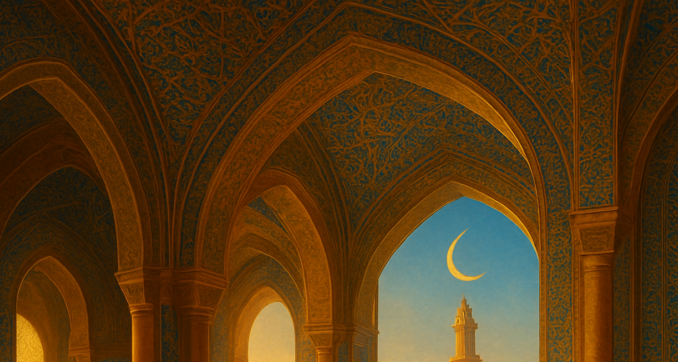
What if the deepest spiritual truth is not found in broad daylight, but precisely in the dark of night? The seventeenth surah of the Quran, Al-Isra, opens with an enigmatic nocturnal departure — and within it lies a paradox that every Freemason will recognize: the path toward light begins in total darkness. This essay explores the mystical layers of this surah and asks what the Night Journey can teach us about spiritual transformation.
The Opening: A Journey Through the Night
Al-Isra begins with the words: “Glory be to Him who carried His servant by night from the Sacred Mosque to the Farthest Mosque.” This single sentence has captivated the imagination of mystics, theologians, and seekers for centuries. This is no ordinary journey. It is a movement that transcends the boundaries of time and space — a passage from the earthly to the celestial, from the known to the unknown.
The choice of night is deeply significant. Night is the time when the outer senses fail and the inner eye grows sharper. In many spiritual traditions, night does not symbolize the absence of light but rather the preparation for it. The soul must first wade through darkness before it can bear the light. This is not punishment — it is a necessary purification.
The Chamber of Reflection: Parallels with Freemasonry
The Freemason entering the brotherhood undergoes a strikingly similar experience. The initiation rituals begin in what is known as the Chamber of Reflection — a space of isolation and contemplation. There, the candidate is confronted with himself, stripped of all outward certainties. It is a symbolic death, a dissolution of the old self, before rebirth into the light can take place.
The parallel with Al-Isra is remarkable. Both the Prophet in the Islamic tradition and the Freemason in his ritual undergo a journey that is not physical but interior. Both traditions recognize that spiritual growth is not a linear path but a cycle of descent and ascent, of loss and recovery.
The true spiritual journey is not a movement through space, but a transformation of the soul that begins where the familiar ends.
A Counterpoint: Is Mysticism Truly Universal?
One might object that this comparison is too easy. The Quran speaks from within a specific theological context; Freemasonry is a fraternity that binds itself to no single religion. How can these two be linked without erasing the distinctiveness of each?
The objection is fair but misses an essential point. Freemasonry does not claim to proclaim the same truth as any religion. It seeks what is shared in the human quest for meaning. When a Muslim contemplates the Night Journey, when a Jew rereads the Exodus from Egypt, when a Christian reflects on the burial and resurrection — they all touch the same mystery: the necessity of transformation, the courage to face the unknown.
Freemasonry provides a framework in which these universal themes can be explored without theological competition. It is not syncretism; it is the recognition that the human longing for transcendence runs deeper than any single doctrine.
The Moral Dimension of Al-Isra
After describing the Night Journey, Al-Isra unfolds into an ethical charter. The surah addresses how we treat our parents, warns against wastefulness, demands justice, and cautions against arrogance. This is not an arbitrary transition. The text suggests that mystical experience must lead to ethical action. Enlightenment without moral consequence is hollow.
Here, too, Freemasonry resonates strongly. The ritual experience in the lodge is not an end in itself. It is designed to shape the brother into a better person — more just, more tolerant, more conscious of his place in the world. The rough ashlar must be worked. Building the temple of humanity is not an abstract ideal but a daily practice, expressed in how we treat those around us.
The Night as Teacher
Al-Isra reminds us that the night is not an enemy. It is a teacher. In the silence of the night, when the world falls quiet, the soul can finally speak. The medieval mystic Meister Eckhart once wrote that God is best known in the darkness of unknowing. The Spanish mystic St. John of the Cross called this the “Dark Night of the Soul” — a phase of apparent abandonment by God that in reality conceals the most intimate approach to the divine.
The Freemason understands this wisdom intuitively. He knows that the path to the East — toward the light — leads through the West, through the place of the setting sun. The symbolism of the lodge mirrors the cosmic cycle: birth, death, and rebirth. This is not a creed but an invitation to reflection.
An Open Question: Do We Still Dare to Enter the Night?
What does it truly mean to travel? Modern humanity moves faster than ever before, yet do we ever truly arrive? Al-Isra challenges us to think about the inward journey — the movement that knows no miles, only depths. Freemasonry offers no ready answers for this, but it does offer a method: ritual, symbol, and brotherhood as vehicles for self-examination.
Perhaps the question that lingers is this: do we still dare to enter the night? Do we have the courage to embrace the uncertainty that precedes every genuine insight? The Night Journey is not a historical relic. It is an invitation — here and now — to anyone willing to leave the familiar behind in search of something greater.
Al-Isra speaks of a journey that transcends boundaries — not only geographical but above all spiritual. In that journey, we recognize a universal truth that speaks directly to the Freemason: growth demands courage, light demands darkness, and the true temple is built not without but within. The surah invites each of us to reflect on our own night journey, wherever it may lead.
Copyright text & image: devrijmetselaar.nl
Texts are based on the ideas and content of the author of devrijmetselaar.nl, reviewed, corrected, and supplemented with the assistance of OpenAI. Images are created based on the ideas of the author of devrijmetselaar.nl using OpenAI/DALL-E.
Frequently Asked Questions
What is the significance of the night in the Night Journey described in Surah Al-Isra?
According to the article, night is deeply significant in spiritual traditions as it represents a time when outer senses fail and the inner eye grows sharper. Rather than symbolizing the absence of light, night represents preparation for enlightenment. The soul must wade through darkness as a necessary purification before it can bear the light. This is not punishment but an essential stage of spiritual transformation.
How does the Night Journey parallel Freemasonry initiation rituals?
The article draws a striking parallel between the Prophet's Night Journey and Freemason initiation ceremonies. Both begin in darkness and isolation—the Quranic journey through night and the Freemason's Chamber of Reflection. In both traditions, the individual undergoes a symbolic death and dissolution of the old self before spiritual rebirth into light. Both recognize that spiritual growth follows a cycle of descent and ascent rather than a linear path.
Can Islamic and Masonic spiritual traditions truly be compared without erasing their uniqueness?
The article acknowledges this objection, noting that the Quran operates within a specific theological context while Freemasonry binds itself to no single religion. However, the article argues that the objection misses an essential point: while each tradition has its distinctiveness, there are universal spiritual principles that transcend individual religious frameworks. The comparison does not erase their differences but rather illuminates common mystical truths underlying both traditions.


Be the first to comment