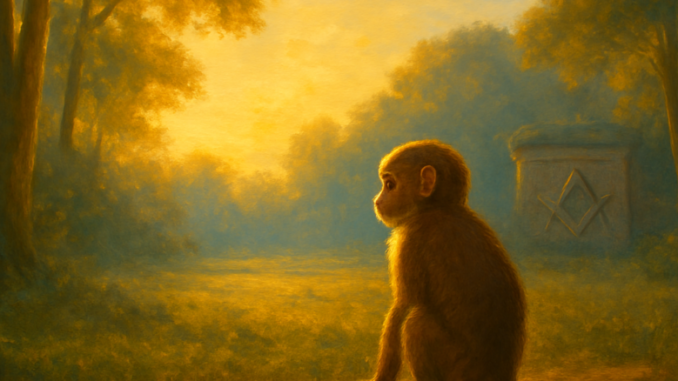
For a full month, a crested mangabey roamed the Dutch countryside, far from his familiar enclosure at the Beekse Bergen safari park. Eventually, he was captured and returned to his group. This small news item from July 2026 raises a timeless question that lies at the very heart of Freemasonry: what happens to our personality when we break free from the familiar — and what changes when we return?
The Primal Urge to Escape
In the eighteenth century, when modern Freemasonry was establishing its first lodges, the understanding of human nature was deeply intertwined with ideas about freedom and constraint. Philosophers of that era wrestled with a fundamental question: is man by nature a social creature, or does he possess a deep-rooted longing to escape every structure that binds him? The English thinkers who laid the foundations of the lodge were well acquainted with their contemporaries’ writings on the social contract. They understood that brotherhood can only exist when individuals voluntarily choose to be part of something greater than themselves.
The crested mangabey who spent a month wandering through the Brabant countryside acted on an impulse we all recognize. There is something in every living being that wants to cross the boundary, that wants to know what lies beyond the horizon. In the Masonic tradition, this impulse is not condemned — it is recognized as a first step on the path toward self-knowledge. Anyone who has never felt the urge to leave has perhaps never truly chosen to stay.
Historical Travelers and Their Return
The history of Freemasonry is rich with stories of brethren who undertook long journeys — some forced, some by choice. In the eighteenth and nineteenth centuries, it was often merchants, sailors, and diplomats who carried Masonic ideals across the world. They left their lodges in Amsterdam, London, or Paris and founded new workshops in distant port cities. But the most meaningful moment was often not the departure — it was the return.
When a traveler returned to his home lodge, he was no longer the same person who had once left. The experiences along the way had shaped his character, challenged his prejudices, and expanded his worldview. The French essayist Michel de Montaigne, who traveled through Europe in the sixteenth century, described how leaving one’s familiar surroundings sharpens the mind like a diamond being cut. Only by stepping back from what is familiar can we see what truly belongs to our core and what was merely habit.
How Trials Shape Personality
In the rituals of Freemasonry, the theme of the journey plays a central role. The candidate entering the lodge is symbolically presented as someone undertaking a journey from darkness into light. This journey is not a literal displacement but an inner transformation. Yet it mirrors a truth every traveler knows: whoever surrenders to the unknown is shaped by that unknown.
Personality is not a fixed quality, but a continuous process of formation and reformation.
The crested mangabey who had to survive outside his familiar environment for a month was undoubtedly confronted with challenges his normal existence never presented. He had to find food in unfamiliar terrain, avoid dangers he had never encountered before, and perhaps endure a form of loneliness that tested his deeply social nature. Such trials forge character — in animals and humans alike.
The Choice to Return
Perhaps the most fascinating aspect of this story is the return itself. The monkey was captured and brought back to his group, but in human experience, the return is often a conscious choice. And it is precisely that choice that reveals something essential about our personality. Anyone who returns to a community after a period of absence does so with new eyes. They see their familiar surroundings differently, recognizing both their value and their limitations.
In the Masonic tradition, this process of departure and return is understood as a spiral movement. We do not return to the same point where we began, but to a higher level of understanding. The lodge remains the same, but we have changed. And through our transformation, our relationship with the community changes as well. This is the mystery of personal growth within a brotherhood: the individual develops, and through that development, the collective is enriched.
Lessons for Today
What can we learn today from both the historical travelers and this escaped primate? First, that the drive toward freedom and discovery is not a weakness but a force that compels us to know ourselves. Second, that returning to the community does not mean surrendering our newly gained insights — it means integrating them into a richer existence.
Consider these four principles that emerge from this reflection: escape as a first step toward self-examination; trial as a formative force for character; return as a conscious reaffirmation of connection; and the spiral movement of growth within community. Each of these principles finds expression in the Masonic journey, and each speaks to a universal human experience.
Freemasonry has always understood that personality is not static. It is forged in the interplay between the individual and the world, between freedom and belonging, between departure and homecoming. The crested mangabey at Beekse Bergen reminds us that this dynamic is not exclusively human — it may well be a universal principle shared by all living beings.
Now that the escaped monkey lives among his kind once more, he carries the invisible traces of his month in the wild. In the same way, we carry the marks of every journey we have taken, every boundary we have crossed, every return we have chosen. Personality is not a finished product but an ongoing story we write in the space between freedom and belonging. It is up to us to live that story with full awareness.
Copyright text & image: devrijmetselaar.nl
Texts are based on the ideas and content of the author of devrijmetselaar.nl, reviewed, corrected, and supplemented with the assistance of OpenAI. Images are created based on the ideas of the author of devrijmetselaar.nl using OpenAI/DALL-E.
Frequently Asked Questions
What does the escaped monkey story have to do with Freemasonry?
The monkey's journey and return illustrates a core Masonic principle: personal growth comes through stepping outside our familiar boundaries and then returning transformed. Just as the monkey changed through its experience in the unknown, Freemasons believe that facing challenges and new experiences—both literal and symbolic—shapes our character and deepens our self-knowledge. This mirrors the Masonic journey from darkness to light, which represents inner transformation.
Does Freemasonry encourage people to abandon their responsibilities?
No—quite the opposite. Freemasonry recognizes that the urge to explore and challenge ourselves is natural and valuable, but it emphasizes that true brotherhood comes when individuals voluntarily choose to commit to something greater than themselves. The escaped monkey eventually returned to his group, just as Masonic brothers are encouraged to use their experiences and growth to strengthen their bonds with their lodge and community.
How does Freemasonry view personal change and growth?
Freemasonry views personality not as a fixed trait but as a continuous process of formation and reformation. The rituals and teachings guide members through symbolic journeys that challenge them to examine their beliefs, expand their worldview, and develop morally. By stepping outside comfort zones—whether through travel, new relationships, or inner work—Masons are encouraged to discover their true core and become better versions of themselves.
What role did travel play in spreading Freemasonry historically?
In the eighteenth and nineteenth centuries, Masonic merchants, sailors, and diplomats carried Masonic ideals across the world, founding lodges in distant cities. However, the most meaningful aspect wasn't simply leaving—it was returning home transformed by their experiences, bringing new perspectives and wisdom back to their original lodge. This tradition demonstrates that Freemasonry values both exploration and the commitment to share growth with one's brothers.


Be the first to comment