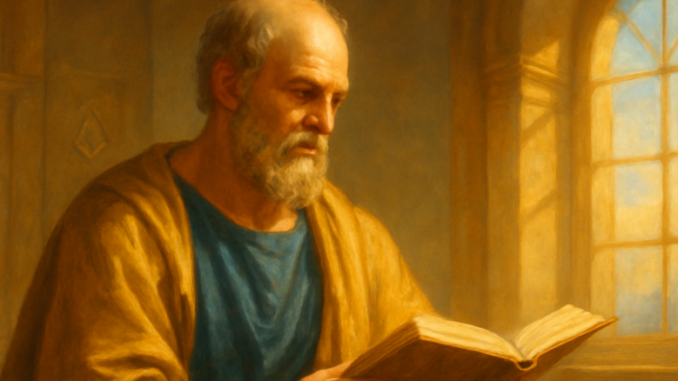
What makes a text nourishing for the mind? And how can reading the words of others help us discover who we truly are? In his eighty-fourth letter to Lucilius, Seneca compares the working mind to bees gathering nectar. But where does this metaphor originate, and which philosophical traditions shaped Seneca’s thinking about intellectual transformation? Let us trace the sources behind this timeless letter and uncover why its message resonates so powerfully — especially for those on a path of self-improvement.
Why Did Seneca Write About Mental Digestion?
The answer lies at the very heart of Stoic philosophy. For the Stoics, wisdom was never a passive possession — it was an active practice. Zeno of Citium, who founded the Stoic school around 300 BCE, insisted that philosophy was not a theoretical exercise but an art of living. Knowledge had to be digested, transformed, and applied in daily life. Seneca inherited this principle and developed it extensively in his letters to Lucilius.
The question Seneca poses is not: how much have you read? Rather, it is: what have you made of it? This distinction was revolutionary in an age when scholars boasted about the size of their libraries. Seneca pushed back against this intellectual hoarding and advocated for something far deeper — genuine absorption and personal transformation through what one reads.
Which Thinkers Shaped Seneca’s Vision?
Seneca did not arrive at his ideas in isolation. He built upon a rich tradition of Greek and Roman thought. Chrysippus, the great systematizer of Stoicism, had already argued that the human mind must actively process everything it receives. Epictetus, a contemporary of Seneca, employed similar metaphors about inner digestion and the transformation of experience into understanding.
But the bee metaphor that Seneca uses so memorably reaches even further back. In his dialogue Ion, Plato compared the poet to a bee flying from flower to flower. Aristotle, in his biological works, wrote extensively about the behavior of bees and their remarkable ability to convert nectar into honey. These images circulated widely in the intellectual world of antiquity, and Seneca applied them brilliantly to the process of reading and writing.
Wisdom does not arise from collecting knowledge, but from transforming it into something uniquely your own — just as bees convert nectar into honey.
The key philosophical figures behind Seneca’s thinking include:
- Zeno of Citium — Founder of the Stoic school, who emphasized practical wisdom above all else
- Chrysippus — Systematized Stoic teachings on mental processing and assimilation
- Plato — Used the bee metaphor to describe poetic inspiration
- Aristotle — Described the biological transformation of nectar into honey
- Epicurus — Respected by Seneca despite belonging to a rival philosophical school
Seneca and the Spirit of Eclecticism
An important question arises: was Seneca truly a pure Stoic? His letters reveal a thinker who drew freely from multiple sources. He quoted Epicurus — who technically belonged to a rival school — with the same respect he afforded his own Stoic predecessors. This intellectual openness is what we call philosophical eclecticism.
In Letter 84, this eclecticism becomes explicit. Seneca encourages Lucilius to read widely but selectively. Take the best from every thinker, he advises, and forge something new from it. This is not intellectual theft but creative synthesis. The idea would later resonate powerfully in Renaissance humanism, when thinkers like Petrarch and Erasmus applied the very same method to classical texts — reading broadly, absorbing deeply, and producing something original from the encounter.
What Does This Mean for the Seeker of Wisdom?
For those familiar with Freemasonry, these ideas will sound remarkably familiar. The Craft shares a strikingly similar tradition of selective adoption and personal transformation. Symbols are not accepted uncritically — they are interpreted individually. Rituals are not repeated mechanically — they are experienced inwardly and made meaningful through personal reflection.
The rough ashlar that the Entered Apprentice receives must be shaped through his own labor. No one else can do this work for him. This principle runs directly parallel to Seneca’s conviction that wisdom gained through reading only acquires real value when it has been melted down and recast by one’s own mind. The Mason does not merely read the old texts — he transforms them into building stones for his personal temple.
In this way, Seneca’s Letter 84 speaks directly to the Masonic journey. The process of intellectual and spiritual refinement — taking raw material and shaping it into something meaningful — is central to both the Stoic tradition and the work of the Lodge.
Why Does Letter 84 Remain So Relevant Today?
In an age of information overload, Seneca’s message sounds more urgent than ever. We consume more text each day than any previous generation in history, but do we actually digest any more? The Stoic call for selective reading and deep processing offers a powerful counterweight to the fleeting nature of the digital age.
The philosophical background of Letter 84 demonstrates that this is not advice bound to a particular time or place. From Zeno to Seneca, from the Stoic school to Renaissance humanism, a common thread runs through the centuries: true knowledge is never a passive possession. It demands active transformation, personal appropriation, and ultimately integration into a lived life. This is the art that Seneca tried to teach his friend Lucilius — and it is the same art he continues to teach us, two thousand years later.
Seneca’s Letter 84 is far more than practical reading advice. It is a window into a rich philosophical tradition that views reading and writing as forms of spiritual alchemy. The nectar gathered from others becomes our own honey; the rough stone is polished through our own labor. In this profound parallel between Stoic philosophy and the quest for inner perfection lies an enduring invitation: read not to accumulate, but to become who you truly are.
Copyright text & image: devrijmetselaar.nl
Texts are based on the ideas and content of the author of devrijmetselaar.nl, reviewed, corrected, and supplemented with the assistance of OpenAI. Images are created based on the ideas of the author of devrijmetselaar.nl using OpenAI/DALL-E.

Be the first to comment