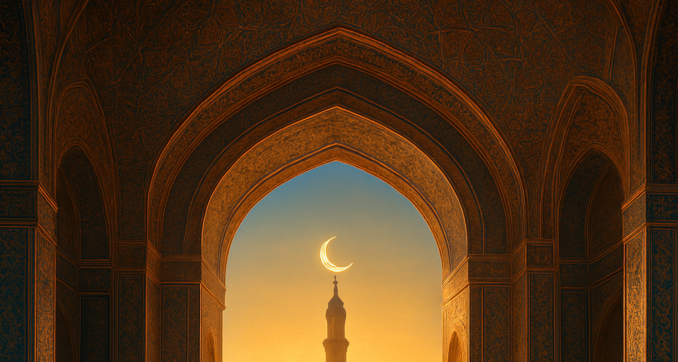
What if the deepest spiritual truth lies not in departure, but in return? The fifty-ninth surah of the Quran, known as Al-Hashr or The Gathering, speaks of exile and reunion — of scattering and the coming together of what was once separated. Read through the lens of Freemasonry, a striking paradox emerges: perhaps we must first become lost before we can truly be found.
The Paradox of Exile
Historically, Al-Hashr describes the expulsion of a tribe from Medina, but its spiritual reach extends far beyond that event. The surah confronts us with an uncomfortable question: can exile be a blessing? Can we only arrive at our true selves when we are stripped of everything we thought we were? The text suggests that the gathering it ultimately describes is not merely a physical reunion, but a return to an original state of unity with the Divine.
This theme resonates deeply within the Masonic tradition, where the candidate symbolically dies to his old self in order to be reborn. The darkness the initiate experiences before being received into the lodge mirrors precisely this spiritual exile. He is temporarily cast out from the light so that he may learn to appreciate its value. The parallel is profound: both traditions teach that deprivation is a necessary precursor to genuine illumination.
The Beautiful Names as an Inner Compass
It is remarkable that Al-Hashr concludes with an enumeration of Divine Names: the Creator, the Fashioner, the Bestower of Form, the Holy, the Source of Peace. These names are not merely theological attributes — they function as meditative anchors. The medieval Islamic philosopher Ibn Arabi described these names as mirrors in which human beings can recognize aspects of their own potential. Each name reveals a quality that the seeker can cultivate within himself.
A Freemason familiar with the working tools of the Craft will recognize a kindred method here. Just as the compasses and the square serve to measure and shape conduct, so the Divine Names offer a spiritual toolkit for self-reflection. The question is not whether one believes in a specific deity, but whether one is willing to hold oneself up against elevated standards. In both systems, the tool is only as powerful as the sincerity of the hand that wields it.
A Counterpoint: Is Unity Truly the Goal?
But a critical note is warranted here. Is the gathering the surah speaks of truly desirable in an absolute sense? The Dutch philosopher Baruch Spinoza, whose pantheistic vision of God as the one substance shares a certain kinship with mystical readings of the Quran, warned that the longing for unity can also devolve into the erasure of diversity. The brotherhood that Freemasonry champions is not uniformity but harmony among different voices.
The true gathering is not the dissolution of the individual into the collective, but the coming together of unique souls, each contributing their own light to the whole. The surah itself seems to confirm this when it speaks of the distribution of resources among different groups — the poor, the orphans, the travelers. Unity here does not mean homogenization; it means just distribution that respects the dignity and individuality of each person.
The Lodge as a Gathering Place
In Masonic ritual, the lodge is described as a space that extends from east to west, from north to south, from the earth to the heavens. This cosmic dimension reflects the very idea of the gathering: the lodge is the space where scattered brethren come together, regardless of social standing or religious background. The Worshipful Master in the east represents the light toward which all orient themselves, much as the believer turns toward the Divine.
What Al-Hashr and Masonic ritual share is the recognition that the human being is fundamentally a pilgrim. Both traditions acknowledge that we are on a journey, temporarily separated from an origin we only dimly remember. The work on the rough ashlar is nothing less than preparation for that ultimate reunion — a daily practice of chipping away at the superfluous to reveal the perfect form hidden within.
The Gathering as an Ongoing Process
Perhaps the deepest wisdom of this surah lies not in the gathering as a destination, but as a continuous process. Johann Wolfgang von Goethe — himself a Freemason and deeply interested in Islam — wrote of “stirb und werde”: die and become. This rhythm of dying to the old and being born into the new, of scattering and gathering, is not a one-time event but a cyclical reality. Every lodge meeting, every meditation on sacred texts, every moment of moral self-examination is a small gathering in its own right.
Consider the layers this reveals:
- The gathering as a return to inner unity
- Brotherhood as a training ground for universal harmony
- The Divine Names as mirrors for self-knowledge
- Ritual as a reenactment of the spiritual journey
An Open Question
The surah leaves us with a haunting thought. It states that if the Quran had been sent down upon a mountain, that mountain would have split apart and crumbled from awe of God. What does this say about the human capacity to receive the Sacred? Are we stronger than mountains, or simply more insensitive? The Freemason who takes his initiation seriously may feel the echo of this question in his own breast.
It is a challenge that transcends religious boundaries. Every tradition that deals with revelation — whether through sacred text, ritual drama, or the silent encounter with the Great Architect of the Universe — must wrestle with the gap between the immensity of what is offered and the frailty of those who receive it. The rough ashlar does not become a perfect cube overnight, and perhaps it is not meant to. The work itself is the answer.
Al-Hashr invites us not to fear exile but to embrace it as a necessary phase in the spiritual journey. For the Freemason who remains open to wisdom from all traditions, this surah holds up a mirror: do we recognize in ourselves the scattered soul that longs for return? And are we willing to do the work that makes such a gathering possible? The answer may not lie in words, but in the daily labor we devote to our own rough stone — one chisel stroke at a time.
Copyright text & image: devrijmetselaar.nl
Texts are based on the ideas and content of the author of devrijmetselaar.nl, reviewed, corrected, and supplemented with the assistance of OpenAI. Images are created based on the ideas of the author of devrijmetselaar.nl using OpenAI/DALL-E.

Be the first to comment