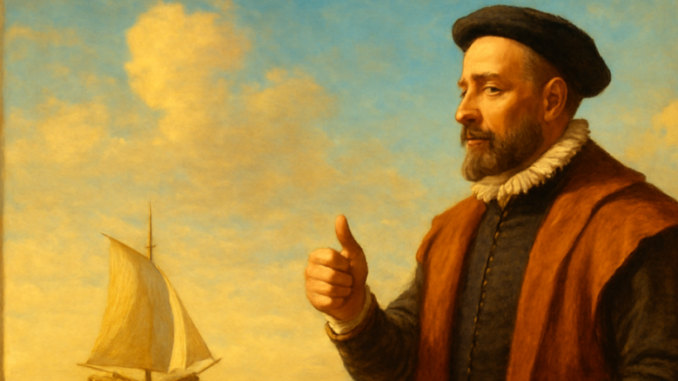
What if the most unassuming parts of the human body carry the greatest meaning? In his thirty-sixth essay of the first book, Michel de Montaigne devotes a short but fascinating reflection to the thumb. What seems like a trivial topic opens a window into how cultures charge body parts with symbolism, power, and ritual significance. It is precisely this attention to the small and the everyday that makes Montaigne a timeless thinker — and one whose insights resonate deeply with the symbolic traditions of Freemasonry.
The Paradox of the Insignificant
If someone asked you to name the least important part of your body, chances are the thumb would not even cross your mind. Its presence is so self-evident that we rarely think about it. Yet Montaigne opens his essay with a striking observation: the Romans assigned the thumb a special status far beyond its physical function. In the amphitheater, a thumb turned up or down determined life and death. A gesture so small, so commonplace, carried the weight of a verdict.
This paradox lies at the heart of Montaigne’s argument. He invites us to examine why cultures attach great meaning to small, seemingly insignificant things. Is it not remarkable that a movement of barely an inch could seal a gladiator’s fate? Montaigne sees no arbitrariness in this, but rather a deeper human tendency to connect the concrete with the abstract — to make the invisible visible through the body itself.
Historical Examples from Antiquity
Montaigne drew generously from classical sources to support his point. He refers to the Roman practice in which young men who wished to avoid military service would cut off or mutilate their thumbs. The punishment for this act was severe, because the thumb was considered essential for handling weapons. Without a thumb, there was no grip on the sword — and therefore no warrior. The body part became a symbol of masculine duty and citizenship.
He also mentions the ancient custom of sealing agreements with the thumb. Much as we sign our names today, people in antiquity would press their thumb onto documents as a mark of consent. The thumb served as an extension of the person — a physical embodiment of one’s given word. This ritualistic use demonstrates how body parts can be transformed into instruments of honor and trustworthiness.
The Thumb as a Bearer of Meaning
What Montaigne touches upon here, without naming it explicitly, is the deep human need for tangible symbols. We are beings who want to anchor abstract concepts — loyalty, courage, judgment — in something visible and palpable. The thumb lends itself perfectly to this purpose: always present, always visible, and yet seldom consciously noticed. It is precisely this combination of omnipresence and invisibility that makes it such a powerful symbol.
The smallest gesture can carry the greatest truth, provided we are willing to see it.
This insight resonates with traditions that still attach meaning to gestures and bodily posture. Think of the handshake as a seal of trust, the bow as a sign of respect, or the raised hand when taking an oath. Montaigne shows us that these rituals are not random — they arise from a universal human grammar of the body. For Freemasons, this observation feels particularly familiar: every gesture in the lodge, from the way we stand to the way we greet one another, is imbued with layers of meaning that extend far beyond the surface.
A Counterweight: The Danger of Overloaded Symbolism
Yet within Montaigne’s reflection lies an implicit warning as well. If we burden every gesture, every body part, every action with meaning, we risk losing simplicity. The Roman who cut off his thumb to avoid battle demonstrates how symbolism can devolve into coercion. The sign of manhood became a burden from which some desperately tried to escape.
Montaigne holds up a mirror here. He does not explicitly ask whether our own symbols liberate or imprison us, but the question hangs in the air. Which gestures do we perform without still knowing why? Which meanings do we carry as chains rather than as wings? This is a question worth sitting with — not only for students of philosophy, but for anyone who works within a symbolic tradition and wishes to keep that tradition alive and meaningful.
The Everyday as a Gateway to Insight
The power of this short essay lies in its method. Montaigne takes something seemingly unimportant and reveals how it contains a whole web of cultural, historical, and philosophical meanings. The thumb becomes a lens through which we can study the human condition. This is Montaigne’s great gift: he teaches us to look at what we overlook every day.
For those interested in symbolism and ritual, this essay offers a valuable lesson. Symbols do not need to be grand or mysterious to be powerful. Sometimes it is the smallest gestures that communicate the deepest truths. Freemasonry, with its rich tradition of symbolic work, recognizes this principle intimately: every working tool, every action within the lodge carries meaning that reaches beyond the visible. The square, the compass, the level — these are ordinary instruments elevated to extraordinary significance through intention and reflection.
An Open Question
True to his essayistic style, Montaigne closes without definitive conclusions. He leaves the reader with material to reflect upon. The lingering question is this: if even the thumb can carry so much meaning, what does that tell us about the inexhaustible depth hidden in all the everyday things around us? Perhaps the real invitation of this essay is to look with fresh eyes at what we have always seen but never truly noticed.
Michel de Montaigne’s essay Of Thumbs is a masterful demonstration of how a seemingly trivial subject can grow into a profound philosophical exploration. By examining the thumb as a carrier of cultural and ritual meaning, Montaigne reveals something universal about how humans relate to symbols. His invitation remains as valid today as it was in the sixteenth century: look at the small, and find the great within it. For Freemasons and all seekers of meaning, this is more than a literary exercise — it is a way of being in the world.
Copyright text & image: devrijmetselaar.nl
Texts are based on the ideas and content of the author of devrijmetselaar.nl, reviewed, corrected, and supplemented with the assistance of OpenAI. Images are created based on the ideas of the author of devrijmetselaar.nl using OpenAI/DALL-E.


Be the first to comment