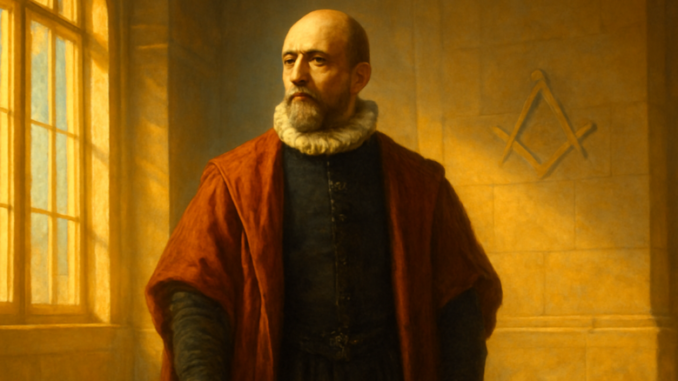
What is the highest reward a person can receive for extraordinary merit? Money? Power? Or something far more elusive — honour? In the seventh essay of his second book, Michel de Montaigne wrestles with precisely this question. He examines why honour stands apart from every other form of reward, and why it is at once the most precious and the most fragile currency a society possesses. Centuries later, his reflections still speak directly to what Freemasonry understands about virtue, recognition, and the dangers of hollow praise.
What Is Montaigne’s Essay Really About?
In this short but potent essay, ‘On the Reward of Honour,’ Montaigne advances a deceptively simple thesis: the only reward truly fitting for great and exceptional deeds is honour. Not material wealth, not estates, not titles of power. What matters, Montaigne argues, is pure recognition — the praise a community bestows upon someone who has risen above the ordinary. With this, he draws a sharp line between rewards you can count and rewards you can only feel.
Montaigne opens by observing that princes and rulers have little to give beyond material goods. They can grant land, distribute gold, assign offices. But when a deed is truly exceptional, these rewards fall short. They are too commonplace, too tangible for something that transcends the everyday. That is why honour was invented: a currency that never wears out, need not be divided, and yet remains priceless.
Lessons from Antiquity: Montaigne’s Examples
As in so many of his essays, Montaigne draws richly from classical antiquity. He points to Roman and Greek traditions where laurel wreaths and honorary titles were conferred upon generals and statesmen who had distinguished themselves in service. He cites the example of Augustus, the first Roman emperor, who refused gifts of great material value because he understood that honour alone was the highest coin. He also refers to the Greek custom of honouring victors at the Olympic Games with nothing more than a wreath of olive branches. It was not the wreath itself that held value, but what it represented: the recognition of an entire community.
Montaigne is especially keen to point out that the power of honour lies in its scarcity. The moment honour is bestowed too freely, it loses its force. He criticises rulers who scatter knightly orders and honorary titles lavishly to buy political favours. In doing so, he warns, they devalue the very instrument that was meant to crown the highest achievements. It is as if you mint a rare coin so many times that it becomes worthless.
What Makes Honour Different from Other Rewards?
Here Montaigne’s thinking touches on a deeper philosophical point. Material rewards are finite and divisible: if you give someone a hundred gold coins, you have a hundred fewer yourself. Honour works in reverse. It does not diminish for the giver and can remain with the recipient for a lifetime. More than that, honour can outlive death itself, as Montaigne illustrates by invoking heroes of antiquity whose names are still spoken centuries later. It is a form of immortality that no wealth can purchase.
At the same time, Montaigne places an important caveat. Honour is fragile. It exists only by the grace of the community that bestows it. A person cannot grant honour to himself; it must come from without. This makes honour a fundamentally social phenomenon. You are dependent on the judgement of others, and that judgement can be fickle. Montaigne, who throughout his essays repeatedly discusses the inconstancy of human opinion, is acutely aware of this vulnerability.
Honour is the only reward that does not wear out through use but grows in value the more sparingly it is bestowed.
Honour in the Context of Freemasonry
Freemasonry awards no medals for the most eloquent speaker, no trophies for the longest-serving Master. Yet the concept of honour plays a quiet but essential role within the Craft. In the lodge, honour is understood as something you earn through your conduct, not through your position. The question Montaigne raises — whether honour retains its value when it is given too freely — is deeply relevant within Freemasonry as well. The degrees and offices within the order are not material rewards. They represent trust, responsibility, and recognition by one’s brethren. That recognition is only meaningful when it is given thoughtfully and sincerely.
Montaigne’s warning against the inflation of honour can be read as a mirror for any organisation that works with recognition. The moment titles, degrees, or praise become automatic, they lose their inner power. This applied to the Roman knightly orders Montaigne wrote about, and it applies equally to contemporary societies. Freemasonry guards against this through its ritual structure: recognition is embedded in a careful process of growth and reflection, not in arbitrariness or favouritism.
What Can We Learn from Montaigne Today?
Montaigne’s essay is brief, but its message is timeless. In a world overflowing with awards, titles, certificates, and digital likes, his plea for restraint in bestowing honour is more relevant than ever. True recognition, he teaches us, is born not from abundance but from scarcity. Not from habit but from genuine admiration. For the Freemason, this means that the true reward of the Masonic path is not the degree you attain, but the respect you earn through the way you live and act.
Montaigne’s key insights deserve a final summary. He regards honour as the highest and purest form of reward. Material gifts are inadequate for truly exceptional merit. The value of honour declines when it is granted too generously. Honour is a social phenomenon — it exists only through the recognition of others. And Freemasonry reflects this principle in its careful and deliberate approach to degrees, offices, and brotherly acknowledgement.
Michel de Montaigne reminds us that in an age of excess, the most valuable things are those that cannot be bought or mass-produced. Honour, properly understood, is a living bond between an individual and the community that recognises his virtue. For Freemasons, this insight strikes at the heart of the Craft: the greatest reward is not what the lodge confers upon you, but what your character inspires in those around you. When honour is given with care and received with humility, it becomes something no currency can rival — a testament to a life well lived.
Copyright text & image: devrijmetselaar.nl
Texts are based on the ideas and content of the author of devrijmetselaar.nl, reviewed, corrected, and supplemented with the assistance of OpenAI. Images are created based on the ideas of the author of devrijmetselaar.nl using OpenAI/DALL-E.
Frequently Asked Questions
What is Montaigne's main argument about honour as a reward?
Montaigne argues that honour is the only reward truly fitting for exceptional deeds, surpassing material wealth, power, or titles. He contends that honour is a priceless currency that never wears out and need not be divided, making it the most appropriate recognition for achievements that transcend the ordinary.
Why does Montaigne believe honour is superior to material rewards?
Montaigne distinguishes between tangible rewards (land, gold, offices) that are commonplace and can be counted, versus honour, which is an intangible recognition that can only be felt. He argues that for truly exceptional deeds, material rewards fall short because they lack the transcendent quality that honour possesses.
What historical examples does Montaigne use to illustrate the value of honour?
Montaigne references classical antiquity, including Augustus refusing great material gifts in favour of honour, Roman generals receiving laurel wreaths, and Greek Olympic victors being crowned with olive branches. These examples demonstrate that the true value lies not in the physical object but in the community's recognition it represents. Montaigne also warns against devaluing honour by bestowing it too freely.

Be the first to comment