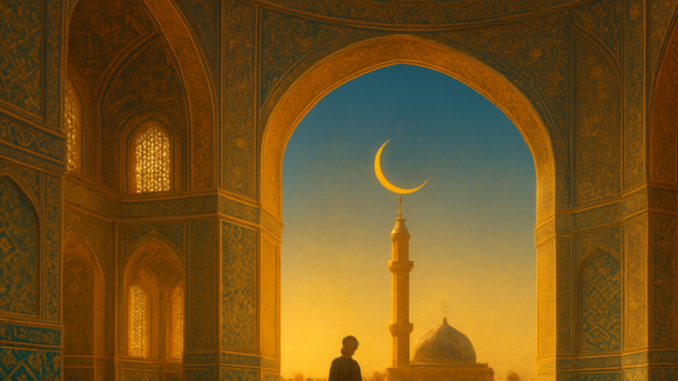
What if a text of just fifteen short verses captures exactly what a Freemason spends a lifetime working toward? Surah 91 of the Quran, titled ‘The Sun,’ opens with a series of cosmic oaths and closes with a stark warning about the soul that neglects itself. It is a text that invites silence, reflection, and honest self-examination. In this article, we explore what this surah has to say about light, purification, and the building of the inner self — and why its message resonates so deeply with the Masonic tradition.
What Does Surah 91 Actually Say?
Surah 91, ‘Ash-Shams’ (The Sun), is one of the early Meccan revelations and consists of only fifteen verses. It begins with a striking accumulation of oaths sworn upon cosmic phenomena: the sun and her morning brightness, the moon that follows her, the day that reveals her, the night that conceals her, the heavens and what built them, the earth and what spread it out. Then the focus shifts dramatically — from the cosmos to the human soul. God has fashioned the soul and breathed into it both the capacity for corruption and the capacity for righteousness. Whoever purifies the soul succeeds. Whoever neglects it fails.
The surah closes with the historical example of the people of Thamud, who ignored their prophet Salih, killed the sign that God had sent them, and were destroyed as a consequence. It is a compact, powerful arc: from the cosmic to the personal, from the heavens to the heart.
Why Does the Surah Begin with the Sun Rather Than God?
This is a fascinating question. In this surah, God swears by His own creation, as though nature itself bears witness to a deeper truth. The sun is not merely a celestial body — it represents the light that makes all things visible. The moon reflects that light. The day reveals; the night conceals. This rhythm of revelation and concealment is no accident. It mirrors the inner movement of the human being: sometimes illuminated, sometimes shrouded in darkness. The question the surah ultimately poses is this: what are you doing with the light you have been given?
For anyone familiar with the tradition of Freemasonry, something deeply recognizable resonates here. Light plays a central role in Masonic ritual. The candidate is initiated from darkness into light — not as a magical act, but as an expression of willingness to see, to learn, and to look honestly at oneself. The sun in this surah does exactly the same thing: it calls upon us not to look away.
What Does the Quran Mean by Purifying the Soul?
The core verses of the surah, freely translated, read: ‘By the soul and the One who fashioned it, and then inspired it with its wickedness and its righteousness: successful is the one who purifies it, and lost is the one who corrupts it.’ Here lies a remarkable starting point. The text does not claim that the human being is born either good or evil. Both possibilities are embedded in the soul. The responsibility rests with each person to choose which direction to take.
Both the Quran and Freemasonry teach that light does not come from the outside — it must be discovered through active self-purification and moral courage.
This idea of an inner duality that demands conscious choice resonates profoundly with the Masonic concept of the rough ashlar. The unworked stone represents the human being in an original state: full of potential, but also full of imperfections. The labor upon that stone is not a punishment but an invitation. Aristotle spoke of virtue as the result of practice, not chance. We become just by performing just acts, courageous by performing courageous acts. Surah 91 says essentially the same thing, but in the language of revelation rather than philosophy.
What Does the Story of Thamud Have to Do with All This?
At first glance, the transition from cosmic oaths and the science of the soul to a historical narrative may seem abrupt. But the structure of the surah is deliberate. After the abstract truth about purification comes a concrete example of what happens when a community refuses that purification. The people of Thamud received a prophet, Salih, and a miraculous sign: a she-camel that served as a sign from God. They killed the animal and ignored the warning. The destruction that followed, according to the text, was the direct consequence of their refusal to purify their souls.
For a Freemason, this story is recognizable as a warning — not a threat. The Masonic tradition carries similar narratives. Consider the legend of Hiram Abiff, the master builder of the Temple of Solomon, who died because others refused to follow the path of patience and merit. The lesson is not that God punishes, but that ignoring inner growth carries consequences — for the individual and for the community alike.
Can You Be Spiritual Without Being Religious?
This may be the question that arises most often when Freemasonry and sacred texts are discussed together. The answer is nuanced. Freemasonry is not a religion and claims no revealed truth. But it does acknowledge that the human being is more than matter alone. The concept of the Great Architect of the Universe leaves room for every personal understanding of the divine — whether that is the God of Abraham, the Brahman of the Hindu tradition, or an abstract principle of order and beauty.
Surah 91 speaks to everyone willing to pause and ask: have I purified my soul, or have I neglected it? That question transcends religious boundaries. Spinoza, who in the seventeenth century regarded nature and God as one, might well have recognized the cosmic oaths of this surah as an expression of that same unity. Goethe, himself a Freemason, wrote in his Faust about the eternal struggle between light and darkness within the human being. The language differs, but the core question remains the same.
What Can We Take Away from This Reflection?
Let us gather the threads. Surah 91 offers, in fifteen verses, a complete worldview: the cosmos bears witness, the soul carries both possibilities within it, and the human being chooses. Freemasonry offers no answers, but it does offer tools — the working tools of the degrees, the symbols of light and darkness, the allegory of the rough stone being shaped through labor and intention. Both traditions converge on a single insight: the work is inner, the responsibility is personal, and the light must be actively sought.
Whether one reads Surah 91 as the word of God, as poetry of extraordinary depth, or as a philosophical meditation on human potential, its challenge remains the same. The sun rises every morning. The question is whether we choose to step into its light or remain in the shadows of our own making.
Surah 91 and the Masonic tradition, different as they are in origin and expression, share a conviction that cuts to the heart of what it means to be human. We carry within us both the capacity for greatness and the tendency toward neglect. The cosmos itself — the sun, the moon, the rhythm of day and night — stands as a silent witness to this inner struggle. The real question is not whether we have been given the light. It is whether we have the courage to let it shape us. That question belongs to no single religion, no single tradition. It belongs to every soul willing to do the work.
Copyright text & image: devrijmetselaar.nl
Texts are based on the ideas and content of the author of devrijmetselaar.nl, reviewed, corrected, and supplemented with the assistance of OpenAI. Images are created based on the ideas of the author of devrijmetselaar.nl using OpenAI/DALL-E.
Frequently Asked Questions
What is Surah 91 and why is it significant to Freemasonry?
Surah 91, titled 'The Sun' (Ash-Shams), is an early Meccan revelation consisting of only fifteen verses. It begins with cosmic oaths and shifts focus to the human soul, emphasizing the capacity for both corruption and righteousness. It resonates deeply with Freemasonry because both traditions use light as a central metaphor for spiritual development and self-examination, with candidates being initiated from darkness into light as a symbol of willingness to learn and examine oneself honestly.
Why does Surah 91 begin with oaths about the sun and cosmic phenomena rather than directly addressing God?
In Surah 91, God swears by His own creation, using nature as witness to deeper spiritual truths. The sun represents light that makes all things visible, while the moon reflects that light, and the day reveals while night conceals. This rhythm mirrors the inner movement of the human being between illumination and darkness. The surah poses the fundamental question: what are you doing with the light you have been given? This approach invites reflection rather than command.
What is the main message of Surah 91 about the human soul?
The central message of Surah 91 is that God has fashioned the human soul with the capacity for both corruption and righteousness. The surah teaches that whoever purifies the soul succeeds, while whoever neglects it fails. This emphasis on self-purification and honest self-examination through the metaphor of inner light aligns closely with Masonic traditions of personal development and spiritual growth through reflection and willingness to see oneself clearly.

Be the first to comment