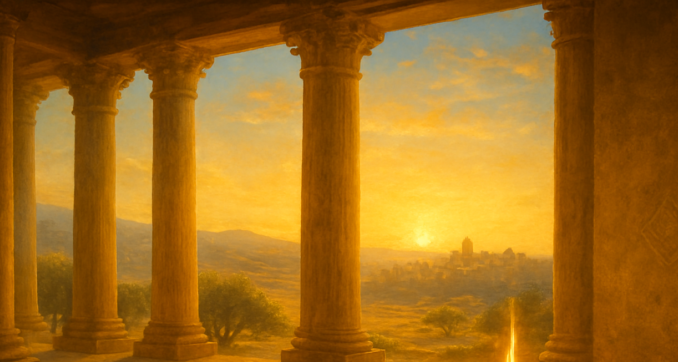
A veil is more than a piece of fabric. It is a boundary between seeing and not seeing, between the known and the hidden. In Paul’s Second Letter to the Corinthians, this veil plays a central role as a symbol for the transformation of human consciousness. For those familiar with the symbolic language of Freemasonry, the text opens up a rich dialogue between two traditions that both speak of breaking through darkness and discovering inner light.
The Earthen Vessel and the Hidden Treasure
Picture a simple clay pot — rough, unglazed, the kind you might find in any archaeological museum. In 2 Corinthians, Paul uses precisely this everyday object as a metaphor for the human condition. “We have this treasure in earthen vessels,” he writes, referring to the divine light that dwells within the fragile human body. It is an image that resonates directly with Freemasonry, where the rough ashlar represents the unworked human being who is transformed through labor and reflection.
The pot itself is not worthless because of its simplicity. On the contrary, it is precisely the vulnerability of the material that makes the presence of the treasure within all the more remarkable. Paul invites his readers to look beyond the surface — beyond the cracks and fractures of existence — toward that which is truly of value. This is not passive observation, but an active contemplation of the kind we also encounter in the Masonic lodge during moments of silence and reflection.
The Veil of Moses and the Unveiled Face
One of the most intriguing passages in this letter refers to Moses, who after his encounter with the divine wore a veil over his face. The radiance was too intense for ordinary eyes. Paul reinterprets this ancient story, arguing that the veil did not merely cover the light — it can also cover the human heart. Only when the veil falls away, he writes, is the face unveiled and can the person be transformed “from glory to glory.”
The falling of the veil is not a moment of revelation from the outside, but an inward movement in which a person finally dares to see themselves.
This image of the falling veil finds a direct parallel in the Masonic rite in which the candidate is literally blindfolded before receiving the light. The blindfold is not intended as punishment or trial, but as a symbol of the state of ignorance in which every person begins. The moment of unveiling marks the transition to a new consciousness — an experience that cannot be conveyed through words alone, but only through lived experience.
Destruction and Construction: The Temporary Tent
Paul speaks in this letter of the earthly body as a “tent” that is taken down, set against an eternal “building” in the heavens. The architectural metaphor that emerges here is familiar ground for anyone acquainted with Freemasonry. The transition from tent to building suggests not only immortality, but also a process of refinement and construction. Just as a mason works stone by stone on a cathedral, so does a person work on their inner architecture.
The tent is temporary, portable, vulnerable to the elements. The building, by contrast, stands firm — thoughtfully designed and built to endure. This distinction invites a profound question: which part of ourselves is perishable, and which part are we building to last? Freemasonry offers no ready-made answer, but it does provide tools for contemplation: the square that measures rectitude, the compasses that set boundaries, the level that tests balance and equilibrium.
Reconciliation as Inner Cement
A theme running throughout the entire letter is reconciliation. Paul had to defend himself against critics in Corinth, and he did so not with attack, but with an appeal to mutual understanding. He speaks of “the ministry of reconciliation” as a calling entrusted to all believers. In the Masonic context, we can understand this as the cement that holds the stones of the brotherhood together — not merely tolerance, but active reconciliation, the bridging of that which divides.
This reconciliation manifests on multiple levels: as the restoration of broken relationships, as a bridge between the personal and the collective, and as moral growth through the acknowledgment of one’s own shortcomings. Marcus Aurelius wrote centuries later about similar themes in his Meditations — the individual as part of a greater whole, with a duty to strive for harmony. Where the Stoic philosopher spoke of cosmic order, Paul speaks of community in faith. Both traditions, along with Freemasonry, emphasize that inner peace and outward reconciliation are inseparably connected.
The Light That Shines in Darkness
“For God, who said, ‘Let light shine out of darkness,’ made His light shine in our hearts.” These words from Paul connect the creation of the universe with the inner illumination of the individual. It is a thought that aligns directly with one of the central teachings of Freemasonry: that the search for light does not end with intellectual knowledge, but penetrates to the very core of who we are.
The darkness from which the light must shine is not something that comes from outside. It is one’s own ignorance, one’s own blindness, one’s own veil. The transformation that Paul describes — and that is visualized in the lodge — is therefore always a personal journey. No one can walk this path for another, but the brotherhood can serve as witness and support along the way.
The Second Letter to the Corinthians offers no blueprint, but an invitation. An invitation to look beyond the earthen vessel toward the treasure within, to let the veil fall and behold one’s own true face, to build where others tear down. For the Freemason who reads this text, there arises a recognition that transcends the boundaries of time and tradition — the recognition that the work of inner transformation is universal, timeless, and always deeply personal.
Copyright text & image: devrijmetselaar.nl
Texts are based on the ideas and content of the author of devrijmetselaar.nl, reviewed, corrected, and supplemented with the assistance of OpenAI. Images are created based on the ideas of the author of devrijmetselaar.nl using OpenAI/DALL-E.
Frequently Asked Questions
How does 2 Corinthians relate to Freemasonry?
Both 2 Corinthians and Freemasonry use symbolic language to describe the transformation of human consciousness and the journey from darkness to light. The article explores how Paul's metaphors of veils, earthen vessels, and spiritual unveiling parallel the symbolic teachings found in Masonic ritual and practice.
What does the veil symbolize in this biblical passage?
The veil represents a boundary between ignorance and understanding, between the hidden and the revealed. According to Paul, the veil can cover not only the face but the human heart, and its falling away represents an inward transformation that allows a person to see themselves and the divine truth more clearly.
Why is the earthen vessel important in understanding this message?
The earthen vessel symbolizes the fragile human body that contains divine light within it. This metaphor resonates with Freemasonry's concept of the rough ashlar—the unworked person who possesses great inner value and potential for transformation through labor and reflection.
What is the connection between Moses's veil and Masonic blindfolding?
Both represent a state of spiritual ignorance or protection before enlightenment. Just as Moses wore a veil because the divine radiance was too intense, Masonic candidates are blindfolded to symbolize their initial state of darkness, with the removal of the blindfold marking a transformative moment of receiving the light.
How does the tent-to-building metaphor relate to spiritual growth?
This architectural metaphor suggests a process of refinement and construction, where a person gradually builds toward something more permanent and eternal. Like a mason carefully constructing a cathedral stone by stone, individuals engaged in spiritual work progressively develop and elevate their consciousness.

Be the first to comment