Symbolic ladder of virtues connecting ancient scripture and Freemasonry
Christianity

Second Epistle of Peter: A Testament of Moral Vigilance

Somewhere in the second century of our era, a short but powerful letter circulated among early Christian communities. Attributed to the apostle Peter, it warned against false teachers and called for steadfastness in knowledge and virtue. More than eighteen centuries later, these ancient words still carry remarkable weight — especially when read through the lens of Freemasonry. The parallels between this epistle and the ideals cherished by Masons around the world are striking, and well worth exploring. A Letter Born in a Time of Confusion The Second Epistle of Peter was written during a period when early Christianity was grappling with deep internal division. Various teachers spread competing interpretations of the faith, and communities searched for solid ground. In this turbulent context, the author penned a passionate plea for steadfastness, emphasizing that true knowledge is not simply given — it must be earned through virtue and dedication. This historical backdrop matters for anyone seeking to understand the text today. The letter speaks not only to the believers of its time but touches on universal themes: How do we distinguish truth from deception? How do we build a solid moral foundation in times of uncertainty? These are questions that resonate as […]

Masonic lodge illuminated by candlelight symbolizing watchfulness and light
Christianity

1 Thessalonians: Watching in the Light as a Fraternal Duty

There is a remarkable tension at the heart of Paul’s First Letter to the Thessalonians: he calls for vigilance as though the end is near, yet simultaneously urges the patient building of a loving community. How can urgency and patience coexist? This paradox lies at the core of a text that proves surprisingly relevant for anyone reflecting on moral growth and brotherhood — including those who walk the Masonic path. The Paradox of the Watchful Builder Paul wrote this letter around 50 AD to a young community in Thessalonica, a port city in northern Greece. It is the oldest known text in the New Testament — older even than the Gospels. What stands out immediately is the dual message: on the one hand, Paul expects the end of days to arrive soon; on the other, he offers detailed instructions for daily life. Work with your hands. Encourage the fainthearted. Be patient with everyone. At first glance, this seems contradictory. Why invest in relationships and craftsmanship if everything is about to end? And yet, there is a deeper truth hidden in this tension. The attitude of watchfulness does not replace the work of community building — it intensifies it. Those who […]

Symbolic veil falling away revealing light in a Masonic temple setting
Christianity

2 Corinthians: The Veil That Falls From the Heart

A veil is more than a piece of fabric. It is a boundary between seeing and not seeing, between the known and the hidden. In Paul’s Second Letter to the Corinthians, this veil plays a central role as a symbol for the transformation of human consciousness. For those familiar with the symbolic language of Freemasonry, the text opens up a rich dialogue between two traditions that both speak of breaking through darkness and discovering inner light. The Earthen Vessel and the Hidden Treasure Picture a simple clay pot — rough, unglazed, the kind you might find in any archaeological museum. In 2 Corinthians, Paul uses precisely this everyday object as a metaphor for the human condition. “We have this treasure in earthen vessels,” he writes, referring to the divine light that dwells within the fragile human body. It is an image that resonates directly with Freemasonry, where the rough ashlar represents the unworked human being who is transformed through labor and reflection. The pot itself is not worthless because of its simplicity. On the contrary, it is precisely the vulnerability of the material that makes the presence of the treasure within all the more remarkable. Paul invites his readers to […]

Open Gospel of Matthew with Masonic square and compasses on a stone surface
Christianity

Matthew’s Gospel as a Blueprint for the Inner Temple

What if a sacred text was never primarily meant to be believed, but to be built? The Gospel according to Matthew — the opening book of the New Testament — presents itself on the surface as a historical account of a master and his disciples. But for those willing to look deeper, something else emerges: a layered blueprint for inner transformation, where words function as building stones and parables serve as tools for the spirit. The Paradox of the Foundation Matthew closes with an image that any builder will recognize immediately: the parable of the wise and the foolish builder. One constructs his house upon rock, the other upon sand. When the storms arrive, only the first house stands. There is a paradox here that demands reflection. What exactly is that foundation? Is it literal obedience to rules, or is it something subtler — something that arises only when one does not merely hear the words but truly integrates them? In Freemasonry, we often speak of the importance of a solid foundation before the greater edifice can be raised. The rough stone must first be worked before it fits into the whole. Matthew seems to suggest precisely the same idea: […]

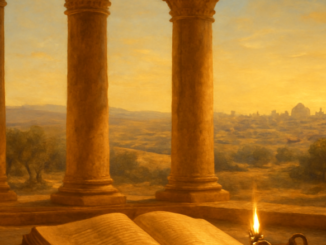
Open Volume of Sacred Law with Masonic square and candle in a lodge setting
Christianity

Micah and Freemasonry: Do Justice, Love Faithfulness

The candle flickers softly as a Brother opens the Volume of the Sacred Law. His fingers trace the pages until they rest on a passage he has read dozens of times before — yet tonight, the words seem to carry a different weight. “What does the Eternal require of you?” he reads aloud, and the question lingers in the stillness of the lodge room. The Book of Micah, written by a prophet in the eighth-century Kingdom of Judah, poses a question that has echoed through millennia. What does it truly mean to live a good life? The answer Micah offers is deceptively simple and yet infinitely demanding: do justice, love faithfulness, and walk humbly. For anyone familiar with the traditions of Freemasonry, these words resonate like echoes of deeply familiar principles. The Heart of Micah’s Message Micah prophesied during a time of profound social inequality. The wealthy enriched themselves at the expense of the poor, judges accepted bribes, and religious leaders sold their services to the highest bidder. Against this backdrop, the prophet raised his voice — not with elaborate theological arguments, but with a clear moral appeal. His most famous pronouncement appears in the sixth chapter: “He has told […]