In a quiet lodge, a man sits with his head bowed. His hands are still trembling from a conflict that nearly pushed him to the edge that afternoon. Around him, brothers stand in silence — waiting, listening. No one judges, no one rushes. Slowly, he finds the words he couldn’t find outside. This is the moment when anger makes room for something else.
When Anger Takes Over
A recent news story from Belgium shocked many: a fired dentist deliberately drove his Porsche into his former practice. It was an act of pure destruction, born from deep hurt and uncontrollable rage. Fortunately, no one was killed, but the damage — both material and human — was immense. Events like these raise uncomfortable questions. How does someone reach that breaking point? And more importantly, what could have been done to prevent it?
In today’s society, anger seems to dominate more and more. Social media amplifies outrage, conflicts escalate faster than ever, and a pervasive sense of powerlessness drives people to desperate acts. The dentist who used his car as a weapon is not a monster from another world. He is the product of a society that offers too little space for processing pain, rejection, and loss.
The Lodge as a Training Ground for Self-Mastery
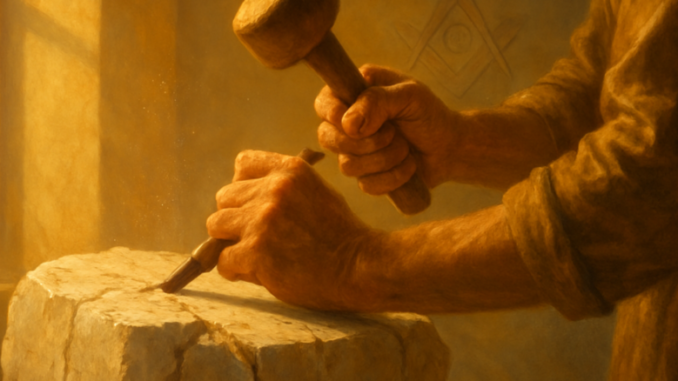
Freemasonry offers no magical cure for human anger. What it does offer is a structure in which men and women learn to confront their darkest impulses. From the very first degree, the importance of self-knowledge is hammered home — quite literally. The rough ashlar, that enduring symbol of the unrefined self, must be shaped with patience and discipline. This process demands honest confrontation with one’s own shortcomings, including the instinct for revenge.
Seneca, the Stoic philosopher whose ideas resonate deeply with Masonic thought, wrote extensively about anger. He considered it a form of temporary madness that robs a person of reason. His remedy? Not suppression, but deliberate delay. Count to ten, sleep on it, give yourself time before you act. In Masonic ritual, we find strikingly similar wisdom. Every gesture is intentional, every step carries meaning. There is simply no room for impulsivity.
Forgiveness as an Act of Strength
It’s easy to dismiss forgiveness as weakness. Our culture often glorifies the person who strikes back, who defends their honor, who refuses to be walked over. But true strength lies in the ability to let go — not because the other person deserves it, but because you deserve to be free from the chains of resentment.
Forgiveness is not a gift to the other person. It is your own liberation from the prison of anger.
Marcus Aurelius, the philosopher-emperor whose meditative writings have inspired generations, understood this deeply. He wrote that every morning we should remind ourselves that we will encounter difficult people. But their behavior, he reasoned, stems from ignorance about good and evil. By understanding this, we can cultivate compassion instead of hatred. The dentist in Belgium was fired. Perhaps unjustly, perhaps not. But his reaction didn’t just destroy a building — it destroyed his own future, his reputation, and potentially the lives of others.
Brotherhood as a Safety Net
What sets Freemasonry apart from many other organizations is its emphasis on brotherhood — and this is no empty concept. It means that brothers and sisters support one another through difficult times. When someone loses their job, when a marriage falls apart, when life deals its hardest blows, there is a community that listens without immediately passing judgment.
The dentist from the news may have had no one to turn to. Perhaps there were people around him, but he didn’t dare to speak. In a society where men are still expected to be strong and silent, asking for help is a revolutionary act. Freemasonry breaks this pattern. Within the privacy of the lodge, vulnerability is not a source of shame — it is a prerequisite for growth.
What Society Can Learn
The question isn’t only what Freemasons can learn from this incident, but what the broader society can take from it. We need structures where people can express their frustrations before those frustrations explode. These can be lodges, but they can also be sports clubs, support groups, or simply friendships rooted in genuine openness.
Voltaire, himself a Freemason and a passionate advocate for reason and tolerance, warned about the dangers of fanaticism. Although he was primarily addressing religious extremism, his message applies equally to personal obsessions. When a single emotion — whether love, hatred, or wounded pride — dominates our entire thinking, we lose the capacity for nuance. And without nuance, we are capable of anything.
Keep Working the Rough Stone
The dentist’s story ends, for now, with destruction and likely a prison sentence. But even after the gravest mistakes, the possibility of transformation remains. Freemasonry believes fundamentally in the perfectibility of human beings — not perfection as a destination, but as a perpetual movement toward improvement.
Every day offers the chance to work the rough ashlar a little further. Every confrontation with anger is a test — not one to pass or fail, but one to learn from. The question we should ask ourselves is not: could I ever do something like that? The question is: what am I doing today to ensure that anger never drives me that far?
The incident in Belgium is a stark reminder of how fragile the line between self-control and destruction really is. Freemasonry offers no guarantee against human failure, but it does offer a path of self-reflection, brotherhood, and forgiveness. In a world that spins ever faster and where anger is easily stoked, that path is more relevant than ever. The choice to walk it lies with each of us.
Copyright text & image: devrijmetselaar.nl
Texts are based on the ideas and content of the author of devrijmetselaar.nl, reviewed, corrected, and supplemented with the assistance of OpenAI. Images are created based on the ideas of the author of devrijmetselaar.nl using OpenAI/DALL-E.


Be the first to comment