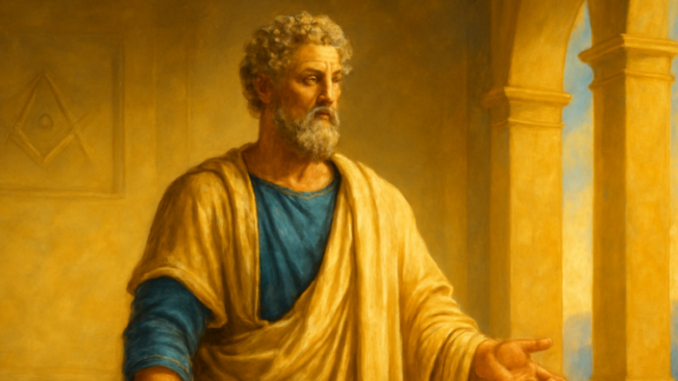
In the year 175 AD, a Roman emperor camped at the far edges of his empire wrote personal notes never intended for publication. In what we now know as Book XI of his Meditations, Marcus Aurelius combined sharp self-criticism with gentle humor in a way that still resonates nearly two millennia later. These reflections did not emerge in a vacuum. They flowed from centuries of philosophical thought about the human condition — from the streets of Athens to the slave quarters of Rome. The question this article explores: which thinkers and traditions laid the foundation upon which Marcus Aurelius built his unique connection between humor and self-knowledge?
The Stoic Tradition as Foundation
The Stoic school, founded by Zeno of Citium around 300 BC, forms the primary intellectual bedrock of Book XI. Zeno developed his teachings in the Stoa Poikile — the Painted Porch in Athens from which the movement takes its name. At the core of this philosophy lies the conviction that virtue is the only true good, and that external circumstances, including fame, wealth, and even physical well-being, belong to the so-called “indifferent things.” Marcus Aurelius inherited this vision, but added something less prominent in earlier Stoics: the ability to look at one’s own shortcomings with a smile.
Chrysippus, the third head of the Stoic school, refined Stoic logic into a sophisticated system and emphasized the importance of self-reflection. His writings, of which sadly only fragments survive, were required reading for every serious Stoic. Marcus Aurelius alludes to this tradition indirectly in Book XI when he invites the reader to examine their own thoughts critically — not with self-loathing, but with the objective eye of a physician examining a patient.
Epictetus: The Teacher Behind the Curtain
No thinker exercised more influence on Marcus Aurelius than Epictetus, the former slave who became one of the most respected philosophers of his age. Epictetus taught at Nicopolis, and his lessons were recorded by his student Arrian in the Enchiridion and the Discourses. Marcus Aurelius studied these texts intensively under the guidance of his tutor Junius Rusticus.
Self-knowledge without humor leads to self-flagellation; humor without self-knowledge leads to self-deception. The Stoic sage combines both into an instrument of inner freedom.
Epictetus taught that we have power only over our own judgments, choices, and reactions. Everything beyond that falls outside our control. This insight lies at the heart of Book XI, where Marcus Aurelius repeatedly reminds himself of the absurdity of growing angry over things he cannot change. The humor emerges precisely at the intersection of this wisdom: anyone who truly understands how little we control cannot help but smile at their own pretensions.
For those familiar with Masonic teachings, this resonance may feel particularly familiar. The working tools of Freemasonry — the square, the compass, the level — all point toward self-examination and the pursuit of virtue. The Stoic practice of distinguishing between what lies within our power and what does not mirrors the Masonic emphasis on refining the rough ashlar of one’s own character, not the characters of others.
Heraclitus and the Doctrine of Change
Throughout his Meditations, Marcus Aurelius refers frequently to Heraclitus of Ephesus, the pre-Socratic thinker famous for declaring that one cannot step into the same river twice. This emphasis on perpetual change — the panta rhei — resonated deeply with the philosopher-emperor. In Book XI, this insight serves as the basis for a particular kind of self-relativizing: if everything is in constant flux, why would we cling so tightly to our current state of being?
Heraclitus was also known for his enigmatic style and his reputation as “the obscure philosopher.” Yet his work contained moments of sharp irony, such as when he criticized his fellow citizens by remarking that they might as well hang their children rather than change their laws. This combination of seriousness and mockery resurfaces in the way Marcus Aurelius addresses himself in Book XI — alternating between earnest resolve and a wry awareness of his own limitations.
Seneca and the Roman Practice of Philosophy
While the Greek Stoics laid the theoretical foundations, Roman philosophers like Seneca translated these ideas into the practice of everyday life. Seneca, writing a century before Marcus Aurelius, combined philosophical depth with literary elegance. His Letters to Lucilius are a treasure trove of practical wisdom about self-examination. In these letters, Seneca regularly displays a gentle self-deprecation when describing his own failings — confessing to laziness, impatience, and the very human struggle to live up to one’s ideals.
Seneca’s influence on Book XI is evident in its accessible, personal tone. Where Chrysippus built abstract systems and Epictetus gave direct instructions, both Seneca and Marcus Aurelius offer a window into the individual’s struggle with philosophical ideals. Both acknowledge that the gap between wisdom and behavior cannot be bridged in a single leap — and both do so with a certain grace. This honesty about the distance between aspiration and reality is something that resonates throughout the Masonic tradition as well, where the journey of self-improvement is understood to be lifelong.
Cynic Influences on Stoic Humor
Stoicism did not arise in isolation but built upon the Cynic tradition of Diogenes of Sinope. The Cynics practiced a radical form of free speech that often came paired with biting humor and deliberate provocation. Diogenes, who according to legend searched for an honest man with a lantern in broad daylight, represented a tradition in which mockery was a philosophical tool — a way of stripping away pretense to reveal truth.
Several key ideas passed from the Cynics through to Marcus Aurelius’s reflections in Book XI. Among them: self-knowledge as a path to virtue rather than a source of shame; the relativizing of social status and external recognition; humor as a means of breaking attachments to worldly things; and the cosmic perspective that shrinks human worries to their proper size.
Marcus Aurelius tempered the Cynic radicalism but retained its essence: the capacity to observe human affairs from a distance. In Book XI, we see this when he writes about the transience of fame and the ultimate equality of all people in death. This is not the bitterness of the Cynic but Stoic acceptance, seasoned with a touch of irony. It is this mature, measured humor — laughter born not of contempt but of understanding — that makes these passages so enduring.
Plutarch and the Biographical Tradition
Although Plutarch was a Platonist rather than a Stoic, his work contributed significantly to the intellectual climate in which Marcus Aurelius wrote. His Parallel Lives offered vivid portraits of great men wrestling with their own flaws — leaders who embodied courage and wisdom while simultaneously stumbling in recognizably human ways. This biographical tradition reinforced the idea that greatness and imperfection are not mutually exclusive, a lesson Marcus Aurelius clearly took to heart.
Plutarch’s influence reminds us that philosophy in the ancient world was never purely abstract. It was embedded in stories, in real lives, in the messy business of governance and human relationships. Marcus Aurelius’s Meditations stand in this tradition: philosophy as lived experience, tested against the pressures of war, political intrigue, and personal loss. The humor in Book XI is not an escape from these realities but a way of confronting them with clear eyes and a steady spirit.
The philosophical roots of humor in Book XI of Marcus Aurelius’s Meditations run deep — drawing from the austere logic of Chrysippus, the liberating insights of Epictetus, the flowing cosmology of Heraclitus, the practical wisdom of Seneca, the provocative spirit of Diogenes, and the biographical richness of Plutarch. What makes Marcus Aurelius remarkable is not that he drew from these sources, but how he wove them together into something deeply personal: a quiet laughter at himself that never tips into despair. For those who walk the Masonic path of self-improvement, these ancient reflections offer a timeless reminder that true wisdom begins with knowing oneself — imperfections and all — and that a gentle sense of humor about the journey is not a weakness but a sign of genuine understanding.
Copyright text & image: devrijmetselaar.nl
Texts are based on the ideas and content of the author of devrijmetselaar.nl, reviewed, corrected, and supplemented with the assistance of OpenAI. Images are created based on the ideas of the author of devrijmetselaar.nl using OpenAI/DALL-E.

Be the first to comment