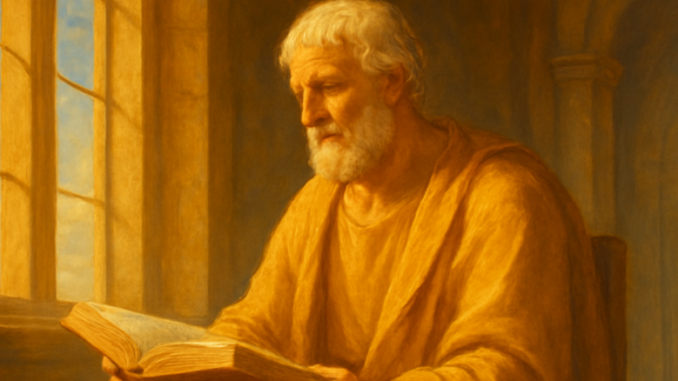
Candles flicker in the silence of the lodge. An elder brother leans over a yellowed book, his finger tracing lines written nearly two thousand years ago. They are the words of Seneca, addressed to his friend Lucilius, contemplating the very essence of all that exists. For a moment, time dissolves — and he feels how the same questions that preoccupied Seneca still pulse in the heart of every seeker.
The Search for What Is Essential
In Letter LVIII of his Letters to Lucilius, Seneca dives deep into a philosophical question that has occupied humanity for centuries: what is the true nature of things? Drawing on categories that trace back to Plato, he examines how we can understand and classify reality. He wrestles with the limitations of language, wondering whether words can ever do justice to the deepest truths. This relentless search for meaning runs remarkably parallel to the journey every Freemason undertakes.
For Seneca, philosophy was never an abstract pastime — it was a practical art of living. He wrote not to impress with erudition, but to help Lucilius become a better person. This intention mirrors the very heart of Freemasonry: the pursuit of knowledge not for its own sake, but as a means toward inner growth and moral refinement. Both traditions recognize that true wisdom expresses itself in deeds, not merely in words.
Language as an Imperfect Tool
A central theme in Letter LVIII is the inadequacy of language. Seneca laments that Latin lacks sufficient words to express certain philosophical nuances. He attempts to translate Greek concepts but repeatedly encounters the boundaries of what can be said. This awareness — that the deepest truths cannot be fully captured in words — resonates profoundly with Masonic tradition.
Where words fall short, symbols speak. Both the Freemason and the Stoic understand that the essence of things reveals itself to those who learn to look beyond the surface.
Freemasonry excels at using symbols to communicate what language cannot contain. The square, the compasses, the rough ashlar, and the perfect ashlar are not mere decorations — they are windows into deeper meanings. Like Seneca, the Freemason recognizes that some insights can only be experienced, never fully explained. Ritual functions as a language beyond language, a way of transmitting the unspeakable.
Categories of Being and the Stairway of Perfection
In this letter, Seneca discusses the classical division of all that exists. He distinguishes several levels of being, from the most general concept down to specific, tangible things. This hierarchy calls to mind the degrees within Freemasonry, where each step brings deeper understanding and greater responsibility. The Entered Apprentice, the Fellowcraft, and the Master Mason represent not only different stages of knowledge but also of self-knowledge.
This parallel is more than coincidental. Both Stoic philosophy and Freemasonry view the human being as a work in progress. We are not finished at birth but are shaped through study, reflection, and honest confrontation with ourselves. The rough stone that is gradually worked into a perfect cube stands as a powerful symbol of this process. Seneca would have recognized this image immediately as an expression of his own deepest convictions.
Brotherhood in the Search
One of the most striking qualities of the Letters to Lucilius is their warm, personal tone. Seneca does not write as a distant teacher but as a friend walking alongside Lucilius. He freely admits that he himself is still searching, that he too struggles with the same questions. This attitude of equality and mutual respect lies at the core of what Freemasons call brotherhood.
In the lodge, men meet not as superiors and subordinates but as brothers helping one another on the path toward light and knowledge. The wisdom of an experienced Master is not meant to rule but to be shared. Seneca embodies this ideal when he writes that he treats Lucilius as his equal, despite their difference in age and experience. The true teacher is always also a student.
Mortality as a Teacher
Letter LVIII closes with reflections on death and the impermanence of all things. Seneca does not regard death as an enemy but as part of the natural order. This acceptance of finitude is precisely what gives life its value and urgency. Why delay the pursuit of virtue when time is limited?
Within Freemasonry, the confrontation with mortality also plays a significant role. The memento mori — the reminder of death — is not a morbid fascination but an exhortation to live meaningfully. The skull that appears in certain rituals reminds the Mason that his time is precious and that every day offers a new opportunity to work upon himself.
Shared Principles Across the Ages
When we step back and consider Seneca’s philosophy alongside Masonic tradition, several shared principles emerge clearly. Both emphasize the importance of honest self-reflection — of looking inward without flinching. Both place moral growth above material gain, viewing virtue as the highest aim of a well-lived life. Both cherish the bond between seekers as a source of strength and wisdom. And both turn to symbols when language inevitably falls short of conveying the full depth of human experience.
A Bridge Across Two Millennia
When we read Seneca today, we are not merely listening to a voice from the distant past. We are meeting a companion on the very journey every Freemason recognizes: the journey inward, toward the essence of things, toward who we truly are. His questions are our questions. His doubts feel familiar. And his answers, however provisional, offer both comfort and direction.
Letter LVIII is far more than a philosophical treatise. It is an invitation to search together, to acknowledge the limitations of language and yet continue to speak, to accept impermanence and for that very reason to use each day for growth. The Freemason who reads these words finds an ally in Seneca — a kindred spirit reaching across the centuries, extending a hand in brotherhood.
Seneca’s ancient wisdom and the living tradition of Freemasonry share a common heartbeat: the conviction that the examined life is the only life worth living. Whether through Stoic philosophy or Masonic ritual, the call is the same — to refine the rough stone, to seek light in the midst of darkness, and to walk the path of self-improvement not alone, but in the company of fellow seekers. Across two thousand years, that message has lost none of its power.
Copyright text & image: devrijmetselaar.nl
Texts are based on the ideas and content of the author of devrijmetselaar.nl, reviewed, corrected, and supplemented with the assistance of OpenAI. Images are created based on the ideas of the author of devrijmetselaar.nl using OpenAI/DALL-E.


Be the first to comment