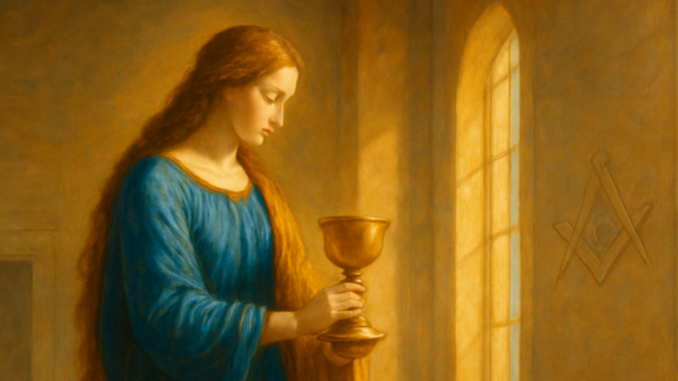
Perhaps you’ve experienced it too: you’re halfway through Dan Brown’s The Da Vinci Code, and you find yourself wondering — could any of this actually be true? The claim that Mary Magdalene was the wife of Jesus and that the Holy Grail actually represents their bloodline is so ingeniously constructed that it almost sounds plausible. But how much of this theory holds up under scrutiny? In this article, we examine the historical facts, the exaggerations, and the pure fiction behind one of the most talked-about claims in popular culture.
Dan Brown’s Central Claim
In The Da Vinci Code, Dan Brown presents the theory that Mary Magdalene was not merely a follower of Jesus, but his wife. According to the novel, she fled to France after the crucifixion while pregnant, and their bloodline continued through the centuries. The Holy Grail, then, is not a chalice at all — it is a metaphor for the womb of Mary Magdalene and the royal lineage that descended from her. It’s a bold hypothesis that has captivated millions of readers around the world. But how does it measure up against what historians and biblical scholars actually know?
What the Historical Sources Actually Say
The canonical Gospels, written between roughly 70 and 100 AD, make no mention whatsoever of a marriage between Jesus and Mary Magdalene. She is, however, prominently named as a witness to the crucifixion and as the first witness to the resurrection — a role that gives her a position of considerable importance in early Christianity. Yet the leap from that status to a marital relationship finds no support in any early Christian text.
The apocryphal writings, including the Gospel of Philip that Dan Brown references, offer no conclusive evidence either. The frequently cited passage in which Jesus supposedly kisses Mary Magdalene contains gaps in the manuscript, and the Coptic word for “kiss” can also refer to a spiritual greeting — a common practice among early Christian communities.
Harvard historian Karen King, who studied the so-called “Gospel of Jesus’s Wife,” emphasized that even if such texts were authentic, they would at most reveal what certain early Christian communities believed — not what is historically factual. The fragment she studied was later determined to be a probable modern forgery.
The Holy Grail: Chalice or Bloodline?
The traditional image of the Holy Grail as the cup from the Last Supper originates in medieval literature, particularly the works of Chrétien de Troyes in the twelfth century. The interpretation of the Grail as a bloodline, as presented in The Da Vinci Code, is far more recent. It derives primarily from the 1982 book Holy Blood, Holy Grail by Michael Baigent, Richard Leigh, and Henry Lincoln. Brown clearly drew on this work for his novel, but the authors themselves were widely criticized by historians for their speculative methodology and lack of primary sources.
The bottom line is straightforward: there is no historical document that confirms a marriage between Jesus and Mary Magdalene. The Grail-as-bloodline theory is a modern construction, not a hidden truth waiting to be uncovered.
The Priory of Sion: A Proven Fabrication
A crucial element in The Da Vinci Code is the Priory of Sion, a secret society alleged to have protected the bloodline of Jesus for centuries. Dan Brown presents this as historical fact. The reality, however, is far less glamorous. The Priory of Sion was founded in 1956 by Pierre Plantard, a Frenchman with dubious motives. The supposedly ancient documents meant to prove the Priory’s existence — the so-called Dossiers Secrets — were exposed in the 1980s as forgeries that Plantard himself had planted in the Bibliothèque Nationale in Paris. French researchers and journalists have documented this extensively.
Where Dan Brown Gets It Right — and Where He Doesn’t
It is true that Mary Magdalene was wrongly identified in Western church history with the sinful woman in the Gospel of Luke — a confusion introduced by Pope Gregory the Great in 591 AD. This is historically demonstrable, and the Roman Catholic Church officially corrected it in 1969. It is also true that early Christian texts paint a more diverse picture of Mary Magdalene than later tradition would suggest.
But the leap from “important female disciple” to “secret wife and mother of a royal bloodline” is an enormous extrapolation for which the evidence simply does not exist.
Fact: Mary Magdalene was an important figure in early Christianity.
Exaggerated: She was systematically erased from history by the Church.
Fiction: She was the wife of Jesus and fled to France while pregnant.
Fiction: The Priory of Sion is an ancient secret society.
What This Means for the Searching Mind
As Freemasons, we learn to distinguish between symbol and literal truth, between tradition and historical fact. The stories told within our rituals point toward deeper truths about human growth and morality — without claiming that Hiram Abiff is a documented historical figure in the way that Julius Caesar was. This distinction is precisely what readers of The Da Vinci Code would do well to take away: a compelling story can inspire reflection on hidden histories and overlooked voices, but critical thinking requires that we recognize fiction for what it is.
Dan Brown has prompted millions of people to think about the role of women in religious history, the construction of canonical texts, and the power of secret societies. These are valuable conversations. But the specific claims about Mary Magdalene as wife and ancestral mother of a bloodline are not endorsed by any serious historian.
The Mary Magdalene theory from The Da Vinci Code is a fascinating literary construction built on modern speculation, not historical documentation. If you feel drawn to mysteries and hidden truths, that is a wonderful impulse — one that Freemasonry itself encourages. But a genuine search for truth requires that you weigh your sources, test your assumptions, and develop the intellectual honesty to separate a good story from established fact. That discipline, more than any secret society or hidden bloodline, is what brings us closer to the Light.
Copyright text & image: devrijmetselaar.nl
Texts are based on the ideas and content of the author of devrijmetselaar.nl, reviewed, corrected, and supplemented with the assistance of OpenAI. Images are created based on the ideas of the author of devrijmetselaar.nl using OpenAI/DALL-E.

Be the first to comment