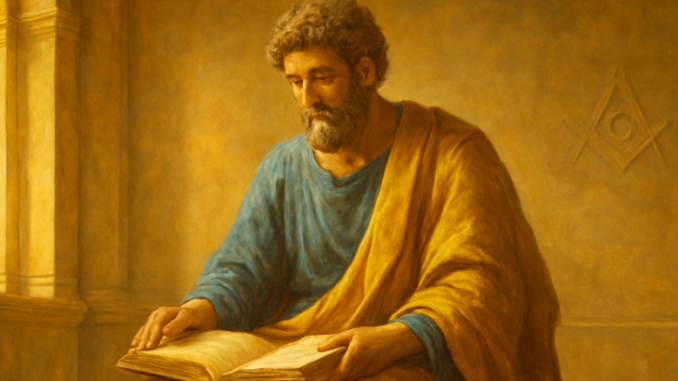
Why would a Roman emperor from the second century still have something meaningful to say about human connection? And what does his reflection on the brevity of life have to do with the brotherhood that Freemasons strive for? In the second book of his Meditations, Marcus Aurelius confronts himself with an uncomfortable truth: everything passes, including ourselves. Yet within that very acknowledgment lies a surprising lesson about what truly binds us together as human beings.
What Does Marcus Aurelius Actually Mean by Impermanence?
Let us first consider what the emperor actually writes. In Book II of the Meditations, Marcus Aurelius describes how everything we know passes like waves on a river. Our bodies decay, our names are forgotten, and even the memory of our deeds eventually fades. This may sound bleak, but for the Stoic, it is no cause for despair. It is an invitation to clarity.
The impermanence Marcus Aurelius describes is not nihilism. It is a call to distinguish between what is truly valuable and what is merely appearance. Fame, possessions, power — these are fleeting things. But virtue, character, and the way we treat others carry a different quality. Not because they last forever, but because they form the very essence of who we are.
How Does Impermanence Relate to Brotherhood?
Here we touch on something essential. Marcus Aurelius does not write as a hermit who has turned his back on the world. He writes as someone standing in the middle of life, surrounded by people. It is precisely the awareness of impermanence that makes connection precious. If our time is limited, then every encounter gains weight. Every moment of genuine attention given to another person becomes a gift.
In Freemasonry, we recognize this principle in the emphasis on brotherhood. The lodge is not a place for superficial contacts or fleeting acquaintances. It is a space where people meet with the intention of truly seeing one another. That intention gains depth when we realize that our time together is finite.
It is precisely the awareness of impermanence that transforms every handshake, every conversation, and every glance of recognition into an act of genuine connection.
What Can We Learn About Self-Reflection?
Marcus Aurelius wrote his Meditations for himself. They were not lessons for others but conversations with his own mind. He constantly posed questions to himself: Am I acting justly? Am I being honest with myself about my motives? Am I using my time in a way that aligns with my values?
This form of self-reflection will feel familiar to anyone acquainted with Freemasonry. The work of building the inner temple presupposes that we know ourselves — including our shortcomings. The ritual and symbolism of the lodge invite precisely this kind of inner dialogue. Not to condemn ourselves, but to grow.
The impermanence Marcus Aurelius describes lends urgency to this self-reflection. If we do not know how much time remains, then there is not a moment to lose to self-deception or procrastination. Today is the day to work on who we want to become.
The Shared Search for Truth
A recurring thread in Stoic philosophy is the question of what is genuinely true. Marcus Aurelius encourages himself to look beyond the surface of things. Pomp and splendor are mere decoration. Popularity is the fickle favor of others. Even physical beauty is temporary.
Freemasonry shares this longing for deeper truth. It is no coincidence that light and knowledge are central themes in the tradition. The light that is sought is not the light of useful information or practical know-how. It is insight into what is essential — beyond the surface of daily existence.
Marcus Aurelius and the Masonic tradition meet in the conviction that this search need not be a solitary one. It is precisely in dialogue with others, in brotherly exchange, that insights ripen and mature. The lodge provides a protected space for these kinds of conversations — a place where truth can be pursued without pretense.
What About Moral Perfection?
Here we must tread carefully. Marcus Aurelius was not a perfectionist in the modern, anxious sense of the word. He knew he made mistakes. His writings are filled with admonitions to himself to be more patient, kinder, and more just. The Stoic does not pursue flawlessness but continual improvement.
This aligns beautifully with the Masonic idea of the rough ashlar that must be shaped and refined. We do not begin as finished human beings. The work on ourselves is never complete. But the direction is clear: we strive toward virtue — not because we earn something by it, but because it is the only path to a meaningful life.
Consider these four pillars that both Marcus Aurelius and Freemasonry hold dear:
- Self-reflection as a daily practice — examining our thoughts and actions with honest regularity.
- Brotherhood as a response to impermanence — cherishing connection because our time is finite.
- The search for truth as a shared endeavor — pursuing insight together rather than in isolation.
- Moral growth as a lifelong process — working the rough stone with patience and persistence.
What Remains When Everything Passes?
If everything fades, what still holds meaning? Marcus Aurelius offers a surprisingly warm answer. What endures is not fame or memory. What endures is the influence we have had on others. The virtue we have practiced. The moments in which we were truly present for a fellow human being.
In Freemasonry, we find a similar idea. The chain of brothers stretches across time. What we pass on to the next generation — the values we embody, the wisdom we share — that is our true legacy. Not the stones we stack, but the manner in which we build.
The second book of Marcus Aurelius’ Meditations confronts us with the impermanence of everything we know. But rather than paralyzing us, this insight sets us free. It creates space for what truly matters: connection with others, honesty with ourselves, and the ongoing labor of shaping our character. For those familiar with Freemasonry, these themes resonate like a well-known melody — ancient yet ever relevant, reminding us that the most enduring things we build are not made of stone, but of virtue and brotherly love.
Copyright text & image: devrijmetselaar.nl
Texts are based on the ideas and content of the author of devrijmetselaar.nl, reviewed, corrected, and supplemented with the assistance of OpenAI. Images are created based on the ideas of the author of devrijmetselaar.nl using OpenAI/DALL-E.
Frequently Asked Questions
How does Marcus Aurelius define impermanence, and why is it not nihilism?
Marcus Aurelius describes impermanence as the natural process by which everything passes like waves on a river—our bodies decay, names are forgotten, and deeds fade from memory. However, this is not nihilism. Instead, it is an invitation to clarity that helps us distinguish between what is truly valuable and what is merely appearance. While fame, possessions, and power are fleeting, virtue, character, and how we treat others carry a different quality because they form the essence of who we are.
What is the connection between impermanence and Masonic brotherhood?
The awareness of impermanence makes connection precious because our time is limited. In Freemasonry, this principle underlies the emphasis on genuine brotherhood. The lodge is a space where people meet with the intention of truly seeing one another, not for superficial contacts. When Masons realize their time together is finite, every handshake, conversation, and moment of recognition becomes a meaningful act of genuine connection.
What can Freemasons learn from Marcus Aurelius's approach to self-reflection?
Marcus Aurelius wrote his Meditations as conversations with his own mind, constantly questioning himself about whether he was acting justly, being honest about his motives, and using his time in alignment with his values. Freemasons can apply this practice by engaging in regular self-reflection within the lodge environment, using the principles of brotherhood and impermanence as guides to ensure their actions and intentions align with the higher values of the fraternity.

Be the first to comment