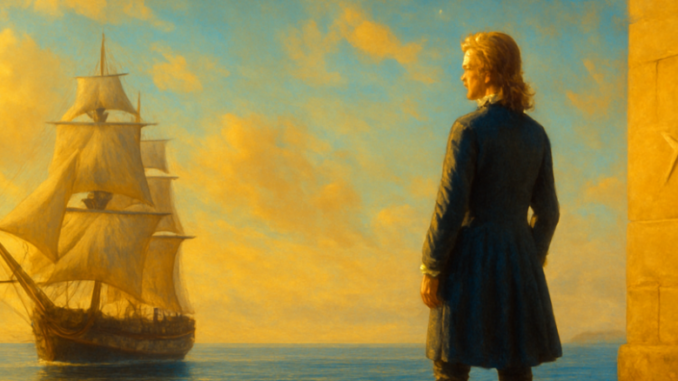
What does it truly mean to pursue the good in a world full of setbacks? Voltaire posed this question more than 250 years ago in his famous satirical novel. Today, we revisit that question — not as literary historians, but as seekers looking for the connection between philosophical insight and the values that Freemasonry holds dear. This is a reflection on optimism, virtue, and the inevitable struggle that accompanies the good life.
Why Did Voltaire Take Aim at Naïve Optimism?
Voltaire lived during a period of sweeping intellectual transformation. The Enlightenment ushered in a new faith in reason, but also in the notion that we inhabit “the best of all possible worlds.” This brand of optimism, popularized by the philosopher Gottfried Wilhelm Leibniz, was demolished by Voltaire with biting irony. His protagonist Candide travels through a world ravaged by war, natural disasters, and human cruelty, while his tutor Pangloss insists that everything is for the best.
But was Voltaire a pessimist? That would be too simple. Voltaire did believe in progress — but progress that must be fought for. The good does not arise on its own. It demands effort, reflection, and the deliberate cultivation of virtue. And it is precisely here that his thinking touches the heart of what Freemasonry strives toward.
What Does the Garden Teach Us About Moral Perfection?
At the end of the novel, Candide arrives at a conclusion that sounds deceptively modest: “We must cultivate our garden.” This statement has often been misinterpreted as a call to withdraw from the world. But is that really what Voltaire meant? Or is something far deeper at work?
Cultivating the garden is not an escape from the world — it is a daily commitment to the good, stone by stone, deed by deed.
In Freemasonry, we know the image of the rough ashlar that must be shaped into a perfect cube. This work is never finished. It requires patience, self-reflection, and the courage to confront our own shortcomings. Voltaire’s garden and the Freemason’s stone tell the same story: moral perfection is not a destination, but a continuous process of refinement.
How Do Optimism and Active Labor Relate to Each Other?
This is where things get truly interesting. Voltaire did not oppose hope — he opposed passive optimism. He rejected the belief that everything will turn out fine without any effort on our part. This speaks directly to a core value within Freemasonry: the conviction that each person is responsible for their own inner growth and for their contribution to society.
The Freemason is not invited to sit and wait for the light to reach him. He must seek truth for himself, step by step, through ritual and contemplation. The world does not improve through hoping — it improves through action. Voltaire would have wholeheartedly agreed.
The Role of Brotherhood in the Struggle for Good
Candide ultimately finds peace not in solitude, but within a small community of companions. Together they tend the garden. This collective dimension should not be underestimated. The struggle for the good is a heavy burden when carried alone. Voltaire shows us that connection is essential.
Within the lodge, Brethren experience the same truth. Freemasonry is not a solitary path, even though the inner work centers on personal development. It is the community that supports, mirrors, and inspires. The garden is cultivated together; the temple is built together. This is not a casual metaphor — it is a lived practice.
What Does Candide Tell Us Today About the Search for Light?
The question presses itself upon us: is Voltaire’s message still relevant? We live in a time when grand narratives are under pressure, when cynicism often seems easier than hope. But that is precisely why Candide speaks so powerfully. The work acknowledges the darkness without surrendering to it.
The good is not a given — it is a task. Reflection without action is barren. Community strengthens the individual search. The garden and the rough ashlar both demand daily work.
The search for light, so central to Freemasonry, is exactly this: not waiting for the darkness to recede, but lighting a candle yourself. Voltaire understood this. His satire was not destruction — it was a call to responsibility.
Where Do Voltaire and the Freemason Meet?
The answer lies in a shared conviction: that humanity is not perfect, but can strive toward perfection. Voltaire was not a Freemason in the formal sense, although his connections with Enlightenment circles were extensive. Yet his thinking resonates deeply with Masonic values — the emphasis on virtue, the rejection of blind dogmatism, the belief in human dignity, and the power of community.
The struggle for the good is not a battle to be won. It is a struggle waged day after day, in the silence of one’s own soul and in the warmth of brotherhood. Voltaire invites us not to shy away from this struggle, but to embrace it. The garden awaits.
Voltaire’s Candide offers no easy answers, but it asks the right questions. What are we willing to do for the good? How do we face adversity? And with whom do we tend our garden? For those who know Freemasonry, these questions sound familiar. They form the very heart of the path we walk — stone by stone, day by day, searching for the light we must kindle ourselves.
Copyright text & image: devrijmetselaar.nl
Texts are based on the ideas and content of the author of devrijmetselaar.nl, reviewed, corrected, and supplemented with the assistance of OpenAI. Images are created based on the ideas of the author of devrijmetselaar.nl using OpenAI/DALL-E.
Frequently Asked Questions
What is the connection between Voltaire's 'Candide' and Freemasonry?
Both Voltaire's philosophy and Freemasonry emphasize that moral perfection and the good life require active effort and continuous self-improvement. Just as Voltaire rejected naive optimism in favor of deliberate virtue cultivation, Freemasonry uses the image of the rough ashlar being shaped into a perfect cube to represent the ongoing work of personal refinement. Neither tradition believes the good arises on its own—it must be fought for through reflection, labor, and commitment.
What did Voltaire really mean by 'we must cultivate our garden'?
This famous conclusion is often misinterpreted as withdrawal from the world, but it actually represents a daily commitment to doing good through consistent, incremental effort. It is not an escape but an active engagement with moral improvement—stone by stone, deed by deed—much like the Freemason's work on the ashlar. The garden symbolizes the never-finished process of personal and spiritual development.
Did Voltaire believe in optimism or pessimism?
Voltaire was neither a pure optimist nor a pessimist. He rejected the naive optimism of his time—the belief that everything happens for the best without human effort—but he did believe in progress. However, his optimism was active and earned: progress must be fought for, demanded through effort, reflection, and the deliberate cultivation of virtue. This perspective aligns closely with Freemasonry's emphasis on personal responsibility for inner growth.

Be the first to comment