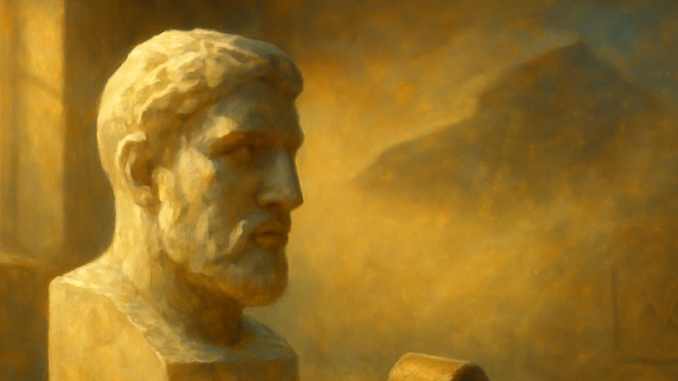
Imagine designing something radical. A vehicle made of stainless steel, angular as an origami sculpture, built to shatter every convention. It launches with enormous fanfare, the world is divided in its reaction, and a few years later it quietly disappears from production. But this article isn’t about cars. It’s about you — about how you build your personality, when you find the courage to revise your design, and what Freemasonry has to say about the whole process.
A Structure That Didn’t Fit
The news was clear: that futuristic steel machine that was supposed to revolutionize the automotive market a few years ago has been pulled from production. The angular stainless-steel pickup truck turned out to be vulnerable to rust, difficult to repair, and dangerous to pedestrians. The design was spectacular, but its execution collided with reality. What we’re left with is a fascinating example of a structure that didn’t fit its environment, didn’t serve its users, and ultimately couldn’t live up to its own ambitions.
It’s tempting to turn this into a story about technological failure. But look deeper. How many people build their personalities the same way? They choose a striking exterior, a sharp profile, an image designed to impress. And over time, they discover it doesn’t work. The surface cracks. The construction is hollow inside. In Freemasonry, we call this the difference between the rough ashlar and the perfect ashlar — the difference between who you are when you begin and who you can become when you work on yourself honestly.
Personality as a Building Project
The philosopher Aristotle wrote that character is not something you’re born with but something you develop through repeated action. Virtue comes from acting virtuously, not from talking about it. That sounds simple, but it demands something uncomfortable: you must be willing to examine your own design critically. Not once, but continuously.
In Freemasonry, this principle is translated into a concrete practice. Every brother is invited to see himself as an unworked stone. The goal is not to carve that stone into some ostentatious work of art but to shape it so it fits into a greater whole. Building your personality, then, is not a solo project. It means aligning your character with the community you live in, with the values you profess, and with the honesty you bring to self-examination.
Three Practical Steps to Work on Your Character
How do you translate this into your daily life? Here are three concrete steps, inspired by the Masonic tradition, that you can start applying today.
1. Practice an Evening Self-Review
The Roman philosopher Marcus Aurelius described in his personal writings how he evaluated each day every evening. What did I do well? Where did I fall short? What can I do differently tomorrow? In Freemasonry, a similar tradition exists: the moment of silent reflection at the close of a lodge meeting, where every brother examines himself. Try this for one week. Take five minutes every evening. No self-punishment — just honest reflection. You’ll notice patterns emerging that you completely miss during the day.
2. Ask for Honest Feedback
The steel vehicle was designed in an environment where criticism wasn’t welcome. That’s fatal — for products and for personalities alike. Johann Wolfgang von Goethe, himself a Freemason, wrote that a person only comes to know himself through action, and action only becomes meaningful when others respond to it. Ask someone you trust: where do you see a blind spot in me? Where do my words and actions not align? It takes courage, but it is precisely the kind of courage that makes your character stronger.
3. Have the Courage to Revise Your Design
This may be the hardest step. Revising feels like failing. It feels like admitting your original plan wasn’t good enough. But in the building tradition of Freemasonry, it’s precisely the other way around: the master builder is not respected because he never makes mistakes, but because he has the wisdom to recognize and correct them. The legendary builder Hiram Abiff stands in the tradition not as a symbol of perfection but as a symbol of dedication to the work — despite everything that goes wrong.
Personality is not an image you project. It’s a structure you continually test, refine, and align with the reality around you.
Why Authenticity Is Stronger Than Standing Out
It’s telling that the angular pickup truck failed at exactly the point where it aimed to excel: indestructibility. The material that was supposed to be invincible turned out to be vulnerable. The form that was meant to impress turned out to be impractical. There’s a direct lesson here for anyone working on their character. Standing out is easy. Making an impression — anyone can do that. But being genuine, acting consistently, acknowledging your mistakes, and adapting without losing your core: that is the real work.
Wolfgang Amadeus Mozart, also a Freemason, composed music that was simultaneously complex and accessible. His genius lay not in seeking shock but in finding harmony. That is precisely what personal development in Freemasonry aims for: not a flashy exterior, but inner coherence.
The Workshop Is Always Open
The beauty of the Masonic approach to personality is that there is no finish line. You are never done. Every day offers a chance to work on your stone again — to smooth a corner, to polish away a rough edge. It’s not about perfection; it’s about the willingness to keep working. The workshop never closes. And unlike a production line where a failed model is simply discontinued, you can always revise your design.
So the next time you read about a bold design that didn’t survive contact with reality, don’t just see a product failure. See a mirror. The question is never whether your first design was perfect — it never is. The question is whether you have the honesty to examine it, the humility to listen to feedback, and the courage to keep building. In Freemasonry, the rough ashlar is not something to be ashamed of. It is where every meaningful journey begins.
Copyright text & image: devrijmetselaar.nl
Texts are based on the ideas and content of the author of devrijmetselaar.nl, reviewed, corrected, and supplemented with the assistance of OpenAI. Images are created based on the ideas of the author of devrijmetselaar.nl using OpenAI/DALL-E.
Frequently Asked Questions
What does the article mean by comparing personality to a building project?
The article uses the metaphor of a building project to explain that character is not something fixed at birth but something you actively construct and refine over time. Just as a vehicle's design must fit its function and environment, your personality must align with your values, community, and honest self-examination. In Freemasonry, this is represented by the concept of the rough ashlar (unworked stone) being shaped into the perfect ashlar (refined stone), symbolizing personal development through continuous work on yourself.
How does Freemasonry view the relationship between character and personal development?
According to the article, Freemasonry teaches that character development is not a solo endeavor but involves aligning yourself with a greater whole. A Freemason views himself as an unworked stone that must be shaped—not into an ostentatious work of art, but into something that fits meaningfully within a community. This requires honest self-examination and the willingness to continuously revise your design based on how well you function in your environment and relationships.
What can we learn from the failed stainless steel vehicle mentioned in the article?
The vehicle serves as a metaphor for how people often build striking exteriors and impressive personas that don't actually work in practice. The truck looked revolutionary but was vulnerable to rust, difficult to repair, and dangerous to pedestrians—its spectacular design collided with reality. Similarly, people may construct striking personalities or personas, but if they lack substance, don't serve others, or aren't honestly examined, they eventually crack and fail. This illustrates why character must be built authentically, not just for appearance.


Be the first to comment