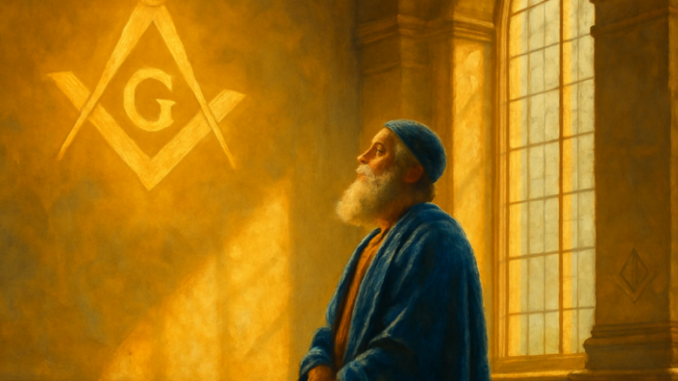
You’ve read the book — or at least heard about it. You remember the secret chambers, the mysterious inscriptions, and the dramatic revelations about Masonic symbols hidden throughout Washington D.C. But how much of what Dan Brown describes in The Lost Symbol is actually based on fact? And what can you, as a reader or a genuine seeker of truth, take away from it all? In this fact-check, we hold the book’s most important claims up against the historical record.
What Dan Brown Claims About Masonic Symbols
In The Lost Symbol, Dan Brown paints a picture of Washington D.C. as a city drenched in Masonic symbolism. The Capitol, the Washington Monument, even the street layout — everything, he suggests, was deliberately designed by Freemasons to carry a deeper, hidden message. The novel implies that these symbols point to ancient mysteries and secret knowledge passed down through the Brotherhood for centuries. It makes for a gripping story, but it raises an essential question: how much of this is actually true?
What’s True: Freemasons and the Founding of Washington D.C.
It is historical fact that several of America’s Founding Fathers were Freemasons. George Washington was initiated into the Craft at the lodge in Fredericksburg, Virginia, in 1752. Benjamin Franklin was an active member and even served as Grand Master of the lodge in Pennsylvania. The cornerstone of the Capitol was laid in 1793 during a ceremony rich with Masonic ritual — Washington himself wore a Masonic apron for the occasion. These facts are well documented in the archives of the Library of Congress and the George Washington Masonic National Memorial, among other sources. So far, Dan Brown is on solid historical ground.
The Square and Compasses in the Street Plan
One of the most persistent claims — and one that plays a role in The Lost Symbol — is that the street layout of Washington D.C. deliberately contains the shape of a square and compasses. This is where things get complicated. Pierre Charles L’Enfant, the French architect who designed the city’s street plan, was not a proven Freemason. While certain streets and plazas do form angles that can look reminiscent of Masonic working tools, no historical document exists confirming that L’Enfant intentionally embedded these shapes as Masonic symbols.
Historians at the Smithsonian Institution have repeatedly addressed this claim with nuance. The geometric patterns are far more likely the result of neoclassical urban planning principles that were standard across Europe at the time. This is a prime example of how Dan Brown seamlessly blends historical fact with speculation — making it nearly impossible for the casual reader to tell where one ends and the other begins.
What’s Exaggerated: Secret Chambers and Hidden Messages
In The Lost Symbol, a hidden cellar beneath the Capitol plays a pivotal role. It’s true that the Capitol does contain underground spaces, including a crypt that was originally intended as a burial vault for George Washington. However, this space is no secret — it’s accessible to visitors and thoroughly described in official guides published by the Architect of the Capitol. Dan Brown takes a publicly accessible room and makes it seem far more mysterious than it actually is. That’s not a lie, exactly, but it is a significant dramatization of reality.
The same applies to the claim that The Apotheosis of Washington, the massive painting inside the Capitol dome, contains a hidden Masonic message. The fresco, painted by Constantino Brumidi in 1865, depicts George Washington ascending into a heavenly realm surrounded by Greek and Roman deities. Brumidi used classical allegories that were entirely commonplace in official art during the nineteenth century. There is no historical evidence that this work carries a specific Masonic message — though its elevated imagery does share thematic ground with Freemasonry’s emphasis on enlightenment and personal elevation.
What’s Pure Fiction: The Ancient Mysteries as a Literal Secret
The greatest liberty Dan Brown takes in The Lost Symbol is the idea that Freemasonry guards a literal, tangible secret — a hidden location where the “Ancient Mysteries” are physically preserved. This is fiction. Freemasonry does not safeguard secret documents containing lost knowledge. What it does cherish are rituals and allegories that trace back to the medieval stonemason guilds and to the philosophical traditions of thinkers such as Plato, Aristotle, and later Spinoza.
The “secret” of Freemasonry is not a hidden treasure. It is a personal experience — one that every Brother or Sister undergoes through ritual work in the lodge. The symbols Dan Brown describes are real, but their meaning doesn’t lie in secret codes. They are tools for personal growth and self-reflection, available to anyone willing to look for them.
What You Can Do With This Knowledge
If The Lost Symbol has sparked your curiosity, there’s no reason to be disappointed that not everything in it is literally true. The real value lies in the questions the book raises. Here are three concrete steps to continue your own exploration:
1. Attend a public event at a Masonic lodge near you. Most lodges hold open evenings or public lectures several times a year, where you can ask questions about rituals and their meaning. It’s the most direct way to separate fact from fiction.
2. Read James Anderson’s Constitutions of 1723. This is the foundational document of modern Freemasonry. It’s freely available and gives you a clear picture of what the Brotherhood actually stands for — no thriller required.
3. Explore the philosophical sources yourself. Plato’s writings on the world of ideas, Aristotle’s ethics, and Marcus Aurelius’s reflections on virtue form the intellectual soil from which many Masonic rituals have grown. Start with Plato’s Allegory of the Cave and consider what it might mean for your own search for insight and understanding.
The gap between fiction and reality, in the end, isn’t a disappointment — it’s an invitation. Dan Brown’s novel may dramatize and embellish, but it points toward something genuine: a centuries-old tradition built on the pursuit of self-knowledge, moral growth, and the honest search for meaning. The symbols are real. The history is rich. And the deeper truths that Freemasonry points toward aren’t locked away in a secret vault — they’re waiting for anyone with the curiosity to seek them out.
Copyright text & image: devrijmetselaar.nl
Texts are based on the ideas and content of the author of devrijmetselaar.nl, reviewed, corrected, and supplemented with the assistance of OpenAI. Images are created based on the ideas of the author of devrijmetselaar.nl using OpenAI/DALL-E.

Be the first to comment