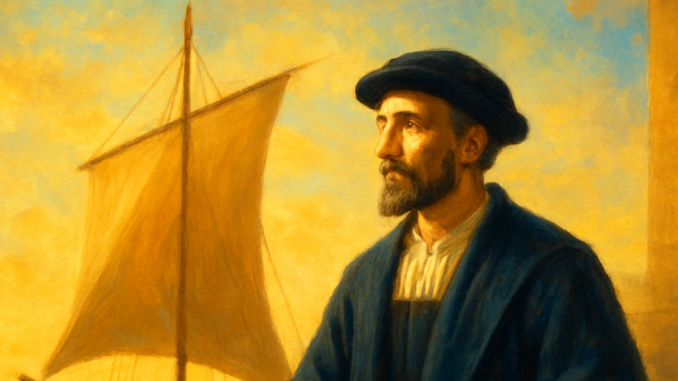
Picture this: you sit down at the table and eat with a knife and fork. You put on shoes before stepping outside. You shake someone’s hand as a greeting. It all feels perfectly natural, as though it couldn’t be any other way. But why? Michel de Montaigne posed exactly this question in his forty-ninth essay of the first book, ‘Of Ancient Customs.’ And he didn’t do so in an intellectual vacuum. Behind his seemingly lighthearted observations lies a deep philosophical framework, nourished by Greek and Roman thinkers, by Renaissance humanism, and by a sharp skepticism that remains directly applicable today — especially for those who walk the path of Freemasonry.
Plutarch as Teacher: Collecting Counterexamples
The most visible influence on this essay is Plutarch, the Greek writer of the first century AD. Montaigne repeatedly called him his favorite author, and in ‘Of Ancient Customs’ that admiration is palpable. In works such as the Moralia, Plutarch gathered countless anecdotes about strange customs among different peoples. Montaigne adopted this method directly: he stacks example upon example — from peoples who went unclothed to communities that consumed their dead — not to shock, but to make a philosophical point. Each counterexample undermines the self-evidence of what we call ‘normal.’
This is no random list. It is a deliberate rhetorical strategy rooted in Plutarch’s conviction that comparison leads to self-knowledge. Whoever knows only their own culture ultimately knows nothing. Insight arises only through contrast. For Freemasons, this resonates deeply: the ritual deliberately places the candidate in unfamiliar situations — not to confuse, but to loosen ingrained assumptions and create space for genuine reflection.
Seneca and the Stoic Undercurrent
Alongside Plutarch, the voice of Seneca, the Roman Stoic, echoes throughout this essay. Seneca constantly warned that the human mind becomes trapped in automatisms. In his Letters to Lucilius, he wrote that most people do not live but are lived — by habit, by expectation, by the opinions of others. Montaigne shares this diagnosis. He shows how customs become so deeply anchored in our thinking that we mistake them for laws of nature, when in reality they are arbitrary conventions.
The Stoic lesson is practical: whoever truly understands their habits gains freedom. Not by abolishing all habits — that would produce chaos — but by choosing them consciously rather than following them blindly. You can apply this principle today. Ask yourself about any daily action: am I doing this because it’s meaningful, or because I’ve always done it this way? That single question, asked consistently, transforms the way you move through life.
Pyrrhonian Skepticism: Doubt as a Tool
The deepest philosophical layer in this essay is skepticism — specifically the Pyrrhonian variety that traces back to the Greek philosopher Pyrrho of Elis. Montaigne had the famous motto ‘Que sais-je?’ (‘What do I know?’) engraved on a beam in his study. In ‘Of Ancient Customs,’ he applies this principle systematically: every certainty about ‘the right way of doing things’ is interrogated, and no answer is given the final word.
This is not nihilism. Montaigne does not reject all values; he simply refuses to elevate one set of values to a universal standard. The tradition of Sextus Empiricus, whose rediscovered works became available again during the Renaissance, gave him the intellectual tools to sustain this position. The result is an attitude of permanent openness: willing to listen, unwilling to pass final judgment.
Customs are not truths; they are agreements we have forgotten to question. Whoever dares to examine them begins to think freely for the first time.
Renaissance Humanism: Rediscovering the Human Being
Montaigne wrote this essay in the second half of the sixteenth century, in the heart of Renaissance humanism. Thinkers like Erasmus and Giovanni Pico della Mirandola had already placed human dignity and individual judgment at center stage. Montaigne went a step further: where Pico della Mirandola celebrated the human being as a creature capable of shaping itself, Montaigne revealed how difficult that self-formation is in practice. Customs are the invisible chains that hinder the process.
Aristotle also plays a role in the background. In the Nicomachean Ethics, Aristotle described how virtue arises through repetition: you become just by performing just actions. Montaigne partially inverts this argument. If good habits can form virtue, then bad habits can just as easily perpetuate vice — without us even noticing. The repetition that Aristotle regarded as beneficial becomes ambiguous in Montaigne’s hands: a force that can build up just as readily as it can numb.
What You Can Do With This Today
The philosophical background of this essay is not merely of academic interest. It offers a concrete program for anyone who wants to live more consciously — and in particular for Freemasons who regard self-examination as a core value. Here are three steps you can apply immediately:
1. Choose one daily habit and ask Pyrrho’s question: do I actually know why I do this? Write down your answer. More often than not, it turns out to be thinner than you expected.
2. Read a passage from Plutarch or Seneca about a custom you find strange. Notice the emotion it evokes: revulsion, curiosity, recognition? That emotion tells you something about your own assumptions.
3. Bring Montaigne’s method into conversation. When someone labels something as ‘normal,’ ask gently: normal for whom? That single question opens doors you didn’t expect.
In Freemasonry, the candidate is invited to leave familiar certainties behind and approach the world with an open mind. Montaigne’s essay provides the philosophical foundation for exactly this practice. The tools he borrowed from Plutarch, Seneca, and Pyrrho are the same tools that every Mason is encouraged to wield: observation, questioning, and the courage to examine what everyone else takes for granted.
Montaigne’s essay on custom is far more than a Renaissance curiosity. It is a living philosophical toolkit — one that invites us to hold our certainties up to the light and ask whether they truly deserve our allegiance. For Freemasons especially, this call to question, reflect, and grow is not an abstract exercise but the very heart of the Craft. The next time something feels ‘perfectly natural,’ pause and ask yourself: is it nature, or is it merely habit? The answer may surprise you — and that surprise is where real understanding begins.
Copyright text & image: devrijmetselaar.nl
Texts are based on the ideas and content of the author of devrijmetselaar.nl, reviewed, corrected, and supplemented with the assistance of OpenAI. Images are created based on the ideas of the author of devrijmetselaar.nl using OpenAI/DALL-E.
Frequently Asked Questions
What is Montaigne's main argument in 'Of Ancient Customs'?
Montaigne argues that customs we consider natural and inevitable are actually arbitrary conventions. By collecting examples of different customs from various cultures — from clothing practices to burial rituals — he demonstrates that what feels 'normal' to us is merely the result of habit and cultural conditioning, not laws of nature. This philosophical insight, influenced by Plutarch and Seneca, reveals that our assumptions about how things 'should be' are largely unfounded.
How does Montaigne use Plutarch's method to develop his philosophy?
Montaigne directly adopted Plutarch's method of gathering counterexamples from different peoples and cultures. Rather than presenting a single argument, he stacks example upon example to undermine the self-evidence of what we consider 'normal.' This rhetorical strategy is rooted in Plutarch's conviction that genuine self-knowledge only arises through contrast and comparison — by understanding how other cultures do things differently, we gain insight into the arbitrary nature of our own customs.
What is the connection between Montaigne's ideas and Freemasonry?
Montaigne's exploration of how customs trap us in automatisms resonates with Masonic practice. Freemasonry deliberately places candidates in unfamiliar ritual situations, not to confuse them but to loosen ingrained assumptions and create space for genuine reflection. Similarly, the Stoic principle that understanding one's habits leads to freedom — choosing them consciously rather than following them blindly — aligns with the Masonic goal of helping individuals achieve self-awareness and conscious transformation through ritualistic experience.

Be the first to comment