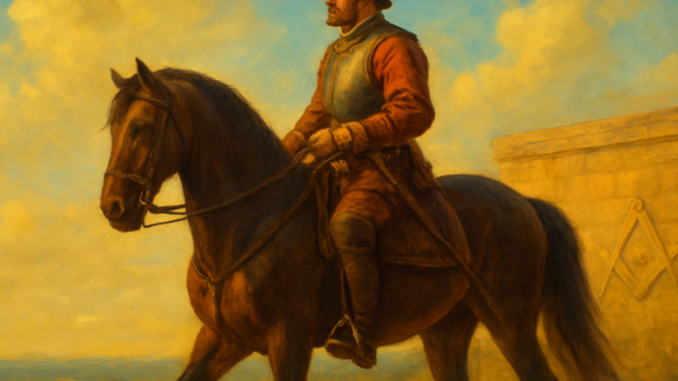
When Michel de Montaigne writes about horses in wartime, it might seem like nothing more than a military-historical curiosity. But place his words alongside the values of Freemasonry, and surprising parallels emerge. Two worlds separated by centuries — the sixteenth-century essay and the brotherhood of builders — turn out to ask strikingly similar questions about loyalty, character, and the courage it takes to truly serve. This article brings both perspectives together and explores what they share.
Montaigne’s World: The Horse as a Mirror of the Rider
In the forty-eighth essay of the first book of his celebrated Essays, Michel de Montaigne turns his attention to the war horse. He describes how princes and generals throughout history regarded their horses not merely as instruments of war, but as extensions of their own character. A horse that holds steady in the chaos of battle reveals something about the rider who trained it. Montaigne draws on classical sources to illustrate his point: he references Julius Caesar, who rode a horse that would tolerate no other rider, and Alexander the Great, whose legendary stallion Bucephalus became synonymous with royal courage.
What truly fascinates Montaigne, however, is not the military achievement itself, but the relationship between man and animal. A great war horse is not the one that obeys most readily, but the one that cooperates with its rider out of trust. The rider who governs only through force loses the horse at the very moment it matters most. In this observation, Montaigne sees a broader human pattern: genuine connection arises not through subjugation, but through mutual respect and patiently built trust.
The Freemason’s World: Connection as Foundation
Freemasonry has no war horses, but it knows well the principle of connection as a sustaining force. In the lodge, brethren work together on their own inner construction — not through blind obedience to a master, but through voluntary dedication to shared values. Brotherhood in Freemasonry is not a hierarchical obligation; it is a conscious choice to recognize the other as a fellow seeker on the path toward truth and light.
The rituals of Freemasonry reinforce this time and again. At every meeting, the brother is reminded of the importance of trust, of working on the rough stone of his own character, and of his bond with his fellow brethren. Just as the mason’s tools only become meaningful in the hands of a craftsman who cooperates with others, so too does the individual pursuit of virtue gain its true significance within a community of like-minded seekers.
Two Perspectives, One Core Conviction
At first glance, the sixteenth-century battlefield and the stillness of the lodge seem like incomparable worlds. Yet Montaigne and Freemasonry meet in a shared core conviction: lasting connection is always rooted in inner quality, never in outward display. Montaigne describes how certain princes adorned their horses with gilded bridles and impressive armor, only to watch those same animals bolt at the first cannon shot. It was not the decoration that counted, but the character of the animal and the bond it shared with its rider.
Any Freemason will recognize this immediately. The lodge is not a place of outward show but of inner work. The wearing of the apron — the simplest garment of the mason — serves as a reminder that true dignity does not reside in titles or decorations, but in the sincerity with which a person commits to his own growth and to his community. Both Montaigne and Freemasonry distrust the façade and seek what lies beneath it.
Real connection — whether between rider and horse or between brethren in a lodge — is never born of force or spectacle. It grows from the quiet strength of trust and shared character.
Loyalty and Virtue: From the Battlefield to the Temple
Montaigne emphasizes in his essay that a horse’s loyalty is never a given. It must be earned. He references the Roman historian Pliny the Elder, who recorded how certain horses refused to accept another master after the death of their rider. This kind of loyalty, Montaigne suggests, transcends mere animal instinct. It carries something noble within it — a form of devotion that speaks to something deeper in the nature of bonds.
Freemasonry speaks in remarkably similar terms about loyalty. The legend of Hiram Abiff, the master builder of King Solomon’s Temple, revolves around a single question: will you remain faithful to your values even when the pressure becomes unbearable? Hiram Abiff refused to surrender the secrets of his craft, even at the cost of his own life. That steadfastness is no different from the loyalty Montaigne admires in the noblest war horses — a loyalty that does not waver when the stakes are highest.
Shared Values Across the Centuries
It is remarkable how closely the themes in Montaigne’s essay resonate with the core values of Freemasonry. Both traditions emphasize self-reflection as a prerequisite for genuine connection with others. Both place virtue above display, holding that inner quality outweighs outward splendor. Both understand loyalty as a conscious choice, not an imposed duty. And both share the conviction that character is forged in trial, not in comfort.
These are not superficial similarities. They point to a deep human truth that transcends time and context. Whether expressed through the metaphor of a war horse standing firm amid cannon fire or through the symbol of a rough stone being shaped into something worthy, the underlying message is the same: what you are on the inside determines the quality of every relationship you build on the outside.
What This Teaches Us
The comparison between Montaigne’s world and that of Freemasonry teaches us something essential: the question of authentic connection is timeless. Whether it concerns a rider who must trust his horse in the heat of battle, or a brother who makes himself vulnerable in the lodge, it always comes down to the same choice. Do you reach for the superficial, the quick, the impressive? Or do you dare to invest in the slow, sometimes invisible work of genuine trust?
Montaigne would likely have felt at home in a lodge. His entire life’s work revolves around the very question that every Freemason asks himself at each meeting: who am I truly, beneath all the layers the world has placed upon me — and how can I become more worthy of the trust that others place in me?
Across the centuries, from Montaigne’s study in sixteenth-century France to the lodges of the modern world, the same truth echoes: real strength lies not in show or force, but in the quiet, patient cultivation of character, trust, and loyalty. Whether we find that truth reflected in the eyes of a steadfast war horse or in the handshake of a brother, the lesson is the same — and it remains as vital today as it ever was.
Copyright text & image: devrijmetselaar.nl
Texts are based on the ideas and content of the author of devrijmetselaar.nl, reviewed, corrected, and supplemented with the assistance of OpenAI. Images are created based on the ideas of the author of devrijmetselaar.nl using OpenAI/DALL-E.
Frequently Asked Questions
What is the connection between Montaigne's writings on war horses and Freemasonry?
Montaigne's essay on war horses emphasizes the importance of trust and mutual respect between rider and horse, rather than domination through force. This principle parallels Freemasonry's core values, where brotherhood is built on voluntary dedication to shared values and conscious recognition of fellow seekers, not blind obedience or hierarchical obligation.
What does Montaigne mean when he says a great war horse is one that cooperates out of trust?
Montaigne argues that a rider who governs a horse only through force will lose the horse's loyalty at the crucial moment in battle. True connection comes from patiently built trust and mutual respect. A horse that cooperates willingly reveals something about the character and leadership of the rider who trained it, illustrating a broader human truth about genuine relationships.
How does Freemasonry apply the principle of trust and cooperation in its practice?
Freemasonry applies this principle through its rituals and lodge work, where brethren voluntarily dedicate themselves to shared values and work together on their inner development. Rather than blind obedience to authority, Freemasons cooperate as fellow seekers on a path toward truth and light, with each member's tools and efforts becoming meaningful only through cooperation with others.

Be the first to comment