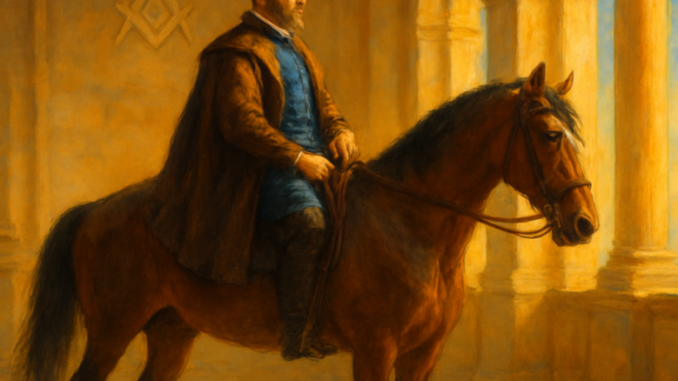
In an age when war shaped every facet of political life, Michel de Montaigne turned his penetrating gaze toward an unexpected subject: the horse. In Essay 48 of Book One of his famous Essays, titled ‘On War Horses,’ he examines the role of the mount in battle, the extravagance of princes, and the vanity that can lurk behind military splendor. What initially reads as a catalog of historical anecdotes gradually reveals a deeper meditation on appearance versus reality — on outward display versus inner worth. For those who walk the path of Freemasonry, these reflections carry a remarkably familiar ring.
The Heart of the Essay: Splendor as a Mirror of Character
Montaigne opens his essay by observing how much importance great military commanders and rulers placed on their horses. The horse was far more than a means of transport — it was a status symbol, an extension of the rider, and sometimes the very difference between life and death on the battlefield. He describes how generals such as Julius Caesar and Alexander the Great formed near-mythical bonds with their mounts. Bucephalus, Alexander’s legendary horse, occupies a prominent place in the discussion. Montaigne notes that Alexander even named a city after the animal — a gesture that transcended any military necessity.
Yet Montaigne’s purpose is not merely to glorify horses. He uses these examples to make a broader point: the way people display their strength, wealth, and status reveals much about their inner character. Some commanders deliberately chose simplicity, while others draped themselves in excess. The horse becomes a lens through which Montaigne places human vanity and virtue side by side, inviting the reader to judge which quality truly defines greatness.
Historical Examples: From Caesar to the Ottoman Sultans
Montaigne draws generously from classical antiquity and from his own era. He references Julius Caesar’s writings about the Gauls, who would dismount and fight on foot when circumstances demanded it, using the horse as a means of retreat rather than attack. He also discusses the practices of the Mamluks — the warrior caste of Egypt — and the habits of Ottoman sultans, who spent enormous sums maintaining their stables.
These examples are not chosen at random. By placing different civilizations alongside one another, Montaigne reveals how various cultures approached the same fundamental dynamic: the relationship between human and animal, between power and service. Each culture projected its values onto the horse, turning it into a symbol that said far more about the rider than about the beast itself.
Particularly striking is his reference to the Roman custom of decorating horses with military honors, as if the animal itself were a soldier. Montaigne sees in this a form of human projection: we bestow honor on the instrument, when the true courage should belong to the one who wields it. Or should it? Montaigne deliberately leaves the question open — a rhetorical strategy perfectly suited to a thinker who made doubt itself a philosophical method.
Two Worlds: The Knight and the Freemason
It is fascinating to place Montaigne’s reflections alongside the perspective of Freemasonry. At first glance, the medieval knight and the Freemason seem to have little in common. The knight seeks honor on the battlefield, surrounded by weapons and warhorses. The Freemason seeks enlightenment within the lodge, surrounded by ritual tools. Yet they share a fundamental conviction: outward display without inner growth is hollow.
In the chivalric tradition, the horse was a mark of rank, but the true knight was judged by his conduct, his loyalty, and his courage. In Freemasonry, ritual objects function in a remarkably similar way. The square, the compasses, and the rough ashlar are not ends in themselves. They point to something beyond: the ongoing work of shaping one’s own character. Montaigne would undoubtedly have recognized this parallel. His essay implicitly warns against confusing the tool with the craftsman, the exterior with the interior.
The horse carries the rider, but it is the rider who chooses the direction. In the same way, rituals and working tools carry the seeking individual, but it is the inner will that gives meaning to the journey. This insight lies at the heart of both Montaigne’s philosophy and the Masonic tradition.
What Both Worlds Share: The Lesson of Simplicity
Montaigne observes that some of history’s greatest commanders deliberately chose plain horses and simple equipment. They understood that true authority does not reside in gold and ornamentation but in competence and character. This principle resonates deeply within Freemasonry, where brethren come together as equals regardless of their social standing. The apron that every Freemason wears is deliberately simple. It is not a sign of wealth or rank but of labor and dedication.
Both in Montaigne’s world and within the lodge, the same truth holds: whoever hides behind outward grandeur misses the point. The Greek philosopher Plato wrote that the soul is the true vehicle of the human being, not the body. Marcus Aurelius, the Roman emperor and Stoic philosopher, similarly warned against attachment to material glitter. Montaigne consciously places himself within this tradition when he contrasts the lavish stables of princes with the functional sobriety of seasoned warriors.
For the Freemason, this lesson is woven into the very fabric of lodge life. The beauty of the ritual lies not in its outward form but in the transformation it brings about in the one who experiences it. Elaborate regalia, impressive lodge rooms, and polished ceremony are meaningful only when they serve the deeper purpose of moral and spiritual development.
The Lasting Relevance of Montaigne’s Perspective
While war horses may seem like a purely historical subject today, the underlying message remains powerfully alive. We live in a world where outward display — from social media profiles to brand worship — often receives far more attention than inner development. Montaigne reminds us that tools, status symbols, and appearances only acquire true value when they are carried by someone of depth and integrity.
For the Freemason, this is a familiar thought. The ritual in the lodge is not an end in itself but a path toward self-knowledge. The working tools are not decorations but instruments of transformation. And the apron, in its deliberate simplicity, stands as a constant reminder that what matters most cannot be seen with the eyes alone.
Montaigne’s essay on war horses is ultimately not an essay about horses at all. It is a meditation on what we choose to value — and whether those values reflect who we truly are or merely who we wish to appear to be. In an age of relentless image-crafting, that question has never been more urgent.
Montaigne’s brief essay on war horses offers a timeless challenge that speaks directly to the heart of Masonic philosophy: look beyond the trappings to find the truth. Whether it is a knight’s warhorse or a Freemason’s working tools, the outward symbol only matters when it reflects genuine inner work. In the end, it is not the brilliance of the instrument that defines us but the quality of the hand — and the character — that guides it. That is a lesson worth carrying from the battlefield to the lodge, and from the lodge into everyday life.
Copyright text & image: devrijmetselaar.nl
Texts are based on the ideas and content of the author of devrijmetselaar.nl, reviewed, corrected, and supplemented with the assistance of OpenAI. Images are created based on the ideas of the author of devrijmetselaar.nl using OpenAI/DALL-E.
Frequently Asked Questions
What is the main thesis of Montaigne's 'On War Horses' essay?
Montaigne uses the horse as a lens to examine the contrast between appearance and reality, arguing that the way military commanders displayed their strength, wealth, and status through their mounts revealed much about their inner character. The essay explores how some leaders chose simplicity while others indulged in excess, ultimately judging which quality truly defines greatness.
Why are Montaigne's reflections on war horses considered relevant to Freemasonry?
Montaigne's meditation on substance over show, inner worth versus outward display, and the true nature of character aligns with Masonic principles that emphasize introspection, moral virtue, and the importance of internal development over external vanity and status symbols.
What historical examples does Montaigne use to support his arguments about war horses?
Montaigne draws from classical antiquity and his own era, including Julius Caesar's accounts of the Gauls, Alexander the Great's legendary bond with Bucephalus (whom Alexander honored by naming a city after), the practices of the Mamluks warrior caste, and the habits of Ottoman sultans who spent enormous sums maintaining their stables.

Be the first to comment