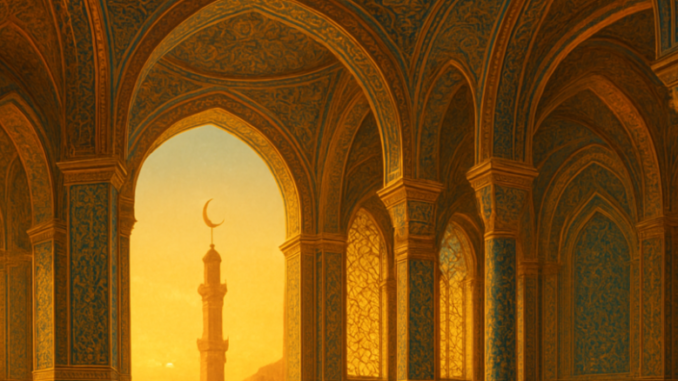
Somewhere in seventh-century Mecca, words rang out that struck listeners to their very core. Verses about the end of times, about bones reassembled, about a soul calling itself to account. These verses form the seventy-fifth chapter of the Quran, known in Arabic as Al-Qiyamah — The Resurrection. It is a text that has left a profound impression not only within Islam but also raises questions that any sincere seeker of truth will recognize. For Freemasons, who place the inner journey and moral growth at the center of their practice, this chapter offers surprisingly familiar points of connection.
A Historical Shock in Mecca
When the Prophet Muhammad recited this chapter during the early period of his mission, the Arabian Peninsula was a world defined by tribal allegiances, trade caravans, and a multitude of religious practices. The idea of a bodily resurrection after death was difficult for many Meccans to accept. The chapter opens accordingly with a powerful oath: “I swear by the Day of Resurrection.” Immediately after comes a second, less expected oath: “And I swear by the self-reproaching soul.”
That second oath is remarkable. Amid cosmic imagery of the end of days, the text suddenly turns inward — toward the human conscience. It is as though the chapter is saying: the true resurrection does not begin with the destruction of the world, but with the awakening of the soul that dares to question itself.
This inward turn was radical in the context of seventh-century Arabia. The Meccan elite measured wealth and prestige by outward display. The chapter shatters that pattern by confronting the individual with a deeper form of accountability — not before the tribe, but before one’s own conscience and before a higher reality.
The Self-Reproaching Soul as Mirror
The Arabic term used here refers to a soul that continually calls itself to account. Islamic scholars throughout the centuries — from early Quran commentators to later mystics — have regarded this concept as the conscience in its most active form. This is not guilt that paralyzes, but honest self-reflection that leads to growth. The medieval Persian poet Rumi, who lived in the thirteenth century and was deeply influenced by Quranic themes, wrote extensively about this process of inner purification. He compared the soul to a rough stone that is polished into a jewel through trials and tribulation.
The resurrection that Surah 75 speaks of is not merely a cosmic event, but a daily invitation: dare to question yourself before life does it for you.
In Freemasonry, we recognize this process in the work on the rough stone — the rough ashlar. Every Freemason is invited to work upon themselves, not as punishment but as a privilege. The rough ashlar is not a condemnation of who you are; it is an acknowledgment that growth is possible. The self-reproaching soul in this chapter functions in precisely the same way: not as a prosecutor, but as a compass.
From Cosmic Vision to Personal Practice
The chapter describes vivid imagery: the sun and moon joined together, eyes dazzled, a human crying out for escape. These eschatological passages have a rich history of interpretation within Islamic tradition. But alongside the literal reading, there exists an inner reading that has been strongly developed within the Sufi tradition. The Andalusian mystic Ibn Arabi, who lived in the twelfth and thirteenth centuries, emphasized that every Quranic description of the end times can also be read as a description of spiritual transformation in the here and now. The destruction of the old world becomes the release of ego and habit. The reassembling of bones becomes the recovery of inner coherence.
This approach closely parallels how rituals function in Freemasonry. When a candidate enters the lodge, he undergoes a symbolic death and rebirth. The old self is left behind and a new consciousness is kindled. This is not a theological claim but an experience-based practice that brethren of all backgrounds and beliefs can recognize. Resurrection, in this sense, is not something that happens to you — it is something you undergo when you summon the courage to look honestly in the mirror.
Seeking Light in Dark Moments
One of the most powerful verses in this chapter describes the moment when a person realizes there is no escape from their own truth. “On that day, the human being will be told what he sent forth and what he left behind,” the text reads. This evokes the image of a life’s balance sheet — a moment of ultimate honesty. In Western philosophical tradition, we find related ideas in Socrates, who according to Plato stated that the unexamined life is not worth living. Montaigne, too, wrote about the importance of self-knowledge as the foundation for an authentic life.
For Freemasons, this life balance is no abstract concept. In ritual practice, brethren are regularly invited to reflect upon their actions and their intentions. The plumb line, the moment of contemplation, working in silence — these are all forms of the same self-examination that the chapter so powerfully describes. The aim is never condemnation, but the honest desire to grow.
What This Chapter Has to Say to Us Today
In an age when distraction is available everywhere and self-reflection is sometimes experienced as uncomfortable, Surah 75 offers a clear counterweight. The text reminds us that accountability is not something that can be postponed to some distant future. The conscience speaks now — in every choice we make, in every word we speak. Whether you are Muslim, Christian, Jewish, humanist, or follow any other path of thought, the call of the self-reproaching soul is universal.
Freemasonry has always drawn wisdom from diverse traditions — philosophical, spiritual, and cultural. It does not claim ownership of any single truth but seeks the threads of meaning that connect sincere seekers across boundaries of faith and culture. Surah 75 is a striking example of how a text rooted in one specific tradition can illuminate themes that are central to the Masonic journey: the confrontation with one’s own imperfections, the courage to change, and the faith that transformation — resurrection, rebirth — is always possible.
The rough ashlar does not become a perfect cube by itself. It requires intention, effort, and above all the willingness to see oneself clearly. That is the deeper message of this ancient chapter, and it is a message that resonates as strongly in the lodge as it does in the quiet of personal reflection.
The Resurrection described in Surah 75 is, at its deepest level, not merely about the end of the world — it is about the beginning of a new awareness within each of us. For Freemasons, this resonates with the very heart of the Craft: the conviction that every human being carries within them the potential for transformation. The self-reproaching soul is not our enemy; it is our most faithful guide on the path from darkness to light. In daring to confront ourselves with honesty and humility, we do not merely study the concept of resurrection — we live it.
Copyright text & image: devrijmetselaar.nl
Texts are based on the ideas and content of the author of devrijmetselaar.nl, reviewed, corrected, and supplemented with the assistance of OpenAI. Images are created based on the ideas of the author of devrijmetselaar.nl using OpenAI/DALL-E.
Frequently Asked Questions
What is Al-Qiyamah and why is it significant?
Al-Qiyamah is the seventy-fifth chapter of the Quran, also known as 'The Resurrection.' It was recited by Prophet Muhammad in seventh-century Mecca and contains verses about the end of times, reassembled bones, and spiritual accountability. It is significant because it addresses not only physical resurrection but also emphasizes inner spiritual awakening and self-accountability, concepts that remain profoundly relevant today.
What does 'the self-reproaching soul' mean in the context of this chapter?
The self-reproaching soul refers to an active conscience that continually calls itself to account. Rather than paralyzing guilt, it represents honest self-reflection that leads to personal growth and moral development. Islamic scholars and mystics have interpreted this as the conscience in its most powerful form, inviting individuals to engage in continuous inner purification and questioning.
How does this Quranic concept relate to personal transformation?
Surah 75 presents resurrection not merely as a cosmic future event, but as a daily invitation to inner rebirth and self-examination. The chapter challenges individuals to look beyond outward displays and material concerns, instead confronting them with deeper accountability before their own conscience and a higher reality. This process of questioning and purification mirrors the spiritual journey that many traditions, including Freemasonry, place at the center of their practice.

Be the first to comment