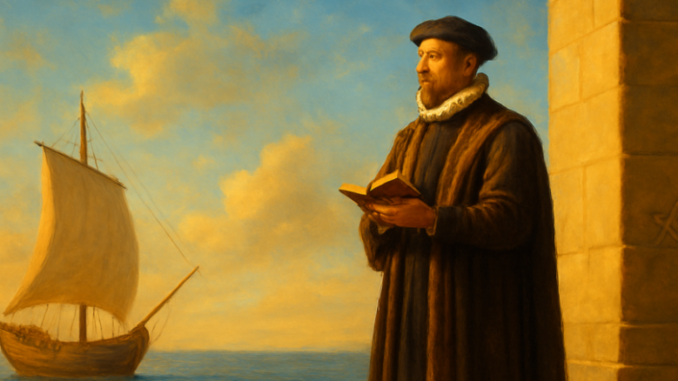
You have probably experienced it: you feel absolutely certain about something, only for someone to offer a different perspective that makes the ground beneath your feet feel suddenly less solid. That moment of wavering certainty is exactly the territory Michel de Montaigne explores in his essay ‘On the Uncertainty of Our Judgment.’ It is a text that invites you to confront an uncomfortable question — one that resonates deeply with anyone on the Masonic path of self-improvement: how reliable is what you think you know?
What Is This Essay About?
In the forty-seventh essay of the first book of his celebrated Essais, Michel de Montaigne investigates a theme that occupied him throughout his entire writing life: the fallibility of human judgment. He argues that we, as human beings, rush to conclusions far too quickly, while reality is almost always more complex than our first impressions suggest. In this particular essay, Montaigne focuses primarily on decisions made in times of conflict and war, but his message reaches far beyond the battlefield. Whether it concerns military strategy, a personal choice, or a moral dilemma, our ability to predict the outcome of events is fundamentally limited.
The Battlefield as a Mirror of Our Uncertainty
Montaigne illustrates his argument with a series of examples drawn from military history. He references the Roman general and consul Publius Aemilius Paullus and the martial lessons of Julius Caesar, both of whom he considered lifelong intellectual companions. The central point he makes through these examples is surprisingly simple: even the most brilliant strategists have been wrong time and again. An army on the brink of defeat could, through an unexpected turn of events, emerge victorious. A commander who appeared to be doing everything right could be undone by an unforeseen circumstance.
The lesson? Success is not proof of good judgment, and failure is not proof of bad judgment. The outcome of a decision tells you remarkably little about its quality. This is a thought you may recognize from your own life. How many times have you made a choice that turned out well, even though at the time you barely knew what you were doing? And how often has a carefully considered decision gone wrong? Montaigne forces you to be honest about that randomness and to admit that fortune, chance, and unforeseen circumstances play a far greater role than our egos would like to acknowledge.
The Core Idea: Humility Before the Unknown
The thread running through this essay is a plea for intellectual humility. Montaigne places himself within a philosophical tradition stretching back to the Greek skeptics, particularly Pyrrho of Elis and Sextus Empiricus, who fundamentally questioned the human capacity for knowledge. But where the ancient skeptics sometimes tended toward a paralysis of judgment, Montaigne is more practical. He does not say you should never make a decision. What he does say is that you should not confuse the outcome of that decision with the wisdom behind it. That distinction is subtle but crucial.
The uncertainty of our judgment is not a weakness to be overcome, but a truth that invites us toward humility and continuous self-examination. For Freemasons, this idea carries a particular resonance. The Masonic tradition places self-knowledge and the honest assessment of one’s own limitations at the very heart of the Craft. The rough ashlar is not perfected in a single stroke; it requires ongoing work, ongoing reflection, and the willingness to admit that our perspective is always incomplete.
Montaigne also cites the Roman philosopher and statesman Seneca, who likewise warned against the tendency to construct wisdom in hindsight where, in the moment, there was only uncertainty. It is a deeply human habit to see patterns where randomness reigns, and to justify our actions with knowledge we only acquired after the fact. Montaigne punctures that illusion with a blend of humor and seriousness that is characteristic of his style.
What This Essay Has to Say to You Personally
You could read this essay as a historical document about the art of war, but that would do it a disservice. The power of Montaigne’s writing lies precisely in how he elevates the specific to the universal. If our judgment is already unreliable on the battlefield — where the stakes are literally life and death — how much more uncertain must it be in daily life, where the information we have is even more incomplete?
Ask yourself honestly: when did you last revise your opinion about someone? When did you admit that your first impression was wrong? Montaigne would say that such moments are not signs of weakness but evidence of a sharper mind. The ability to suspend judgment, to doubt before you decide, is for him a form of wisdom that most people would rather avoid. In the lodge, we practice exactly this: listening to a Brother’s perspective that challenges our own, sitting with discomfort rather than reaching for easy certainty, and recognizing that the work of self-improvement never truly ends.
Doubt as a Method, Not a Paralysis
What makes this essay so timeless is that Montaigne does not present doubt as an obstacle but as a method. He invites you to look critically at the foundations of your own convictions — not in order to believe in nothing, but to believe more consciously. Not to stop making choices, but to make your choices with an open awareness of what you cannot know. This attitude resonates strongly with the philosophical tradition of self-knowledge found in thinkers like Socrates, whose famous declaration ‘I know that I know nothing’ echoes throughout Montaigne’s entire body of work.
For Freemasons, this method of constructive doubt is not abstract philosophy — it is lived practice. Every degree, every symbol, every moment of reflection in the lodge is designed to remind us that certainty is often an illusion and that true wisdom begins with acknowledging the limits of what we understand. The square and compasses teach us to measure ourselves honestly, not to construct flattering narratives about our own infallibility.
Montaigne does not close his essay with a definitive answer or a tidy conclusion. That is entirely in keeping with his method: the essay itself is an exercise in the very uncertainty it describes. He leaves you with questions rather than answers, and that is precisely the point. For if there is one thing Michel de Montaigne wants you to take away, it is this: the ability to live with uncertainty is not a sign of ignorance but of maturity.
‘On the Uncertainty of Our Judgment’ is one of Montaigne’s most accessible yet most challenging texts. It touches something every person recognizes: the discomfort of not knowing, the temptation of false certainty, and the courage required to be honest about the limits of our own understanding. For those walking the Masonic path, this essay serves as a powerful reminder that the pursuit of Light is not about arriving at final answers — it is about cultivating the humility, the patience, and the intellectual honesty to keep asking better questions.
Copyright text & image: devrijmetselaar.nl
Texts are based on the ideas and content of the author of devrijmetselaar.nl, reviewed, corrected, and supplemented with the assistance of OpenAI. Images are created based on the ideas of the author of devrijmetselaar.nl using OpenAI/DALL-E.
Frequently Asked Questions
What is the main argument of Montaigne's essay 'On the Uncertainty of Our Judgment'?
Montaigne argues that human judgment is fundamentally fallible and unreliable. He contends that people rush to conclusions too quickly while reality is far more complex than first impressions suggest. Using military history examples, he demonstrates that even brilliant strategists are frequently wrong, and that success or failure is not a reliable measure of the quality of a decision, as fortune and unforeseen circumstances play a greater role than we acknowledge.
Why does Montaigne use military examples to illustrate his point about uncertainty?
Montaigne uses military history and examples from generals like Publius Aemilius Paullus and Julius Caesar because warfare provides clear-cut examples of how outcomes can be unpredictable. He shows that armies on the brink of defeat can emerge victorious through unexpected turns of events, and commanders following seemingly perfect strategies can be undone by unforeseen circumstances. These examples effectively demonstrate that even in high-stakes situations where careful judgment is critical, the results often defy prediction.
How does Montaigne's essay relate to the Masonic path of self-improvement?
The essay invites readers on the Masonic journey to confront an uncomfortable question about the reliability of their own knowledge and judgment. By acknowledging the limits of human certainty and the role of chance, Montaigne's work encourages the kind of intellectual humility and honest self-assessment that is central to Masonic self-improvement. It teaches that wisdom involves recognizing what we don't know rather than being overconfident in our judgments.


Be the first to comment