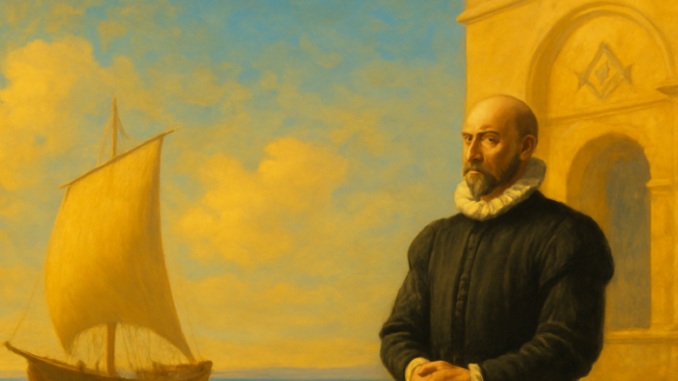
A name seems like the most natural thing in the world. We carry one from birth, sign it beneath contracts, and have it carved into gravestones. But what is a name, really? Is it merely a label — an arbitrary sound attached to a person? Or does a name carry something deeper: a promise, a destiny, a hidden meaning? Michel de Montaigne poses exactly these questions in his short but remarkably rich essay “On Names,” the forty-sixth essay from the first book of his famous Essais. What he uncovers touches on something that also plays a central role in Freemasonry: the tension between the outward sign and the inner reality.
Names Are Less Self-Evident Than We Think
Montaigne opens his essay with a deceptively simple observation: there are only a limited number of first names and surnames in existence, and yet we insist on drawing personal meaning from them. He notes that names are recycled across centuries — borrowed, distorted, forgotten, and rediscovered. A name that carries glory in one generation can become entirely meaningless in the next. This leads Montaigne to a fundamental question: if names are so changeable and accidental, why do we attach so much importance to them?
The essay is vintage Montaigne in style. He meanders from anecdote to philosophical reflection, from historical example to personal musing. There is no rigid argumentative structure, but that very looseness is precisely what makes his thinking so accessible and inviting. He does not ask the reader to accept a conclusion — he asks the reader to think alongside him.
Historical Examples: Names as Trophies, Vanity, and Confusion
Montaigne draws generously from classical antiquity and his own era to illustrate his point. He refers, among other things, to the Roman custom of attaching names to military victories or conquered territories. Generals such as Publius Cornelius Scipio received the surname “Africanus” after their campaigns. The name became a trophy — a symbol of power. But Montaigne wonders: does such a name truly say anything about the person, or only about an event that happened to be associated with him?
He also discusses how families lose their name through marriage or adoption, and how entire lineages can vanish from history. The name of a noble house can die out within a few generations, while the name of a humble writer may still be spoken centuries later. Montaigne further examines examples from the French aristocracy of his own time, where family names were traded, merged, or altered for political reasons. The name, it turns out, is more of a social instrument than a fixed identity.
Several recurring themes emerge from his examples. Names as trophies: Roman generals adopting the names of conquered lands. Names as impermanence: noble families whose names simply died out. Names as confusion: the persistent problem of people sharing the same name in historical records. And names as vanity: the deeply human urge to pursue immortality through a name.
The Name as a Veil: Surface and Hidden Depth
What makes this essay so fascinating is how Montaigne uses an everyday phenomenon — the name — to expose a deeper philosophical layer. A name functions as a surface: it points toward something, but it is not that something itself. You can know someone’s name without knowing the first thing about who they truly are. Conversely, you can know someone profoundly without ever having heard their name. Montaigne touches here on an insight already formulated by Plato in his dialogue Cratylus: the relationship between a word and the thing it refers to is inherently problematic and never complete.
For Montaigne, the name is ultimately an invitation to humility. We are more than our name, and at the same time less than what our name suggests. The name is a mask we wear in the social world — a marker that others use to place us. But behind that mask lives a person who is constantly in motion: changing, doubting, growing. That tension between the fixed label and the flowing reality beneath it is precisely what Montaigne captures with such mastery.
A name is the thinnest layer of identity: it refers to what we are called, but remains silent about who we are.
The Masonic Dimension: The Word Behind the Word
Anyone familiar with Freemasonry will recognize in Montaigne’s reflections a theme that occupies a central place in the lodge. In Masonic ritual, words, names, and designations play a distinctive role. There are words that may only be spoken at specific moments, and names that refer to ancient traditions and narratives — such as that of the legendary master builder Hiram Abiff. But in the lodge, the point is never the word itself. The point is what the word represents: an inner attitude, a moral aspiration, a connection with something greater than the individual.
Like Montaigne, Freemasons understand that the outward sign — whether it is a name, a word, or a gesture — is merely a gateway. The real meaning does not reside in the sound or the letters, but in the lived experience concealed behind them. When a Freemason receives a new word during a ritual, it is not a fact to memorize. It is an invitation to look deeper — beyond the surface, beyond the name, toward the essence of what it means to be human.
This parallel between Montaigne’s philosophy and Masonic practice is striking. Both traditions insist that symbols, names, and words are tools for inner work — never ends in themselves. The word is a door, not a room. The name is a map, not the territory. And the search for meaning requires moving past the label toward the living reality it represents.
What This Essay Means for the Modern Reader
In an age of personal branding, online profiles, and reputation management, Montaigne’s essay is surprisingly timely. We live in a world where names, titles, and labels seem to carry more weight than ever before. A job title on a social network can open or close doors. A surname can confer privilege or invite prejudice. Montaigne reminds us that all of this is surface. The real question is not what we are called, but who we are beneath the label.
For anyone on a path of self-knowledge — whether inside or outside the lodge — this essay is a quiet but powerful provocation. It asks us to examine the names and titles we cling to, the identities we construct around words, and to wonder honestly: how much of what I present to the world is truly me, and how much is merely a name?
Montaigne does not provide a definitive answer, and that is precisely his genius. He leaves us with the question — and the freedom to explore it for ourselves. In that spirit, he is very much a kindred soul to the Masonic tradition, which holds that the most important truths are not told but discovered through personal experience and reflection.
Montaigne’s essay “On Names” may be brief, but its implications run deep. By examining something as seemingly trivial as a name, he opens a door to questions about identity, impermanence, and the gap between appearance and reality. For Freemasons, his reflections resonate with the understanding that every symbol, every word, and every ritual gesture is an invitation — not to stop at the sign, but to seek what lies beyond it. In the end, the most meaningful work is not carving a name into stone, but shaping the character that no name can fully contain.
Copyright text & image: devrijmetselaar.nl
Texts are based on the ideas and content of the author of devrijmetselaar.nl, reviewed, corrected, and supplemented with the assistance of OpenAI. Images are created based on the ideas of the author of devrijmetselaar.nl using OpenAI/DALL-E.

Be the first to comment