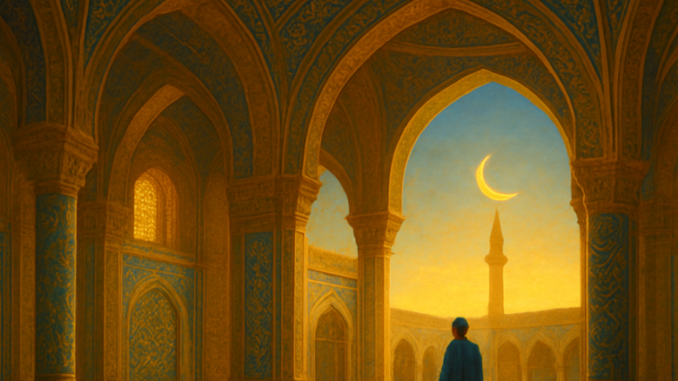
Imagine someone huddled beneath a blanket, overwhelmed by what they have just experienced. Their body is warm and sheltered, but their mind wrestles with a calling far greater than themselves. Then a voice speaks: rise. Cast off what covers you. Go out and share what you know. It is an image that resonates across every age and tradition. In the sixty-fourth surah of the Quran, known as Al-Muddaththir — The Cloaked One — this universal moment of hesitation and courage is rendered with extraordinary power. And it echoes, perhaps surprisingly, the inner journey that every Freemason undertakes.
The Cloak as Refuge
A cloak, a blanket, a covering. In everyday life it is the most ordinary of objects — protection from the cold, a cocoon of safety. But look deeper and you will find that the cloak carries profound meaning in virtually every spiritual tradition. According to Islamic tradition, the Prophet withdrew beneath his garment after receiving an overwhelming revelation. He was literally cloaked — covered, hidden from the outside world. That cloak was not merely fabric. It was the boundary between the known and the unknown, between inner trembling and the waiting world beyond.
Freemasonry knows a strikingly similar moment. The candidate entering the lodge for the first time is blindfolded. He sees nothing, gropes in the dark, cloaked as it were by his own ignorance. That moment of blindness is not a humiliation — it is an invitation. It marks the point at which a person acknowledges that there is something he does not yet see, does not yet understand, and that he is willing to lay down the cloak of complacency.
The Call to Rise
At the heart of this surah lies an imperative command. The cloaked one is not comforted or left in peace. On the contrary: he is called to rise, to warn, to magnify his Lord, and to purify his garments. That last instruction is not hygienic advice — it is a deep metaphor for inner purification. The fourteenth-century Arab scholar Ibn Kathir read in these verses a summons to moral and spiritual preparation: you cannot step out into the world until you are inwardly clear.
Aristotle described a comparable principle in his Nicomachean Ethics: virtue is not a condition that simply befalls you, but an attitude you must actively choose and practice. Freemasonry shares this conviction. The ritual is not a passive spectacle but an act that calls on the participant to rise of his own accord, to take responsibility, to work on his own rough stone. No one can do that for another.
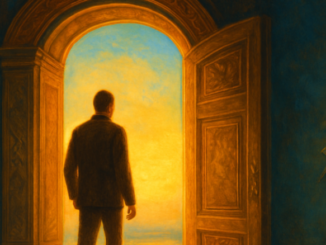
Casting off the cloak is the beginning of every spiritual journey — the moment you decide to stop hiding from the light and instead walk toward it.
Purification as Preparation for the Light
The surah speaks of cleansing garments and avoiding impurity. In the Islamic tradition, this carries both an outward and an inward dimension. The believer prepares for prayer through ritual ablution, but the act simultaneously points to purifying the soul. The water does not merely wash dust from the skin — it serves as a reminder to free the heart from pride, greed, and self-deception.
In Freemasonry, this idea is immediately recognizable in the concept of the rough ashlar. Every brother receives at his initiation the charge to work on himself — to recognize his imperfections and smooth them away, step by patient step. Just as the stonemason transforms a rough block into a usable stone with patience and precision, the Freemason works on his character. It is not a one-time act but a continuous process. Marcus Aurelius, the Roman emperor and Stoic philosopher, wrote in his Meditations that each morning a person must resolve anew to be just and good. That daily choice is itself a form of purification.
Warning as an Act of Brotherhood
A striking element in Al-Muddaththir is the command to warn. In the Islamic context, this refers to the prophetic duty of reminding fellow human beings of their responsibility toward the divine. But beyond that specific faith tradition, the command carries universal weight. Warning, here, is not threatening. It is an act of care, of engagement, of refusing to leave your fellow human being in ignorance.
Freemasonry has no missionary zeal and no dogma to impose on others. But it does uphold the ideal of brotherly admonition — the willingness to gently draw a brother’s attention to his blind spots, not from a place of superiority, but from genuine connection. Voltaire, himself a Freemason, stressed the importance of tolerance and dialogue. He saw in open conversation the key to a civilized society. The warning in this surah can be read in that light as a call to honest, loving communication.
Parallels in Ritual
It is remarkable how many spiritual traditions share the image of a figure moving from darkness into light. In the Quran, it is the cloaked one who rises and steps outside. In Freemasonry, it is the candidate who loses his blindfold and receives the light of the lodge. In the Gnostic tradition, it is the soul awakening from the slumber of matter. Plato described, in his Allegory of the Cave, a prisoner who turns around and sees real light for the first time. In every case, the underlying pattern is the same: the transition from concealment to revelation, from passivity to responsibility.
Several key themes emerge from these parallels. The cloak conceals but also protects — knowledge brings vulnerability with it. Rising is a choice: no one is forced to seek the light. Purification precedes insight: inner preparation creates receptivity. And warning is not judging — it is sharing from a place of genuine connection.
The image of the cloaked figure speaks to something deeply human. We all know moments when we would rather remain hidden — safe beneath our coverings, sheltered from the demands of growth. But the call that rings through this ancient text is the same call that echoes through the Masonic lodge: rise, purify yourself, step into the light, and do not keep what you have learned to yourself. It takes courage to cast off the cloak. But it is precisely in that vulnerable act of rising that the true journey begins — a journey not undertaken alone, but in brotherhood, guided by the timeless aspiration to become a better version of ourselves.
Copyright text & image: devrijmetselaar.nl
Texts are based on the ideas and content of the author of devrijmetselaar.nl, reviewed, corrected, and supplemented with the assistance of OpenAI. Images are created based on the ideas of the author of devrijmetselaar.nl using OpenAI/DALL-E.
Frequently Asked Questions
What is the significance of the cloak or blindfold in both Islamic tradition and Freemasonry?
In Islamic tradition, the Prophet's cloak represents a boundary between the known and unknown, inner trembling and the outside world after receiving revelation. In Freemasonry, the blindfold worn by candidates entering the lodge for the first time serves a similar purpose—it represents acknowledged ignorance and a willingness to lay down complacency. Both symbolize a threshold moment where one recognizes there is something deeper to understand and commits to seeking it.
What does Al-Muddaththir, 'The Cloaked One,' call people to do?
Al-Muddaththir contains an imperative command calling the cloaked one to rise, warn, magnify the Lord, and purify their garments. The purification of garments is not literal hygiene but rather a metaphor for inner and moral purification. According to Islamic scholarship, this represents a summons to spiritual and moral preparation before stepping out into the world to fulfill one's calling.
How does Freemasonry view virtue and personal development?
Freemasonry shares the conviction, similar to Aristotle's philosophy in the Nicomachean Ethics, that virtue is not something that simply happens to you but rather an attitude you must actively choose and practice. Masonic ritual is not passive observation but an active call for participants to rise of their own accord, take personal responsibility, and actively work on their own spiritual and moral development.

Be the first to comment