A daughter claiming hundreds of millions from her famous father’s estate. The renewed legal battle over Michael Jackson’s inheritance touches something far deeper than money. It raises a question that resonates with all of us: what do we truly leave behind? And for whom are we really building? In Freemasonry, that question is never answered with legal documents — it is answered through the daily work of shaping character, forging connections, and practicing brotherhood.
The Table Where No One Sits
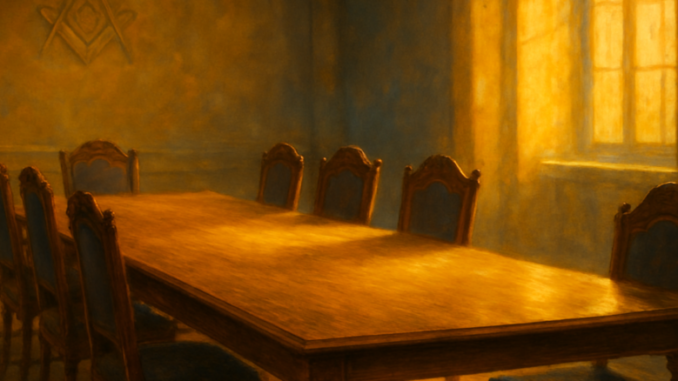
Imagine a long wooden table. A family once gathered around it. They ate, they laughed, they argued. Now the table stands empty. The chairs remain, but no one takes a seat. Instead, the heirs stand on opposite sides of a courtroom, fighting over what once lay on that table — possessions, rights, money. The table itself, and the togetherness it once made possible, has been forgotten.
This image of an abandoned table is not merely a metaphor for the Jackson estate. It is a universal image that every human being recognizes. Families fracture when conversations about values are replaced by battles over value. When the immaterial — the things that truly bind people together — gets crowded out by the material.
Legacy as a Building Project
In Freemasonry, human life is often compared to a building project. Every Brother works on his own stone, but he does so with the awareness that his stone will become part of a greater whole — a temple he himself may never see completed. This temple is not built of stone and mortar. It is a spiritual edifice, raised from principles, from care for others, and from the willingness to leave behind something that reaches beyond one’s own existence.
Hiram Abiff, the Master Builder of Masonic tradition, left no will with sums of money. His legacy consisted of knowledge, craftsmanship, and the willingness to die for his convictions. The legend of Hiram reminds every Freemason that a true inheritance cannot be measured in coins — it is measured in the quality of what you pass on to those who come after you.
When Money Replaces the Bond
It is tempting to reduce the Jackson family inheritance dispute to greed or legal disagreement. But anyone who looks deeper sees something more painful. A family bond that was already under strain during a lifetime gets translated, after death, into the only language a courtroom understands: money. Hundreds of millions become the battlefield where unprocessed emotions, missed conversations, and broken trust are fought out.
The Roman philosopher Seneca wrote that wealth itself is not evil, but that attachment to it deforms the soul. He warned that anyone who measures his worth by what he owns will ultimately lose himself. That warning rings just as clearly two millennia later.
True brotherhood is the inheritance that no court can divide and no will needs to record — it lives on in the actions of those who have received it.
Brotherhood as a Living Testament
What distinguishes Freemasonry from many other societies is its conscious pursuit of a form of connection that does not depend on blood ties, financial interests, or social status. Brotherhood in the Lodge is a choice, renewed daily. It is not inherited — it is built, stone by stone, meeting after meeting.
Johann Wolfgang von Goethe, himself a Freemason and one of the greatest minds in European cultural history, wrote that only those who constantly strive for freedom and life truly deserve them. That effort is the heart of brotherhood: not the passive receipt of privileges, but the active work of building a community that carries everyone. Mozart, also a member of a Masonic Lodge, expressed the same idea in a different form. In his opera The Magic Flute, he shows how trials and cooperation form the path to higher consciousness — not the possession of gold or power.
What a Lodge Can Teach a Family
A Lodge functions at its best when every member feels responsible for the whole. There is no inheritance to divide, because everything that is shared is immaterial: rituals, conversations, mutual support. Precisely because there is nothing to claim, attention can be directed toward what truly matters. This may be the most valuable lesson Freemasonry can offer a world fascinated by inheritance conflicts.
Brotherhood is not inherited — it is built daily. The real legacy is what you have kindled in another person. A community without material claims can focus on spiritual growth. Connection does not arise through division, but through shared devotion.
The Stone You Leave Behind
Aristotle taught that the good life is not measured by what a person accumulates, but by the virtues he practices. In his Nicomachean Ethics, he described friendship as the highest form of human connection — higher than utility and pleasure. That Aristotelian friendship, based on mutual respect and a shared pursuit of the good, bears a striking resemblance to the Masonic ideal of brotherhood.
When we read the news today about a battle over hundreds of millions from a musical legacy, we can shrug our shoulders and scroll on. Or we can pause for a moment and consider the question hiding behind the headlines. Not: how much is the inheritance worth? But: what inheritance am I building, right here, right now, in the way I treat the people around me?
The table does not have to remain empty. But someone has to be the first to sit down — not to demand, but to share.
An inheritance dispute reminds us how fragile human bonds become when the material takes over. Freemasonry offers a different perspective: a brotherhood built not on possessions, but on shared values and daily commitment. The most enduring legacy is never found in a bank account or a courtroom — it lives in the character we shape, the connections we nurture, and the stones we leave behind for others to build upon.
Copyright text & image: devrijmetselaar.nl
Texts are based on the ideas and content of the author of devrijmetselaar.nl, reviewed, corrected, and supplemented with the assistance of OpenAI. Images are created based on the ideas of the author of devrijmetselaar.nl using OpenAI/DALL-E.
Frequently Asked Questions
What is the main lesson Freemasonry teaches about inheritance and legacy?
Freemasonry teaches that true legacy is not measured in money or possessions, but in the intangible things we pass on: knowledge, character, craftsmanship, and spiritual principles. Like Hiram Abiff, the Master Builder of Masonic tradition, a meaningful inheritance consists of principles and values that reach beyond one's own lifetime, rather than coins or legal documents.
How does the article use the metaphor of the empty table?
The empty table represents how families fracture when conversations about shared values are replaced by battles over material possessions and money. It symbolizes the loss of togetherness and connection that once bound a family together, showing how the immaterial things that truly bind people—love, communication, and relationships—get crowded out by disputes over the material.
According to the article, why do inheritance disputes go deeper than just disagreements over money?
Inheritance disputes often reflect deeper family wounds: unprocessed emotions, missed conversations, and broken trust that existed during a lifetime but become translated into legal and financial battles after death. Money becomes the only language a courtroom understands, masking the real issue—a fractured family bond seeking resolution through the wrong medium.

Be the first to comment