Imagine waking up tomorrow with a completely different name. Would anything about who you truly are actually change? It sounds like a simple question, but the longer you sit with it, the more it touches on the very essence of identity, reputation, and whether a person is more than the label they carry. Michel de Montaigne posed exactly this question in his forty-sixth essay from the first book of the Essays: On Names. What he discovered remains surprisingly relevant — and for Freemasons, it carries a special resonance.
The Core Idea: A Name Is Not the Thing Itself
The central theme of On Names is as clear as it is provocative: a name is merely a sound, a convention, an arbitrary label that we attach to people and things. Montaigne argues that we assign far too much weight to names, when in reality they tell us nothing about the true nature of a person or object. He identifies a peculiar human tendency: we confuse the word with the thing itself, allowing our judgment to be clouded by the sound of a name rather than by the deeds or qualities behind it.
Montaigne approaches this subject with his characteristic blend of erudition and lightness. He draws on classical antiquity, personal experiences, and the history of his own era to demonstrate just how arbitrary the relationship between name and essence really is. And he doesn’t shy away from humor. He finds it amusing how people puff themselves up with an impressive name, or how dynasties cling to a family name as though it were a guarantee of greatness in itself.
Examples from Antiquity and Montaigne’s Own Time
Montaigne marshals a wealth of examples to drive his point home. He references Plato, who in the dialogue Cratylus raised the question of whether names belong to things by nature or are merely a matter of convention. He also mentions Roman emperors and generals whose names acquired luster over the centuries — not because of the names themselves, but because of the deeds associated with them. The name Caesar, for instance, only became a title radiating power after Julius Caesar. Before him, it was nothing more than a family name.
Closer to home, Montaigne points to the custom of naming children after saints or famous ancestors, hoping that the virtues of the namesake would somehow transfer to the child. He observes dryly that this rarely produces the desired effect. A name does not make a hero, just as a title does not make a sage. He also discusses the phenomenon of families changing their name to align themselves with a more distinguished lineage, or kings deliberately choosing a name to create a certain impression. All these examples serve the same purpose: exposing the gap between appearance and reality.
The Key Themes at a Glance
A careful reading of the essay reveals several recurring threads that structure Montaigne’s thinking about names:
The arbitrariness of names: There is no necessary connection between a name and the qualities of the person who bears it.
Vanity and reputation: People use names to impress, but true merit lies in deeds, not in labels.
Confusing word and reality: We allow ourselves to be misled by sounds and titles, when we would do better to look at what someone actually does and is.
The transience of fame: Even the most celebrated names fade with time, revealing just how fleeting outward honor really is.
A name is a sound that fades; what endures are the deeds with which you filled it.
Why This Essay Resonates with Freemasonry
You might wonder what a sixteenth-century essay about names has to do with Freemasonry. The answer runs deeper than you might initially think. In Freemasonry, the distinction between outward appearance and inner truth plays a fundamental role. When a candidate enters the lodge, he leaves behind his social status, titles, and yes, even the connotations of his name. What matters is not who you are in the outside world, but who you can become as a human being.
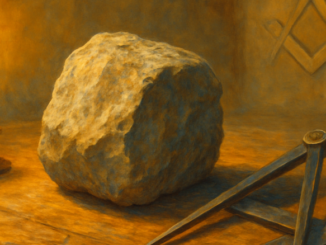
This principle aligns closely with Montaigne’s argument. Where he demonstrates that names are misleading and guarantee nothing about someone’s character, Freemasonry teaches that true merit springs from inner work. The rough ashlar is not refined by inscribing a fine name upon it, but by patiently and honestly working on yourself. Titles within the lodge — such as Fellow Craft or Master Mason — do not refer to social rank but to stages of personal growth and ethical awareness.
Beyond the Label: Identity as a Living Process
Montaigne invites us to look beyond the label. This applies to how we judge others, but perhaps even more to how we see ourselves. How much of your self-image is tied to the name you carry, the title on your business card, or your family surname? And how much of it is shaped by the choices you make each day, the way you treat others, and the quiet moments in which you dare to look honestly at yourself?
Aristotle already distinguished between what something is called and what something essentially is. Montaigne takes that insight and grounds it in the practice of everyday life. He doesn’t ask us to abolish names, but to appreciate them for what they truly are: useful conventions, not bearers of truth. That attitude of clear-headedness and self-reflection is also found in Seneca, who continually reminded his readers that fame and titles are fleeting, and that only inner virtue endures.
What You Can Take Away from This Essay
On Names is one of the shorter essays in Montaigne’s first book, but the message it carries is far from small. It teaches you to be critical of the tendency to elevate names and titles into something they are not. It reminds you that identity is not a fixed given that can be captured in a single word, but a living process — one that unfolds through action, reflection, and the willingness to grow.
For Freemasons, this insight is especially potent. The Craft asks us to set aside the superficial markers of the profane world and to focus on what truly matters: the quality of our character, the sincerity of our intentions, and the work we do on our inner selves. Montaigne, writing centuries before modern Freemasonry took its organized form, arrived at a strikingly similar conclusion. A name may open a door, but it is your actions that determine whether you deserve to walk through it.
In an age of personal branding, social media profiles, and carefully curated public identities, Montaigne’s essay feels more urgent than ever. Strip away the labels, and what remains? That is the question worth asking — in the lodge and in life.
Montaigne’s On Names offers a timeless reminder that the labels we carry are not who we are. Whether you encounter this idea in a sixteenth-century essay or in the ritual of a Masonic lodge, the lesson is the same: look past the surface. True identity is not bestowed by a name or a title — it is forged through honest self-examination, meaningful action, and the courage to become more than any label could ever contain.
Copyright text & image: devrijmetselaar.nl
Texts are based on the ideas and content of the author of devrijmetselaar.nl, reviewed, corrected, and supplemented with the assistance of OpenAI. Images are created based on the ideas of the author of devrijmetselaar.nl using OpenAI/DALL-E.

Be the first to comment