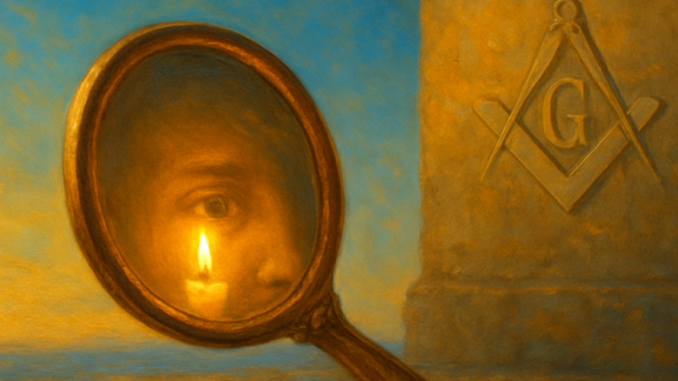
Picture the scene: a group of Brothers are gathered around the table after Lodge. One of them sets down his phone and says, “Did you see this? That author who earns a month’s salary on an erotic platform.” A brief silence falls. Then opinions tumble over one another — some frown, others shrug. And one Brother says quietly: “The question isn’t what she does, but how we judge.” That moment — the silence after the judgment — touches the very heart of what Freemasonry tries to teach us about ethics.
Current Events as a Mirror
The recent news that a well-known author spoke openly about her income from an erotic platform sparked heated debate. Some called it courageous; others called it inappropriate. What stands out is how quickly people reach for a moral verdict. But for anyone familiar with the work of the Lodge, it is precisely that reflexive condemnation that holds a lesson — not about what is right or wrong, but about the deeper question: on what foundation do we actually base our judgments?
In Freemasonry, ethics is never about imposing rules on others. It is about the continuous examination of your own moral compass. The rough stone that must be shaped is always your own stone — never someone else’s. That is what makes conversations about social issues within the Brotherhood so remarkable: the aim is not a collective verdict, but individual honesty.
Aristotle, Virtue, and the Good Life
The Greek philosopher Aristotle wrote extensively about virtue ethics. In his Nicomachean Ethics, he argued that a virtuous life does not consist of blindly following rules, but of developing character. A person becomes just by performing just deeds, courageous by making courageous choices. But — and this is crucial — virtue is always context-dependent. What counts as courage for one person may be recklessness for another. Aristotle explicitly warned against moral arrogance: the danger of elevating our own standards into universal law.
This Aristotelian insight resonates powerfully within Freemasonry. The Brotherhood brings together people from widely differing backgrounds, beliefs, and lifestyles. The Lodge is not a courtroom. It is a workshop where you learn to recognize your own prejudices before you pass judgment on another. That is precisely why a public debate like this one is so valuable as practice material — not for taking a position, but for discovering where your own judgment originates.
On Shame and Autonomy
The author in question spoke in interviews about security — financial independence and the freedom to choose how she earns her living. This touches on a theme deeply rooted in Western philosophy: autonomy. Immanuel Kant described it as the human capacity to be a law unto oneself, free from external coercion. Spinoza went further still, arguing that true freedom arises when a person acts from an understanding of their own nature, rather than from fear of others’ judgment.
Shame is a curious phenomenon. It can be a healthy inner signal that warns us when we are crossing our own values. But it can also be an instrument of social control, imposed by others to regulate behavior that makes them uncomfortable. The distinction between these two forms of shame is exactly the terrain on which the Freemason operates. In the ritual, the candidate is invited to examine their own inner world honestly — not the inner world of their neighbor.
Masonic ethics does not begin with evaluating someone else’s choices. It begins with the honest investigation of your own moral reflexes.
The Mirror of Ritual
Those familiar with the ritual work of the Lodge know that the Chamber of Reflection plays a central role in initiation. The candidate is left alone with themselves. In that silence, every social mask falls away. There is no audience to judge, no social norm to dictate behavior — only the confrontation with one’s own thoughts. It is a powerful exercise in what the ancient Greeks called gnōthi seauton: know thyself. Those words, attributed to the Oracle at Delphi and elevated by Socrates into a life’s maxim, form the golden thread running through all Masonic practice.
When a social issue like this one strikes a nerve, the honest question is not “What do I think of her choice?” The honest question is: “Why does this affect me? What part of my upbringing, my fears, my insecurities is speaking here?” That willingness to turn the judgment around — from the other back toward yourself — may be the most difficult but also the most valuable exercise Freemasonry has to offer.
Voltaire and the Imperative of Tolerance
No discussion of Masonic ethics and tolerance would be complete without Voltaire, who used his sharp pen to argue repeatedly for tolerance. In his Treatise on Tolerance, he contended that fanaticism and moral certainty cause more harm than the deeds they condemn. Voltaire was himself a Freemason, initiated in 1778 — shortly before his death — into the Parisian Lodge Les Neuf Sœurs. His legacy within the Craft is unmistakable: the right to one’s own conscience, respect for individual choice, and the refusal to impose one’s own truth upon others.
It is telling that in the same Lodge, men such as Benjamin Franklin and Nicolas de Condorcet worked toward ideals of liberty and equality. Throughout the centuries, Freemasonry has brought together officials, artists, writers, and thinkers who did not always agree with one another, but who shared one conviction: that moral growth begins with self-reflection, not with correcting others.
The Conscience as Compass
The debate around the erotic platform will fade, as all media storms do. But the ethical questions it raises remain profoundly relevant. How do we deal with choices that challenge our comfort zones? How do we separate genuine moral concern from reflexive judgment? And above all: are we willing to apply to ourselves the same scrutiny we so readily direct at others?
For the Freemason, these are not abstract questions. They are the daily work of the Craft. Every time we encounter something in the outside world that provokes a strong reaction, we are handed an opportunity — not to proclaim what is right, but to examine why we feel the way we do. The gavel and chisel are not meant for someone else’s stone. They are meant for our own.
Freemasonry does not offer its members a ready-made moral code to apply to the world. Instead, it offers something far more demanding: a method. A practice of turning the mirror inward before casting judgment outward. The story of an author and an erotic platform may seem far removed from the solemnity of the Lodge, but the lesson it invites is timeless. True ethical maturity is not about having the right opinion — it is about having the courage to question where that opinion comes from. That quiet work, done stone by stone, is the very essence of the Craft.
Copyright text & image: devrijmetselaar.nl
Texts are based on the ideas and content of the author of devrijmetselaar.nl, reviewed, corrected, and supplemented with the assistance of OpenAI. Images are created based on the ideas of the author of devrijmetselaar.nl using OpenAI/DALL-E.
Frequently Asked Questions
What is the main ethical lesson Freemasonry teaches about judging others?
Freemasonry teaches that ethics is not about imposing rules on others or reaching quick moral verdicts. Instead, it emphasizes continuous examination of your own moral compass. The focus is on shaping your own character (the rough stone) rather than judging others. The aim is individual honesty and self-reflection, not collective condemnation.
How does Aristotle's virtue ethics relate to Freemasonry's approach to morality?
Aristotle's virtue ethics, as described in his Nicomachean Ethics, aligns with Freemasonry by emphasizing that virtue develops through practice and is context-dependent rather than following rigid rules. Both traditions warn against moral arrogance and recognize that what constitutes virtue varies by individual circumstance. This resonates with Freemasonry's workshop approach to learning moral character.
Why does the article use a current events debate as an example for Freemasonry's teachings?
The article uses the public debate about an author's income from an erotic platform as practice material for Freemasons to examine their own judgment and prejudices. Rather than advocating for a specific position on the issue, it serves as a mirror to help individuals recognize where their own moral judgments originate and to practice the Masonic principle of non-arrogant self-examination before passing judgment on others.


Be the first to comment