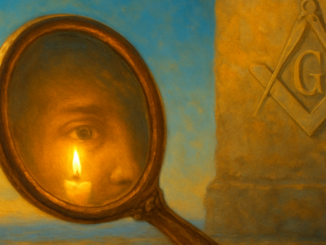
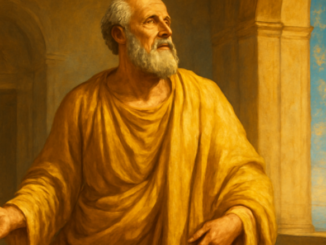
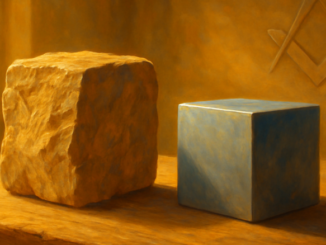
Masonic gavel and rough stone symbolizing ethical self-reflection in the Lodge
Philosophy & Ethics

Freedom, Shame, and Ethics: Lessons From an Erotic Platform

Picture the scene: a group of Brothers are gathered around the table after Lodge. One of them sets down his phone and says, “Did you see this? That author who earns a month’s salary on an erotic platform.” A brief silence falls. Then opinions tumble over one another — some frown, others shrug. And one Brother says quietly: “The question isn’t what she does, but how we judge.” That moment — the silence after the judgment — touches the very heart of what Freemasonry tries to teach us about ethics. Current Events as a Mirror The recent news that a well-known author spoke openly about her income from an erotic platform sparked heated debate. Some called it courageous; others called it inappropriate. What stands out is how quickly people reach for a moral verdict. But for anyone familiar with the work of the Lodge, it is precisely that reflexive condemnation that holds a lesson — not about what is right or wrong, but about the deeper question: on what foundation do we actually base our judgments? In Freemasonry, ethics is never about imposing rules on others. It is about the continuous examination of your own moral compass. The rough stone […]
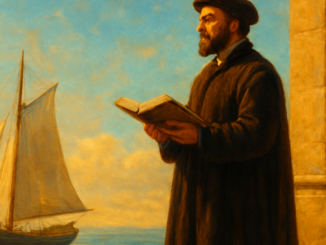
Montaigne essay on duty and conscience with Masonic square and compasses
Michel de Montaigne – Content & Summary

Montaigne on the Laws of Duty: Conscience Over Obedience

Imagine this: you’re at work, facing a difficult dilemma. Your manager asks you to do something that technically falls within the rules — but your inner compass tells you it’s unjust. What do you do? Follow your formal duty, or listen to your own conscience? This tension between outward obedience and inner ethics is exactly the terrain Michel de Montaigne explores in his essay ‘On the Laws of Duty.’ Written centuries ago, it remains remarkably practical — and shares striking common ground with the ethical foundations of Freemasonry. What Is This Essay About? In Essay 23 of the first book of his famous Essays, Michel de Montaigne examines the nature of duty. What do we truly owe others? Where are the boundaries of loyalty to a ruler, a friend, or an ideal? Montaigne argues that duties are never absolute. There is always a tension between what society expects of us and what our personal conscience dictates. The essay is brief but powerful, touching on fundamental questions about loyalty, honesty, and moral courage. Montaigne wrote this against the backdrop of the French Wars of Religion — a period in which people were constantly forced to choose between warring factions. Loyalty to […]

Ancient Stoic philosophy meets Freemasonry: two paths toward caring for others
Lucius Annaeus Seneca – Freemasonry & Connection

Seneca and Freemasonry: Two Paths Toward Care for Others

What happens when you place the words of a Roman Stoic philosopher alongside the principles of Freemasonry? In his ninety-fifth letter to Lucilius, Lucius Annaeus Seneca outlines an ethics that reaches far beyond personal virtue — he calls for active care for one’s fellow human beings. Freemasonry, which emerged centuries later, is built on a remarkably similar foundation. These two traditions, separated by time and form, are united by a shared longing for human connection. How does each tradition approach this idea of care, and what can we learn from the parallels between them? The Stoic Perspective: Humanity as One Body In Letter XCV, Seneca addresses his student Lucilius with an urgent argument: moral precepts alone are not enough. Human beings need a deeper understanding of their connection to others. Seneca compares humanity to a body in which each individual is a limb. Whoever harms another harms himself. Whoever helps another strengthens the whole. This is not a sentimental appeal — it is a philosophical necessity. Stoic ethics begins with reason: if we are social beings by nature, then caring for others is not a choice but a duty that flows from our very essence. Seneca goes further than his […]

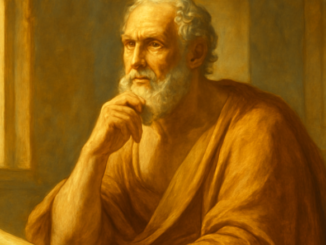
Ancient Stoic philosophical texts symbolizing Freemasonry's moral foundations
Lucius Annaeus Seneca – Letters to Lucilius

Seneca’s Letter XCV: Philosophical Roots of Care for Others

Imagine reading a text written nearly two thousand years ago and recognizing your own inner struggles in every line. How do I live well? What do I owe my fellow human beings? Is it enough to follow rules, or must I understand why I do what is right? These are precisely the questions Lucius Annaeus Seneca poses in his ninety-fifth letter to Lucilius — and they are precisely the same questions that echo through the rituals and ethical foundations of Freemasonry. This article traces the philosophical roots that nourished Seneca when he wrote this remarkable letter and reveals how deeply those roots reach into Masonic thought. The Heart of Letter XCV: Rules or Understanding? In Letter XCV, Seneca addresses a debate that had occupied the Stoic school for generations: are moral precepts sufficient to lead a virtuous life, or does one need a deeper philosophical understanding? His correspondent Lucilius seems drawn to the practical and the manageable — give me a list of rules and I will follow them. But Seneca refuses to make it that simple. He argues that rules without an understanding of the principles behind them are hollow and fragile. You can tell someone to be kind […]

Rough ashlar stone symbolizing self-knowledge and growth in Freemasonry
Philosophy & Ethics

Autism and Self-Knowledge: Ethical Lessons from Freemasonry

When someone discovers later in life that they are fundamentally different from what the world expected, a remarkable moment of self-knowledge emerges. The recent openness of a well-known public figure about receiving an autism diagnosis offers a surprising mirror for a theme that sits at the very heart of Freemasonry: knowing yourself as the foundation for ethical action. Two worlds, two perspectives on the same question — how does honesty about who you are lead to better conduct? The Outsider’s Perspective: Vulnerability as Weakness Modern society holds a curious paradox when it comes to openness. On one hand, authenticity is celebrated as the highest virtue. On the other, vulnerability is often seen as a liability — an Achilles’ heel best kept hidden. When someone publicly declares they are glad about a diagnosis that many perceive as a limitation, it collides with widespread incomprehension. The outsider thinks in terms of normal and deviant, strong and weak, successful despite or because of. This perspective has deep historical roots. As far back as Aristotle, we find the idea that virtue manifests in the middle ground — in moderation and self-control. Any deviation from the norm, in whatever form, was considered a disruption of […]

Masonic rough ashlar symbolizing talent, responsibility, and ethical duty
Philosophy & Ethics

What Being the Favorite Teaches Us About Ethics in Masonry

When someone is labeled the favorite, something curious happens: the expectation of victory transforms winning from a possibility into an obligation. Professional cyclist Lorena Wiebes, who recently claimed another dominant stage victory at the Tour, carries that burden with apparent ease. But what does it truly mean to be required to perform simply because others expect it of you? And doesn’t this touch on a deeper ethical question that lies at the very heart of Freemasonry — the relationship between talent, responsibility, and moral duty? The Paradox of Merit and Expectation There is a philosophical tension here that seems harmless on the surface but raises fundamental questions upon closer examination. A cyclist who has become the best through years of dedication and innate talent is criticized when she doesn’t win. The logic seems perverse: precisely because she excels, what was once remarkable becomes obligatory. Aristotle might have spoken here about the relationship between aretè — the virtue of excellence — and the social context in which that virtue acquires meaning. Freemasonry knows a remarkably similar dynamic. Once a man is initiated as a Brother, he accepts an invisible but very real contract — not just with his lodge, but with […]

Starry night sky with an artificial light source symbolizing ethical boundaries
Philosophy & Ethics

Artificial Nightlight from Space: An Ethical Exploration

Imagine stepping outside on a clear evening and looking up. The stars shine as they have for millions of years. But somewhere among those pinpricks of light, there now floats an artificial sun — crafted by human hands, designed to banish the night. Does that sound like progress, or like hubris? This week, a controversial project aimed at doing exactly that received final approval. It raises a question older than any technology: just because we can do something, does that mean we should? The Promise of Permanent Daylight The concept behind the new satellite is as simple as it is radical: a reflective surface in orbit that bounces sunlight back to specific regions of the Earth — even when those regions should be cloaked in darkness. Proponents point to the practical benefits: savings on street lighting, safer cities, and assistance during nighttime rescue operations. The technology exists, the funding is secured, and now the final approval has been granted. But it is precisely in this moment of triumph that a deeper question emerges. What does it truly mean to abolish the night? What about ecosystems that depend on darkness? Migratory birds that navigate by the stars? People who need the […]

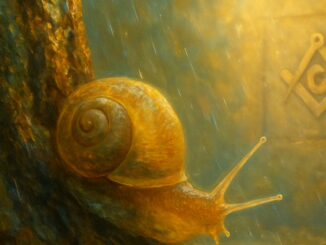
A camouflaged tree snail blending into wet bark in a tropical rainforest
Philosophy & Ethics

Invisible Tree Snails and Ethics: When Hiding Is Wisdom

Imagine walking through a tropical rainforest as the first drops of rain begin to fall. Everything around you shifts and transforms. And there, on a tree trunk barely an arm’s length away, a snail disappears right before your eyes — not by crawling away, but by changing color until it blends perfectly into the wet bark. Biologists recently announced the discovery of a new species of tree snail with exactly this ability. It sounds like magic, but it’s evolution. And it raises a question that sits at the very heart of Freemasonry: when is it ethically right to make yourself invisible? The Art of Disappearing The newly discovered species, found in the rainforests of Southeast Asia, possesses a remarkable adaptive ability. The moment raindrops touch its skin, specialized pigment cells activate, rendering the snail nearly invisible against the backdrop of wet bark. This isn’t a conscious decision on the snail’s part — it’s a finely tuned survival mechanism that has evolved over millions of years. Predators searching for an easy meal simply look right through it. What makes this discovery truly fascinating isn’t just its biological complexity. It’s the deeper question it raises about visibility and vulnerability. When do you […]