When someone discovers later in life that they are fundamentally different from what the world expected, a remarkable moment of self-knowledge emerges. The recent openness of a well-known public figure about receiving an autism diagnosis offers a surprising mirror for a theme that sits at the very heart of Freemasonry: knowing yourself as the foundation for ethical action. Two worlds, two perspectives on the same question — how does honesty about who you are lead to better conduct?
The Outsider’s Perspective: Vulnerability as Weakness
Modern society holds a curious paradox when it comes to openness. On one hand, authenticity is celebrated as the highest virtue. On the other, vulnerability is often seen as a liability — an Achilles’ heel best kept hidden. When someone publicly declares they are glad about a diagnosis that many perceive as a limitation, it collides with widespread incomprehension. The outsider thinks in terms of normal and deviant, strong and weak, successful despite or because of.
This perspective has deep historical roots. As far back as Aristotle, we find the idea that virtue manifests in the middle ground — in moderation and self-control. Any deviation from the norm, in whatever form, was considered a disruption of ideal balance. The Stoics, Marcus Aurelius among them, certainly emphasized acceptance of one’s fate, but Roman society valued conformity and self-mastery far above open vulnerability.
The Freemason’s Perspective: Self-Knowledge as Ethical Duty
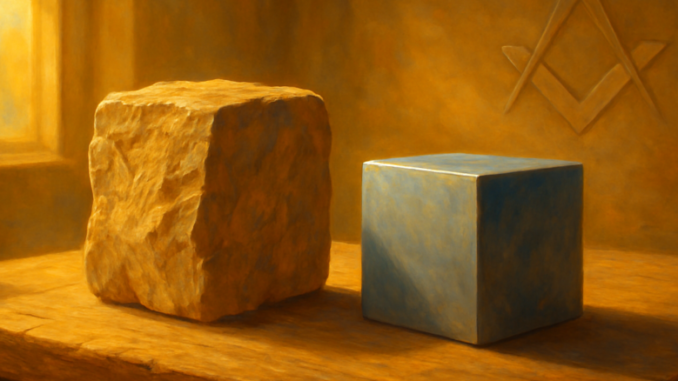
Freemasonry approaches this question from a fundamentally different angle. Central to the Craft is the ancient Greek maxim inscribed above the entrance to the Temple of Delphi: Know Thyself. This is not a casual suggestion — it is an ethical imperative. The Freemason is encouraged to view himself as a rough ashlar that must be shaped and refined. That process of shaping begins with an honest observation of one’s own form, including the cracks, the irregularities, and the unexpected patterns.
In lodge work, this self-knowledge is ritually practiced. During initiation, the candidate is literally brought into darkness before receiving the light. This symbolic journey represents the idea that insight into one’s own shadow must precede illumination. Montaigne, whose essays offer profound reflections on the human condition, would have recognized this principle. In his essay on vanity, he describes how self-knowledge is never a destination but an ongoing exercise in honesty with oneself.
Self-knowledge is not a luxury but an ethical obligation: only those who truly know themselves can act with genuine integrity toward others.
Where Both Perspectives Meet
Despite their differences, the outsider and the Freemason share a fundamental conviction: that there is a direct connection between self-knowledge and right action. The difference lies in how they value the process. Where societal norms tend to judge the end result, Freemasonry focuses on the journey itself. Both acknowledge that anyone who does not know themselves will struggle to truly serve others.
The Scottish philosopher David Hume wrote about moral sentiments as the foundation of ethics. He understood that emotions and self-perception do not stand in opposition to reason but actively nourish it. A diagnosis that explains why someone perceives, reacts, or communicates differently is not, in this sense, a limitation — it is a key. It opens the door to understanding, both of yourself and of how you stand in the world.
Authenticity as the Foundation of Ethical Action
Freemasonry holds no dogma about what is normal. Its ethics are built on brotherhood, tolerance, and personal development. A Brother who discovers that his mind works differently than expected does not stand outside this ethical framework — he embodies its very core. The willingness to examine, to accept, and then to grow is precisely what transforms the rough ashlar into the perfect cube.
Voltaire, who as an Enlightenment thinker had close ties to the Masonic tradition, emphasized in his work the importance of honesty over hypocrisy. In Candide, he shows how pretense and self-deception lead to suffering, while genuine acceptance of reality creates space for true improvement. To cultivate the garden, you must first know the soil you have.
Lessons for the Modern Seeker
What does this comparison teach us? First, that openness about who you are is not a weakness but an act of courage that makes ethical action possible. Anyone who wears a mask will struggle to be sincere with others. Second, that self-knowledge is an ongoing process. A diagnosis is not the final destination — it is a new starting point for further growth.
Consider these core insights:
- Self-knowledge precedes ethical action
- Vulnerability can be a profound source of strength
- Authenticity serves the community, not just the individual
- Working the rough ashlar demands honesty about its true form
The Freemason sees in every discovery about himself an opportunity to build something better. Society may still wrestle with the notion that being different is something to embrace. Yet in the quiet of the lodge, this wisdom has been preserved for centuries: know thyself, and you will know how to act.
The openness about a personal diagnosis touches the very essence of what Freemasonry strives for. It is not the concealment of our peculiarities but the honest exploration of them that makes ethical conduct possible. Where the world demands conformity, the lodge invites authenticity. And in that authenticity lies the key to brotherhood, to tolerance, and to building a better world — stone by stone.
Copyright text & image: devrijmetselaar.nl
Texts are based on the ideas and content of the author of devrijmetselaar.nl, reviewed, corrected, and supplemented with the assistance of OpenAI. Images are created based on the ideas of the author of devrijmetselaar.nl using OpenAI/DALL-E.
Frequently Asked Questions
What is the central concept of Freemasonry related to personal development?
Central to Freemasonry is the ancient Greek maxim 'Know Thyself,' which is not merely a suggestion but an ethical imperative. Freemasons are encouraged to view themselves as rough ashlar (stone) that must be shaped and refined through an honest observation of one's own form, including cracks, irregularities, and unexpected patterns. This self-knowledge is considered the foundation for ethical action.
How does Freemasonry's approach to vulnerability differ from modern society's perspective?
Modern society often views vulnerability as a weakness or liability to be hidden, despite celebrating authenticity as a virtue. In contrast, Freemasonry embraces vulnerability and honest self-assessment as essential to ethical development. The Masonic perspective recognizes that insight into one's own limitations and shadow must precede true illumination and personal growth.
What is the significance of the initiation ritual's 'darkness before light' in Freemasonry?
During initiation, the candidate is brought into darkness before receiving light. This symbolic journey represents the principle that honest self-examination and acknowledgment of one's limitations must come before illumination or enlightenment. It emphasizes that self-knowledge is an ongoing exercise in honesty with oneself, not a final destination.

Be the first to comment