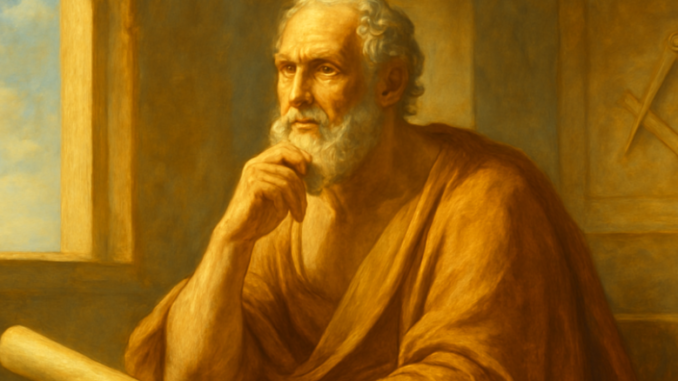
What happens when you place the words of a Roman Stoic philosopher alongside the principles of Freemasonry? In his ninety-fifth letter to Lucilius, Lucius Annaeus Seneca outlines an ethics that reaches far beyond personal virtue — he calls for active care for one’s fellow human beings. Freemasonry, which emerged centuries later, is built on a remarkably similar foundation. These two traditions, separated by time and form, are united by a shared longing for human connection. How does each tradition approach this idea of care, and what can we learn from the parallels between them?
The Stoic Perspective: Humanity as One Body
In Letter XCV, Seneca addresses his student Lucilius with an urgent argument: moral precepts alone are not enough. Human beings need a deeper understanding of their connection to others. Seneca compares humanity to a body in which each individual is a limb. Whoever harms another harms himself. Whoever helps another strengthens the whole. This is not a sentimental appeal — it is a philosophical necessity. Stoic ethics begins with reason: if we are social beings by nature, then caring for others is not a choice but a duty that flows from our very essence.
Seneca goes further than his predecessors Chrysippus and Cleanthes by arguing that theoretical knowledge only acquires value when it is translated into action. It is not enough to know that you should do good. You must understand why, so that care for others becomes rooted in your character rather than remaining dependent on rules or circumstances. This conviction makes Letter XCV one of the most practical texts in the Stoic tradition — philosophy as the art of living, not as armchair wisdom.
The Masonic Perspective: Building Brotherhood
Freemasonry approaches the same fundamental question from a different tradition, yet arrives at a strikingly similar conclusion. Where Seneca starts from philosophical reason, Freemasonry takes ritual and shared experience as its point of departure. In the lodge, people meet as equals regardless of social status, religious background, or political conviction. Brotherhood is not an abstract ideal — it is forged in the practice of working together, listening, and bearing responsibility for one another.
The concept of “Brotherly Love” — one of the three great tenets of Freemasonry alongside Relief and Truth — reflects precisely what Seneca describes as the natural bond between human beings. The Freemason is not asked merely to follow rules. He is invited, through self-reflection and inner growth, to arrive at the insight that care for others is inseparable from his own moral development. This process unfolds gradually through the degrees of Entered Apprentice, Fellowcraft, and Master Mason, with each step revealing a deeper understanding of what it truly means to be connected to your fellow human beings.
Where Both Traditions Converge
The most striking point of convergence between Seneca’s ethics and Freemasonry is the shared conviction that moral action cannot be imposed from the outside — it must grow from within. In Letter XCV, Seneca explicitly warns against the blind following of precepts without understanding the principles behind them. Freemasonry holds a remarkably similar position: the ritual is not an end in itself but a means of bringing the participant to genuine insight. Both traditions distrust superficial obedience and seek an internalized ethics instead.
Care for others is not a commandment imposed from without, but an insight that grows as a person comes to know himself more deeply.
Both traditions also share a striking universalism. Seneca writes that a person is not merely a citizen of one city but of the entire world. Freemasonry likewise opens its doors to people of all backgrounds and convictions, regarding all of humanity as its field of work. This cosmopolitanism — philosophically grounded in Seneca and ritually experienced in Freemasonry — may well be the strongest bridge between these two worldviews.
Two Languages, One Longing
There are, of course, significant differences. Seneca writes as an individual to an individual. His letters are personal conversations — thoughtful and intimate — in which the reader is drawn into a process of reasoning. Freemasonry, by contrast, operates collectively: it is in the encounter with others, in the shared ritual, that insight unfolds. Where Seneca invites the solitary thinker to reflect, the lodge invites a person into community.
Yet this difference is smaller than it first appears. Seneca’s letters were intended to be read and discussed, to form a community of like-minded individuals across distance and time. And the Freemason, in the quiet of his own reflection, is challenged to internalize the lessons of the ritual at a deeply personal level. The Stoic and the Freemason speak different languages, but they address the same core truth: the longing to grow as a human being by connecting with others.
What We Can Learn From This Comparison
The comparison between Seneca and Freemasonry teaches us that the pursuit of care and connection does not belong to any single tradition, era, or philosophy. It is a universal human longing that continually takes new form. Whether you read the letters of a Roman sage or participate in a lodge ritual, the invitation is the same: know yourself, understand your place in the greater whole, and let that understanding manifest in concrete action in service of others.
In an age when individualism and fragmentation often dominate, both Seneca and Freemasonry offer a counterweight that has lost none of its power. Not by moralizing, but by demonstrating that genuine connection begins with the inner work that transforms a person from the inside out. Two ancient paths, one timeless destination — and a reminder that the care we extend to others is ultimately the measure of the care we have taken with ourselves.
Seneca’s Stoic philosophy and Freemasonry’s moral tradition may be separated by centuries, but they share a profound understanding: that true ethical living is not about following external rules but about cultivating an inner awareness of our shared humanity. When we internalize this insight — whether through philosophical reflection or Masonic ritual — care for others becomes not a burden but a natural expression of who we are. In that convergence lies a lesson as relevant today as it was in ancient Rome: we grow most fully as individuals when we commit ourselves to the well-being of all.
Copyright text & image: devrijmetselaar.nl
Texts are based on the ideas and content of the author of devrijmetselaar.nl, reviewed, corrected, and supplemented with the assistance of OpenAI. Images are created based on the ideas of the author of devrijmetselaar.nl using OpenAI/DALL-E.
Frequently Asked Questions
What is the main connection between Seneca's philosophy and Freemasonry?
Both Seneca's Stoic philosophy and Freemasonry are united by a shared emphasis on care for others and human connection. Though separated by time and approach, they both argue that individuals are fundamentally interconnected and that caring for others is not optional but a core duty rooted in human nature. Seneca uses the metaphor of humanity as a body with each person as a limb, while Freemasonry emphasizes this through ritual, brotherhood, and shared experience in the lodge.
Why does Seneca argue that moral precepts alone are insufficient?
According to Seneca in Letter XCV, moral precepts alone are not enough because theoretical knowledge must be translated into action to have true value. Simply knowing you should do good is insufficient—you must understand the underlying reasons why, so that care for others becomes deeply rooted in your character. This transforms ethics from abstract rules into a lived philosophy, making it the art of living rather than mere intellectual exercise.
How does Freemasonry put the concept of care into practice?
Freemasonry approaches care through ritual, shared experience, and the principle of 'Brotherly Love'—one of its three great tenets. In the lodge, people meet as equals regardless of social status, religion, or politics, forging brotherhood through working together, listening, and bearing mutual responsibility. Rather than starting from philosophical reasoning like Seneca, Freemasonry creates the experience of human connection through active participation and communal practice.

Be the first to comment