
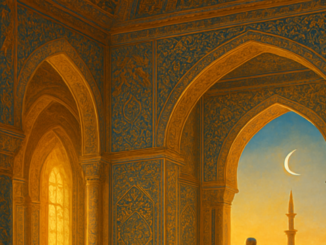
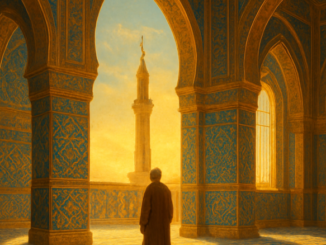
The lodge has fallen silent. After the evening’s labor, a brother sits alone in the anteroom, his hands wrapped around a cup of tea that went cold long ago. Earlier that night, he spoke aloud for the first time about the end of his marriage — not as a complaint, not as an accusation, but as a search for meaning in the act of letting go. Back home, on his nightstand, lies an open Quran turned to the sixty-fifth chapter: At-Talaq — Divorce. Most people associate this text with legal prescriptions, but a deeper reading reveals something far more profound: the spiritual art of parting with dignity.
What Does the Sixty-Fifth Chapter of the Quran Tell Us?
The sixty-fifth chapter of the Quran, known in Arabic as Surah At-Talaq (Surah 65), carries the title “Divorce.” It was revealed in Medina during a period when the young Islamic community was shaping not only its theology but also its social and ethical order. The surah contains just twelve verses, yet it provides detailed guidance on the process of separation between spouses. It prescribes waiting periods, protects the rights of women, and outlines the responsibilities of men. But anyone who reads only the legal layer misses the deeper message woven like a thread throughout the text: a call to God-consciousness, patience, and justice — precisely at the moment when emotions run highest.
What stands out is how repeatedly the surah returns to the concept of taqwa, a term best translated as reverent awareness of the Divine. The Quran asks the believer not to be governed by anger or grief, but to maintain an attitude of dignity and compassion even in the most painful farewell. The chapter is not merely about ending a marriage — it is about how one lets go. And therein lies the true spiritual lesson.
Letting Go as a Building Block of the Inner Temple
For Freemasons, the idea of building is second nature. The entire ritual tradition revolves around shaping the rough ashlar into a polished stone, around raising an inner temple. But building also presupposes demolition. Anyone who has laid a wall incorrectly must find the courage to pry the stones loose and begin again. This is precisely what the chapter on Divorce describes in a figurative sense: the honest acknowledgment that a structure no longer holds, followed by the careful dismantling of it — stone by stone — without damaging the foundation of the other person.
The philosopher Aristotle wrote in his Nicomachean Ethics that virtue does not consist in avoiding difficult situations, but in acting rightly in the midst of them. That idea reverberates through this surah. The question is not whether a divorce takes place, but the ethical quality with which it is carried out. Are rights respected? Is the other person spared humiliation? Is there room for grief and healing? The Quran answers these questions with concrete prescriptions that simultaneously serve as a moral compass.
Responsibility and Justice: Shared Values
One of the most striking aspects of this surah is its emphasis on protecting the vulnerable party. It prescribes that divorced women may not be expelled from their homes during the waiting period, that they must receive financial support, and that pregnant women deserve special care. In seventh-century Arabia, these provisions were revolutionary. They reflect an ethic of care that also stands at the heart of Freemasonry.
In Masonic ritual, a candidate is repeatedly reminded of his duties toward others — not only toward his brethren in the lodge, but toward all people. The obligation of a Freemason is no abstract ideal; it is a daily practice of just conduct. The parallel with the spirit of this Quranic surah is remarkable. Both traditions demand more than good intentions. They demand visibly righteous behavior, especially when circumstances make it most difficult.
The true measure of a person’s character is revealed not in how he builds, but in how he lets go — with dignity, justice, and respect for the other.
Trusting the Unseen Light
The surah concludes with a passage that transcends the subject of marriage and divorce entirely. In its closing verses, the believer is reminded of the creation of the seven heavens, the omnipresence of the Divine, and the promise that whoever places trust in God will ultimately find a way through. It is a perspective that situates personal crisis within a cosmic framework. Your grief is real, the text says, but the universe is greater than your grief.
This cosmic perspective resonates powerfully with the Masonic concept of the Grand Architect of the Universe. Freemasonry prescribes no specific image of God, but it invites every brother to trust in an ordering principle that transcends individual existence. In times of loss and transition, that trust serves as an anchor. It is not a promise that everything will turn out well, but an invitation to meet the unknown with openness rather than fear.
Parallels in Three Core Concepts
Patience: The Quran prescribes waiting periods that create space for reflection. Freemasonry has degrees that can only be attained after a period of maturation. Both traditions recognize that genuine growth requires time.
Justice: Both this surah and the Masonic tradition emphasize that doing right by others is not a sign of weakness but the highest expression of inner strength.
Renewal: After demolition comes rebuilding. After separation comes a new beginning. The process of initiation in Freemasonry itself begins with a symbolic death, followed by rebirth into the light.
The Lesson for Today: Farewell as a Spiritual Exercise
In our time, divorces are often reduced to legal battles — disputes over assets, custody, and who was right. The deeper human dimension is frequently lost. Yet the sixty-fifth chapter of the Quran, read through a contemplative lens, offers a radically different approach. It frames the end of a relationship not as a failure, but as a passage — one that can be navigated with consciousness, care, and grace.
For Freemasons, this reading holds particular resonance. The Craft teaches that every life transition is an opportunity for inner work. The rough stone is never finished; it is always being shaped. Sometimes shaping means chiseling away what no longer serves. The brother sitting alone in the anteroom with his cold cup of tea is not broken — he is doing some of the most important work of his life. He is learning to let go without losing himself, to dismantle without destroying, and to trust that the Unseen Light will guide his next step.
Whether we find wisdom in the Quran, in Masonic ritual, or in the quiet spaces between them, the lesson remains the same: the way we part reveals more about our character than the way we come together. And in every ending, if we are willing to look, there lies the seed of a new beginning.
The sixty-fifth chapter of the Quran and the teachings of Freemasonry may seem like unlikely companions, yet they share a profound message about the human journey. Letting go — of a relationship, a certainty, a version of ourselves — is never easy. But when it is done with patience, justice, and reverence for something greater than ourselves, it becomes more than an ending. It becomes an act of spiritual growth. As the brother eventually rises from his chair, rinses his cup, and steps out into the night, he carries with him not the weight of what was lost, but the quiet strength of someone who chose to let go with dignity.
Copyright text & image: devrijmetselaar.nl
Texts are based on the ideas and content of the author of devrijmetselaar.nl, reviewed, corrected, and supplemented with the assistance of OpenAI. Images are created based on the ideas of the author of devrijmetselaar.nl using OpenAI/DALL-E.


Be the first to comment