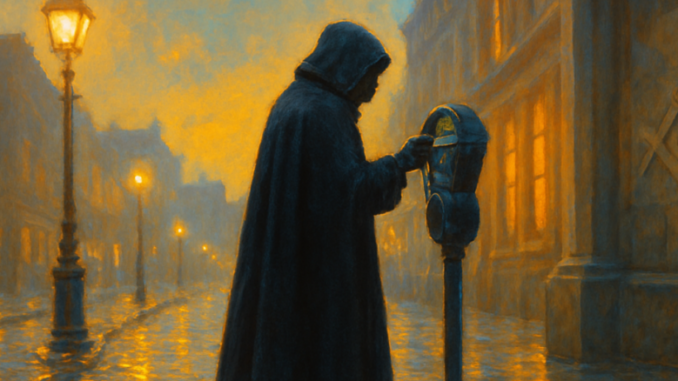
Imagine walking back to your car on a busy London street, mentally bracing yourself for the parking ticket tucked under your windshield wiper — only to find nothing there. No fine. Instead, a bewildered passerby tells you that someone dressed in a bat costume just paid your penalty and vanished into the crowd. It sounds like a scene from a movie, but it’s actually happening. A mysterious figure disguised as a well-known comic book hero has been paying strangers’ parking fines and fuel bills across the British capital for weeks. Nobody knows who he is. And perhaps that’s exactly the point.
A Faceless Hero on the Streets of London
The story has been spreading like wildfire through London in recent weeks. A person in a dark, theatrical costume appears at parking meters, petrol stations, and even beside people desperately searching for loose change. He pays, nods, and disappears. No business card, no social media handle, no request for recognition. The London press has given him a nickname inspired by the famous masked hero from comic books, but what this figure is actually doing is far older than any comic strip. He is practicing an ethic deeply rooted in human civilization: doing good without expecting anything in return.
You may feel the appeal immediately. In a world where every good deed seems to require a photo on social media, where charity often comes attached to a logo and a tax benefit, there is something disarming about someone who simply gives and goes. But why does this touch us so deeply? And what does it have to do with the centuries-old traditions of Freemasonry?
The Virtue of Silent Giving
Within Freemasonry, there is a core principle that is seldom spoken aloud but that every Brother learns through practice: charity is only truly genuine when it is anonymous. This is not an incidental part of the ritual — it is foundational. The medieval stonemason guilds from which Freemasonry historically emerged already had a tradition of mutual aid without show. When James Anderson drafted his famous Constitutions in 1723, charity was explicitly included as one of the pillars of the Brotherhood. Not as a virtue to boast about, but as a silent obligation.
The twelfth-century philosopher Maimonides formulated eight levels of charity. The highest level is giving without the recipient knowing who the giver is, and without the giver knowing who the recipient is. London’s masked benefactor approaches this ideal in an almost literal way. His costume is not a joke — it is a shield. It protects his identity and, with it, the purity of his deed.
True generosity requires no audience. In Freemasonry, the highest form of charity is the act that no one will ever attribute to you.
The Mask as Mirror: Who Are You Without Your Name?
Here we touch on something that goes deeper than charity alone. The masked figure in London poses — perhaps unintentionally — a question that lies at the heart of Freemasonry: who are you when nobody is watching? Your true self, as the Masonic tradition teaches, is not what you present to the outside world. It is what remains when you strip away titles, status, and social masks. Paradoxically, this London benefactor makes that visible by literally putting on a mask.
Johann Wolfgang von Goethe, himself a Freemason and one of the greatest thinkers in European history, wrote extensively about the difference between appearance and essence. In his masterpiece Faust, the protagonist wrestles with the question of whether human striving truly has value when it goes unseen. Goethe concluded that it is precisely invisible action that forms the core of an authentic life. This idea resonates throughout Masonic ritual, in which the candidate symbolically leaves the outside world behind to work on his inner architecture.
Personality Versus Character
There is a crucial distinction that is often forgotten in our time: the difference between personality and character. Your personality is the face you show the world. Your character is the architecture behind it — the load-bearing walls that remain standing when the facade is removed. Freemasonry deliberately focuses on that character. In the lodge, no one asks what your job title is or how much you earn. Instead, the questions are about how you live, how you treat others, and whether you are willing to face yourself honestly.
London’s masked benefactor illustrates this distinction in a surprising way. His personality — as far as the public knows it — consists of a costume and a gesture. But his character speaks through the consistency of his actions: week after week he appears, pays, and departs. There is no campaign, no revenue model, no forthcoming book deal. There is only the act itself, repeated and tireless.
What the Lodge and the Street Have in Common
You don’t have to be a Freemason to understand the power of anonymous goodness. But it is striking how directly the parallel runs. In Masonic ritual, a Brother learns to work on the rough ashlar — a symbol for the unrefined self. That labour is not meant for applause. It takes place in silence, within the privacy of the lodge, and ultimately within the privacy of one’s own conscience. The streets of London are no temple, but the principle is the same: doing good because it is good, not because it is seen.
The Invitation Behind the Mask
What makes this story so compelling? Perhaps it is the reminder that generosity doesn’t have to be a grand gesture. A parking fine is not a fortune; a tank of petrol is not a life-saving operation. But it is precisely in the small and everyday that true power resides. Marcus Aurelius, the Roman emperor-philosopher who wrote his Meditations as private reflections never meant for publication, understood this well. He believed that virtue is its own reward and that the truest acts of goodness are those performed without any thought of recognition.
The masked figure on the streets of London extends an invitation to all of us — an invitation that Freemasonry has been offering for centuries. It is not a call to put on a costume. It is a call to examine what drives you when no one is watching, when there is no reward, and when the only witness is your own conscience. In a culture obsessed with visibility, choosing to be invisible might be the most radical act of all.
Whether or not London’s costumed benefactor has any connection to Freemasonry, his actions embody one of its most enduring lessons: the highest form of giving is the kind that asks for nothing — not even to be known. In every anonymous act of kindness, in every moment we choose substance over spectacle, we echo a tradition that stretches back centuries. The mask may hide a face, but it reveals something far more important — the character beneath. And in the end, that is the only architecture that truly matters.
Copyright text & image: devrijmetselaar.nl
Texts are based on the ideas and content of the author of devrijmetselaar.nl, reviewed, corrected, and supplemented with the assistance of OpenAI. Images are created based on the ideas of the author of devrijmetselaar.nl using OpenAI/DALL-E.
Frequently Asked Questions
Who is the masked figure paying parking fines and fuel bills in London?
The masked figure's identity remains unknown. A mysterious person dressed in a dark, theatrical costume has been spotted across London paying strangers' parking fines and fuel bills without seeking recognition or leaving any contact information. The London press has given him a nickname inspired by a famous comic book hero, but he intentionally maintains anonymity.
What is the connection between the masked benefactor and Freemasonry?
The masked benefactor's practice of anonymous charity aligns with a core principle of Freemasonry: that genuine charity is only truly authentic when given anonymously. This tradition dates back to the medieval stonemason guilds from which Freemasonry emerged, and was formalized in James Anderson's 1723 Constitutions, which explicitly listed charity as a foundational pillar of the Brotherhood.
Why does the masked figure refuse recognition for his charitable acts?
The masked benefactor practices the highest form of charity as described by the twelfth-century philosopher Maimonides: giving without the recipient knowing who the giver is, and without the giver knowing who the recipient is. By refusing recognition, he ensures that his good deeds are performed purely for altruistic reasons rather than personal gain, social media attention, or tax benefits.

Be the first to comment