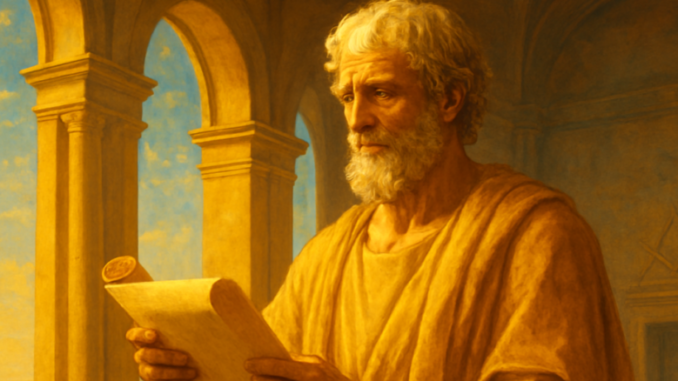
Why did human beings first begin to live together? Not out of convenience or habit, but out of something far deeper. Nearly two thousand years ago, the Stoic philosopher Lucius Annaeus Seneca posed that very question in his ninetieth letter to Lucilius — and his answer resonates remarkably with what Freemasons still pursue today: genuine human connection as the foundation of a virtuous life.
The True Origin of Civilization: Wisdom or Invention?
In Letter XC, Seneca takes issue with the philosopher Posidonius, who argued that the earliest civilizations owed their existence to wise men who devised practical inventions. Building houses, working metal, cultivating crops — Posidonius credited philosophers with these gifts to humanity. Seneca firmly disagrees. He acknowledges the usefulness of such inventions but refuses to attribute them to philosophy. Philosophy, he insists, does not concern itself with clever tools. Its domain is the soul.
This distinction is essential. Seneca draws a sharp line between the material and the interior life. Civilization does not arise from better tools but from people’s willingness to develop morally and to connect with one another through shared values. The question is not how you build a roof — it is why you choose to share that roof with someone else.
Brotherhood as a Moral Choice
Imagine living in a time without laws, without cities, without written language. What would compel you to cooperate with a stranger? Seneca describes a golden age in which people lived in harmony — not because rules existed, but because their character had not yet been corrupted by greed and ambition. The bond between people was natural and unforced. Only when the desire for possession took hold did structures and laws become necessary.
If you have ever visited a Masonic lodge, something here may feel familiar. The brotherhood within the lodge is not based on contracts or legal obligations. It is grounded in a shared moral intention: the desire to become a better person, not only for your own sake but in service of others. That connection is a conscious choice, not an automatic reflex. This is precisely what Seneca means when he writes that the true founder of civilization is not the inventor, but the one who teaches humanity to live virtuously.
True civilization begins not with what we build, but with how we relate to one another — in sincerity, virtue, and the willingness to grow together.
The Rough Stone and the Lost Paradise
Seneca’s portrait of the golden age contains a paradox. He idealizes that early innocence, yet he acknowledges that innocence is not the same as virtue. The people of that age were not wicked, but neither were they consciously good. They lacked the trials necessary to become truly virtuous. Only when temptation and moral decline enter the picture does philosophy find its purpose: to lead humanity back toward the good, but this time with awareness and deliberate choice.
Anyone familiar with Freemasonry will recognize the principle of the rough ashlar here. No one enters the lodge as a perfect human being. It is precisely our imperfections — our rough edges — that serve as the starting point of a lifelong process of inner work. Just as Seneca sees philosophy as the instrument that helps a person consciously rediscover their original goodness, Freemasonry regards its ritual work as a path toward moral refinement. The goal is not a return to some lost paradise, but the deliberate construction of an inner edifice.
What Seneca and the Lodge Share: The Search for Light
There is a striking parallel between Seneca’s view of philosophy and the Masonic concept of the search for light and knowledge. Seneca writes that philosophy does not teach a person how to use their hands but how to direct their mind. Its task is to distinguish truth from illusion, to pierce through false notions of status and possession. In Seneca’s own words, the philosopher seeks not comfort but insight.
Within Freemasonry, this aspiration is symbolized as the journey from darkness to light. During initiation, the candidate begins in blindness — not literally ignorant, but symbolically unaware of the deeper layers of their own existence. The rituals invite self-reflection and the kind of searching questions Seneca also posed: What is truly valuable? What makes a person good? And perhaps the most difficult question of all: Am I willing to examine my own convictions?
Three Core Values That Unite Both Traditions
Self-reflection as a daily practice. Both Seneca and Freemasonry regard honest self-knowledge as the foundation of every moral life. Without the willingness to look inward, no genuine growth is possible.
Virtue above possession. Seneca rejects material progress as a measure of civilization. The lodge similarly emphasizes inner richness over outward status. A person’s worth is not determined by what they own, but by who they strive to become.
Brotherhood as a conscious choice. Connection with others is not something that happens automatically. It is a moral act that requires practice, dedication, and a genuine openness to the other.
Why This Matters Today
We live in an age where technological progress is sometimes confused with human progress. Seneca warned against this nearly two millennia ago. A society that produces ever more sophisticated tools but forgets to ask what those tools are for is not truly civilized. Civilization, in the deepest sense of the word, requires people who are willing to work on themselves and to seek connections that go beyond superficial utility.
That is exactly what happens when brethren come together in the lodge. Not to change the world with grand gestures, but to work quietly and attentively on their own character. It is a modest ambition — and at the same time the most radical one a person can have.
Seneca would have recognized it. And perhaps, if you are honest with yourself, you recognize it too — that quiet longing to build something meaningful within, to connect with others not out of necessity but out of shared purpose, and to pursue a kind of light that no invention or technology can provide. It is an ancient aspiration, and it remains as vital today as it was in Seneca’s time.
Copyright text & image: devrijmetselaar.nl
Texts are based on the ideas and content of the author of devrijmetselaar.nl, reviewed, corrected, and supplemented with the assistance of OpenAI. Images are created based on the ideas of the author of devrijmetselaar.nl using OpenAI/DALL-E.

Be the first to comment