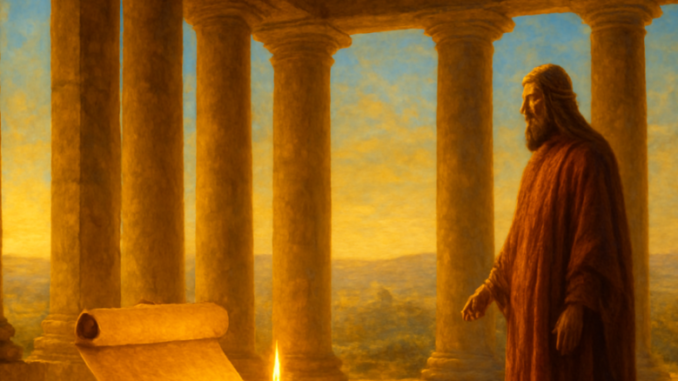
What can the enigmatic visions of a sixth-century BCE prophet possibly teach us today? The Book of Ezekiel brims with images that stir the imagination: wheels within wheels, a valley of dry bones, and a temple described down to the smallest measurement. For those who read with a Masonic eye, these ancient texts open up a world of symbolism that turns out to be remarkably relevant. Let’s enter into conversation with this ancient book and discover what it has to offer the modern Freemason.
Who Was Ezekiel, and Why Should Freemasons Care?
Ezekiel was a priest who was carried into exile in Babylon around 597 BCE, along with many other inhabitants of Judah. There, far from the destroyed Temple in Jerusalem, he received a series of extraordinary visions that he recorded in meticulous detail. But why should a modern person — and especially someone interested in Freemasonry — spend time with these ancient texts?
The answer lies in the universal themes woven throughout the book. Ezekiel speaks of destruction and rebuilding, of personal responsibility, of the possibility of starting anew. These are themes that sit at the very heart of Freemasonry: the idea that a human being is like a rough ashlar that can be shaped, through personal effort and moral growth, into something closer to perfection.
What Does the Vision of the Dry Bones Tell Us?
One of the most powerful passages in Ezekiel describes a valley strewn with dried-out bones. The prophet is asked: can these bones live? As he speaks, the bones draw together, sinews and flesh grow upon them, and finally the breath of life returns. It is a vivid and unforgettable image of restoration and renewal.
“Behold, I will cause breath to enter into you, and ye shall live.”
For the Freemason, this vision speaks to the very essence of the Craft. The rough stone — seemingly dead, inert material — can be transformed through inspiration and labor. This is not merely about physical construction; it is about inner architecture. It is the gathering of scattered elements of the self into a coherent, animated whole. The breath that brings the bones to life is akin to the light that the candidate receives at initiation — the spark that sets the work of self-improvement in motion.
Why Does Ezekiel Describe a Temple in Such Extraordinary Detail?
The final nine chapters of the Book of Ezekiel contain an astonishingly precise description of a visionary temple. Every measurement, every gate, every chamber is laid out with care. This is no arbitrary architectural exercise. In ancient Israel, the Temple was the place where heaven and earth touched, where the divine was present within the human realm.
Freemasonry has drawn on the symbolism of temple building for centuries. It is no coincidence that King Solomon’s Temple stands at the center of Masonic thought and ritual. Ezekiel’s visionary temple adds another dimension to this symbolism: it is a temple that has yet to be built, an ideal that is strived toward but never fully completed. In the same way, the Freemason works on an inner temple — a construction that is never entirely finished but is continuously refined and improved.
The meticulous measurements in Ezekiel’s vision also carry meaning. They suggest that sacred building requires precision, intentionality, and adherence to a higher design. For the Mason, this resonates with the use of the working tools: the square, the level, the plumb line — instruments of accuracy applied not to stone, but to character.
Wheels Within Wheels: A Symbol of Expansive Awareness
Ezekiel’s opening vision is one of the most mysterious passages in all of scripture. He describes living creatures with four faces and wheels that can move in any direction, covered with eyes all around. Generations of readers have attempted to interpret this enigmatic imagery. Without claiming a single definitive meaning, we can identify several layers that resonate with Masonic values.
The eyes surrounding the wheels suggest omniscience and awareness in all directions — a striving toward complete insight. The four faces, each oriented toward a different cardinal point, point to universality and unity within diversity. The ability to move in every direction without turning speaks of a harmony that transcends ordinary human understanding.
For the seeker, this vision illustrates that truth has many faces and that knowledge cannot be confined to a single perspective. The Freemason is encouraged to look at reality from multiple angles, understanding that the light reveals new facets each time we shift our position. This is not relativism but a commitment to deeper, more complete understanding.
Ezekiel’s Radical Teaching on Personal Responsibility
A remarkable aspect of Ezekiel’s message is his emphasis on individual accountability. In an era when people commonly believed that children were punished for the sins of their parents, the prophet proclaimed a radically different view: each person is responsible for their own actions. The righteous will live by their righteousness, and the wicked who repent will likewise find life.
This principle is also central to Freemasonry. No one can build your inner temple for you. The work of self-improvement is a deeply personal undertaking. At the same time, this work takes place within a brotherhood — a community where members support one another without substituting for each other’s labor. The hammer and chisel rest in your own hands. Others may guide, encourage, and inspire, but the actual shaping of the stone is yours alone to do.
Applying Ancient Wisdom to Everyday Life
After all these reflections, a practical question remains: what do we do with this? How do we translate prophetic visions into daily practice? A few concrete considerations may help.
First, take time to consider what has become dry and lifeless in your own experience. Which aspects of yourself have you neglected? The vision of the dry bones teaches that restoration is possible — but it begins with honest recognition of what needs reviving.
Second, ask yourself what kind of inner temple you are building. What values form its foundation? Which rooms deserve more attention? Are there chambers you’ve left unfinished, or spaces you’ve been avoiding altogether?
Third, practice looking at life from different perspectives. The eyes covering the wheels invite a broader gaze than our habitual point of view. Seek out viewpoints that challenge your assumptions. Listen to voices that differ from your own. The Craft teaches us that light enters from many directions.
Ezekiel wrote from a place of exile and loss, yet his visions overflow with hope and the promise of rebuilding. For the Freemason, the Book of Ezekiel offers a rich wellspring of symbolism: the temple as an inner edifice, the dry bones brought to life through inspiration, the all-seeing wheels that call us toward broader awareness. These are images that do not ask for literal imitation but for contemplation and personal application. In this way, the ancient prophet remains a worthy conversation partner for anyone willing to listen — and to take up the tools of building.
Copyright text & image: devrijmetselaar.nl
Texts are based on the ideas and content of the author of devrijmetselaar.nl, reviewed, corrected, and supplemented with the assistance of OpenAI. Images are created based on the ideas of the author of devrijmetselaar.nl using OpenAI/DALL-E.
Frequently Asked Questions
What is the connection between Ezekiel's visions and Freemasonry?
Ezekiel's visions contain powerful symbolism about transformation, rebuilding, and spiritual renewal that parallels core Masonic teachings. The themes of taking rough material and refining it into something perfect, and the journey from darkness to light, are central to both the prophet's message and Masonic practice.
How does the vision of dry bones relate to a Freemason's journey?
The dry bones vision represents restoration and the gathering of scattered elements into a unified whole, much like a Freemason's work of self-improvement and inner development. The breath of life that animates the bones mirrors the enlightenment a candidate receives at initiation, sparking the transformative work of the Craft.
Why is Ezekiel's description of the Temple important to Masonic symbolism?
Ezekiel's detailed visionary temple represents an ideal yet to be built—a perfect structure that Masons strive toward through their work. This concept enriches Masonic temple symbolism beyond the historical Temple of Solomon, adding the deeper meaning of building not just physical structures, but perfecting oneself spiritually.
Can studying Ezekiel help me understand Freemasonry better?
Yes, studying Ezekiel provides valuable insights into the universal themes of personal transformation, moral responsibility, and renewal that form the foundation of Freemasonry. The prophet's symbolic language about building, light, and spiritual awakening offers modern Freemasons a richer understanding of their own journey.


Be the first to comment