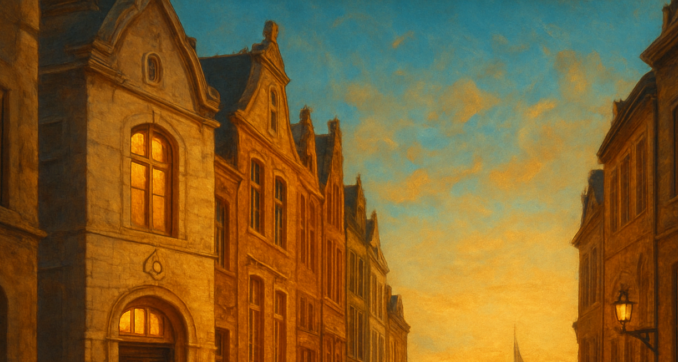
Walk through the narrow streets of Maastricht and you pass centuries of history without even realizing it. Between Romanesque churches and baroque facades hides a lesser-known tradition: that of Freemasonry. In this city where cultures and languages have intersected for centuries, brotherhood has taken on a character all its own. This is not a tour of monuments — it is a journey along the invisible threads that connect people to one another.
A City of Crossroads and Encounters
Maastricht is no ordinary Dutch city. Situated at the point where the Netherlands, Belgium, and Germany converge, it breathes a cosmopolitan atmosphere you simply won’t find anywhere else in the country. The Burgundian character, the influences from the Rhineland, the Walloon traces in the local dialect — everything here speaks of connection across borders. It is precisely in this context that Freemasonry in Maastricht has flourished for centuries.
The lodges in the province of Limburg have always occupied a distinctive position within the Grand East of the Netherlands. Far from the administrative center in The Hague, close to international influences, they developed a character of their own. Here, brotherhood was never abstract. It took shape in the daily interactions between people of different backgrounds who recognized one another as equals despite language barriers and cultural differences.
Freemasonry in Maastricht Through the Ages
The history of the Masonic tradition in the capital of Limburg reaches back to the eighteenth century. In an era when the city found itself alternately under French, Spanish, and Dutch rule, enlightened minds gathered in the lodge. Officers, merchants, artists, and craftsmen met on neutral ground, where rank and origin were temporarily set aside.
The lodge is a place where the outside world is briefly paused, where men meet as travelers on the same road, regardless of where that road began.
These words, once spoken by a Worshipful Master in Maastricht, capture the essence of Masonic brotherhood. It is not about who you are when you walk through the door, but about who you become in the encounter with others. In Maastricht, where identities have always been layered and plural, this principle felt remarkably natural.
The Lodge as a Practice Ground for Brotherhood
What makes Masonic brotherhood different from friendship or professional camaraderie? The answer lies in the intentional practice of it. In the lodge, brotherhood is not a byproduct of shared interests or coincidental sympathy. It is a choice, an exercise, and sometimes even a struggle. You commit to forming bonds with people you did not choose yourself — and it is precisely in that commitment that the transformative power resides.
The lodges of Maastricht carry a rich tradition of this kind of deliberate connection. In a city where Catholic and Protestant traditions, Dutch-speaking and French-speaking communities, established families and newcomers all converged, the lodge served as a laboratory for peaceful coexistence. Not by ignoring conflicts, but by creating a space where difference could exist without dividing.
Ritual as the Binding Force
Ritual plays a crucial role in this process. When Brethren perform the ancient workings together, a shared language emerges that goes deeper than words. The symbols of building, the tools of the stonemason, the journey from darkness to light — they form a common vocabulary that unites across personal differences.
- The compasses and the square as symbols of measure and balance in human relationships
- The rough ashlar, refined through collective labor into something greater
- The apron, a reminder of the dignity of honest work
- The chain of union, making the bond between Brethren tangible
Brotherhood in Maastricht Today
In 2026, Freemasonry in Maastricht faces new challenges. The city has changed. The university brought an international community, European institutions established themselves in the region, and young professionals come and go. How do you build lasting brotherhood in an age of mobility and fleeting connections?
The lodges in the region are seeking answers that fit the times. They organize open evenings where those curious about Freemasonry can learn about the tradition. They collaborate with cultural institutions throughout the city. And above all, they remain faithful to their core mission: offering a space where people can truly meet one another, beyond the roles they play in everyday life.
The Relevance of Ancient Wisdom
In an era when social media connect us but fail to unite us, when polarization poisons public discourse, Freemasonry offers a counterbalance. The lodge is a place where you learn to listen before you speak, where you practice tolerating difference, and where brotherhood is not optional but obligating.
In Maastricht, with its long history of living together in diversity, this message resonates with particular force. The Masonic lodges in this city carry a legacy that reaches far beyond their membership rolls. They remind us that genuine connection is possible — provided we are willing to work for it.
If you walk through Maastricht today and let your gaze wander across the old facades, you might spot a hidden symbol somewhere — a subtle reference to the tradition that has flourished here for centuries. Freemasonry in Maastricht is neither a museum piece nor a historical curiosity. It is a living practice of brotherhood, an exercise in humanity carried out week after week by men who believe we go further together than alone. In a world that often seems divided, that is a message that has lost none of its power.
Copyright text & image: devrijmetselaar.nl
Texts are based on the ideas and content of the author of devrijmetselaar.nl, reviewed, corrected, and supplemented with the assistance of OpenAI. Images are created based on the ideas of the author of devrijmetselaar.nl using OpenAI/DALL-E.
Frequently Asked Questions
What is the history of Freemasonry in Maastricht?
Freemasonry in Maastricht has a rich history dating back to the eighteenth century, when enlightened minds—including officers, merchants, artists, and craftsmen—gathered in lodges during a time when the city alternated between French, Spanish, and Dutch rule. The lodges in Limburg developed their own distinctive character, far from the administrative center in The Hague and influenced by the city's unique position at the crossroads of the Netherlands, Belgium, and Germany. This cosmopolitan environment made Freemasonry a natural meeting ground where people of different backgrounds could recognize one another as equals.
Why is Freemasonry particularly significant in Maastricht?
Maastricht's position at the convergence of three nations created a uniquely cosmopolitan atmosphere where Freemasonry flourished as a bridge between different cultures and languages. The lodge served as a neutral space where Dutch-speaking and French-speaking communities, Catholics and Protestants, and established families and newcomers could all meet as equals, making the Masonic principle of brotherhood feel remarkably natural in this multicultural city. The tradition became deeply woven into the fabric of Maastricht's identity as a city of crossroads and encounters.
What does Masonic brotherhood mean in practice?
According to Masonic tradition in Maastricht, brotherhood is not a byproduct of shared interests but rather an intentional practice and deliberate choice to form bonds with people you did not necessarily choose yourself. Within the lodge, rank and origin are temporarily set aside, and members meet as equals on a shared journey, regardless of their backgrounds or where they come from. This commitment to forming meaningful connections with diverse individuals is what gives Freemasonry its transformative power.
How do Maastricht's lodges differ from Freemasonry elsewhere in the Netherlands?
The lodges in Limburg have always occupied a distinctive position within the Grand East of the Netherlands, developing their own character due to their distance from the administrative center in The Hague and their proximity to international influences. In Maastricht specifically, brotherhood was never abstract but took shape through daily interactions between people of genuinely different backgrounds—including different languages and cultures—which made the practice of Masonic connection feel particularly authentic and meaningful. This cosmopolitan context gave Maastricht's Freemasonry a unique character shaped by centuries of cultural intersection.
Can visitors learn about Freemasonry while visiting Maastricht?
While the article focuses on the invisible threads of Freemasonry woven through Maastricht's history rather than specific monuments, visitors interested in the Masonic tradition can explore the city's centuries-old heritage by walking its narrow streets and learning about the historical lodges that served as gathering places for enlightened minds. The story of Freemasonry in Maastricht is inseparable from the city's identity as a place of cultural and linguistic intersection, making it an enriching aspect of understanding the city's unique character and history.


Be the first to comment