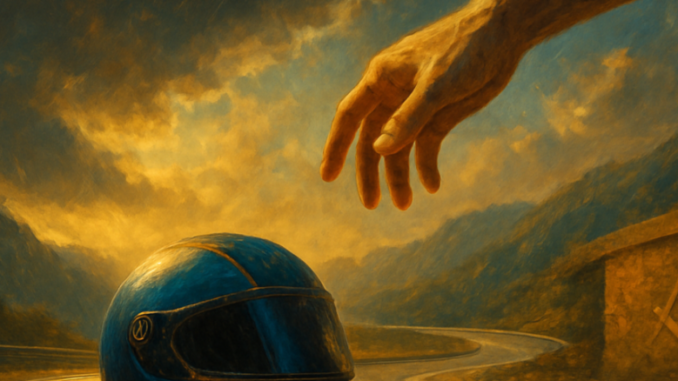
Picture two drivers on the same circuit, facing the same conditions, carrying the same ambitions. One pulls a flawless line through the corners of the Ardennes; the other ends up in the barriers. It’s an image you might recognize from your own life — moments where you perform brilliantly while someone beside you stumbles, or the other way around. What do you do then? How do you handle that inequality of fortune? And what does your response reveal about the nature of true connection?
The Circuit as a Mirror of Life
A racetrack is more than asphalt and curves. It’s a concentrated version of existence itself — risk, choices, timing, and the eternal dance between control and surrender. During a training session in the Belgian Ardennes this week, two experienced drivers had entirely different experiences. One drove smoothly and with composure; the other lost grip and crashed. Neither could have predicted the outcome beforehand.
You probably know that feeling. You’re in the same meeting as a colleague, following the same training, facing the same challenge. Yet things go differently for you than for the person beside you. Sometimes you’re the one who falls. Sometimes you’re the one who keeps going. The question isn’t whether this happens — it’s how you respond when it does.
The Temptation of Comparison
It’s tempting to measure yourself against others. When you succeed and someone else fails, a subtle sense of superiority can creep in. When you’re the one who stumbles while another shines, shame or jealousy may surface. Both reactions are deeply human. But neither builds anything lasting.
In Freemasonry, there’s an ancient principle that speaks directly to this: the idea that we are all rough ashlars still being shaped. No one is finished. No one has the definitive answer. The driver who crashes today might win the race tomorrow. And the one leading the pack right now could end up in the gravel next week. This shifting of fortune isn’t a flaw in life — it’s the very heart of it.
Brotherhood in Unequal Circumstances
True brotherhood isn’t tested when everything is going well. It’s tested in moments of inequality. Can you be genuinely happy for someone who succeeds where you failed? Can you extend a hand to someone who has fallen without a trace of condescension? These are the questions that truly matter.
The real measure of a person lies not in how they handle their own success, but in how they stand beside another in their adversity.
In a lodge, people come together who occupy entirely different positions in daily life. One is thriving in his career; another is struggling. One has just welcomed a child; another has lost someone dear. Yet they stand beside each other as brothers — not because their circumstances are equal, but because their dignity is. This attitude requires practice. It’s an art you must learn, again and again.
The Art of Getting Back Up
A crash isn’t the end. It’s an interruption. The question after every fall isn’t “why me?” but “what now?” In motorsport, drivers typically get back in the car as quickly as possible after a crash. Not out of recklessness, but from an understanding that standing still isn’t an option. Life demands movement — even when that movement is slow and cautious.
This principle echoes across wisdom traditions around the world. The Japanese philosophy of nana korobi ya oki — fall seven times, rise eight — speaks the same truth. And in Freemasonry, the work of self-improvement is a continuous process. You are never finished. Every setback is an invitation to begin again, with a little more insight than before.
What You Can Do
The next time you see someone beside you fall, ask yourself: what is my first impulse? Is it relief that it didn’t happen to me? Is it impatience? Or is it the instinct to stand beside that person — without judgment, without unsolicited advice, simply present?
Be present without judging. Celebrate the successes of others as if they were your own. Accept help when you’re the one who has fallen. And remember that fortune is fickle — for everyone.
Brotherhood is not a theory. It’s a practice. It asks you to set yourself aside, to park your own story for a moment to make room for someone else’s. And paradoxically, that is exactly what makes you richer.
On the circuit at Spa, two drivers ran their own race with entirely different outcomes. But the circuit doesn’t end at the finish line. It continues — lap after lap, season after season. And so it is with us. We fall, we rise, we keep going. The question that lingers isn’t who wins, but who stands beside you when you end up in the gravel. That is the essence of brotherhood: not the absence of adversity, but the presence of connection — especially when things are hard.
Copyright text & image: devrijmetselaar.nl
Texts are based on the ideas and content of the author of devrijmetselaar.nl, reviewed, corrected, and supplemented with the assistance of OpenAI. Images are created based on the ideas of the author of devrijmetselaar.nl using OpenAI/DALL-E.
Frequently Asked Questions
What does Freemasonry teach about dealing with failure or setbacks?
Freemasonry teaches that all members are 'rough ashlars' still being shaped by life's experiences, meaning no one is finished or perfect. The organization emphasizes that setbacks are not endpoints but interruptions, and the true measure of character lies in how you respond to adversity and get back up, not in avoiding failure altogether.
How does Freemasonry define true brotherhood?
True brotherhood in Freemasonry isn't about having equal circumstances, but about recognizing equal dignity in all people. It's tested through genuine support during others' struggles and setbacks, and it requires the ability to celebrate someone else's success even when you've experienced failure, without condescension or jealousy.
Why do people from different backgrounds and situations join Freemasonry together?
Freemasons come together as brothers not because their daily circumstances are equal, but because they share a commitment to mutual respect and support regardless of career success, personal challenges, or life situations. This creates a unique space where people from all walks of life stand beside each other with genuine equality of dignity.
What can Freemasonry teach me about handling success when others around me are struggling?
Freemasonry teaches that success is temporary and fortune shifts constantly—today's winner may face challenges tomorrow. The fraternity emphasizes using your success not to elevate yourself above others, but to extend genuine support and compassion to those currently facing difficulties, recognizing that roles can reverse at any moment.


Be the first to comment