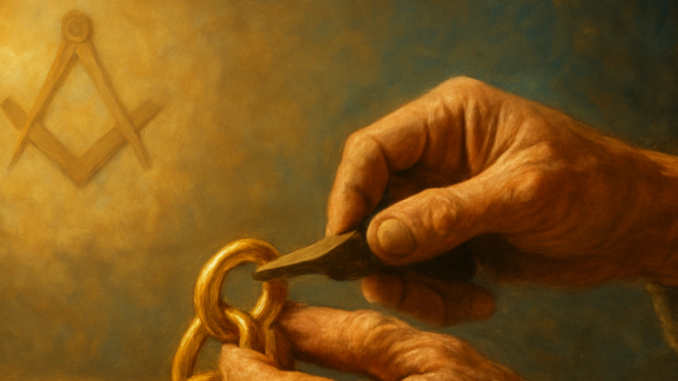
A golden chain around the neck. A handbag of supple leather. A timepiece built to last generations. These objects radiate craftsmanship, tradition, and a connection to the artisan who created them. But what if that chain doesn’t only link gold — what if it also conceals a shadow chain of exploitation? Recent police raids on renowned Italian fashion houses force us to confront a fundamental question: what does true connection actually mean?
The Jewel and Its Shadow
Every piece of jewelry tells two stories. The first is visible: the sparkle, the design, the status it projects. The second story lies hidden in the journey the object took before it reached the display window. In workshops — sometimes far removed from the gleaming boutiques — hands bend over workbenches. Those hands have names, faces, families. The question raised by the Italian investigations is simple yet deeply unsettling: are those hands treated as brothers, or as tools?
In Freemasonry, the chain is a powerful symbol. Brothers stand in a circle, hands clasped together, as a sign of unbreakable unity. That chain is not a hierarchy, not a production line. It is a horizontal bond of equality. Every link carries equal weight. When one link suffers, the entire chain feels the strain.
The Craftsman as Mirror
Imagine a goldsmith in a Florentine workshop centuries ago. He shaped gold not only with his hands but with his entire being. His dignity was woven into his work. The guilds of old — forerunners of the Masonic lodges — understood this intuitively. Craftsmanship was not mere labor to be bought and discarded at will. It was a way of life, protected by a community of equals.
What does it profit a man if he gains the whole world, yet suffers the loss of his own soul?
This ancient passage resonates deeply when we consider the relationship between luxury and the people who produce it. A brand may earn worldwide admiration, but if its foundations rest on exploitation, the soul of the product is corrupted. The sparkle becomes a mask.
Brotherhood Without Conditions
Freemasonry speaks of brotherhood as a bond that extends far beyond economic utility. A brother is not a means to an end. He is valued not for what he produces, but for who he is. This principle stands in stark contrast to a system in which human labor is reduced to a line item on a balance sheet — a cost to be minimized or outsourced to the cheapest link in the chain.
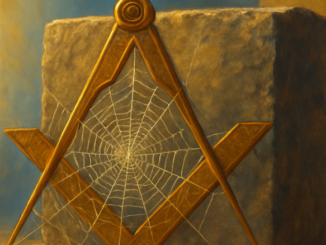
The symbolism of the working tools in the lodge makes this concrete. The compasses, the square, the gavel — these are not merely the instruments of the stonemason. They are metaphors for self-improvement and for the way we treat others. The rough ashlar we work on is ourselves. But the edifice we raise together demands respect for every stone, every hand that contributes.
The Invisible Workshop
What the Italian raids exposed is not unique to the fashion industry. It is a mirror held up to society as a whole. Wherever supply chains grow longer and distances wider, the risk emerges that we forget the human being behind the product. We know the baker on the corner by name. The seamstress in a distant workshop remains anonymous, invisible, easy to ignore.
What do we truly know about the origins of what we wear? What questions do we ask of the brands we trust? How can we restore a chain of genuine connection?
The Freemason learns that seeking light begins with examining darkness — including the darkness embedded in structures we take for granted. Not to condemn, but to understand and to improve.
Repairing the Chain
True luxury, one might argue, is not only the finished product but the entire story that precedes it. A piece of jewelry made by hands that were treated with dignity carries a different energy than an object born of exploitation. This is not sentimentality — it is a deeper truth about value.
The challenge of our time is to make the invisible workshop visible again. To give the anonymous link in the chain a face, a voice, a place at the table. Freemasonry offers no ready-made solution to this, but it does offer a direction: treat others as you wish to be treated yourself. See in every fellow human being a brother or sister, regardless of distance or anonymity.
A Personal Reflection
When I look at a piece of jewelry now, I no longer see just the object. I see the hands that shaped it, the eyes that focused intently, the sweat on a brow. I ask myself: was there a wage that allowed for a dignified life? Was there rest, safety, respect? I often don’t know the answers. But asking the question is already a beginning. It is a way of mending the broken chain in the mind — link by link, person by person.
The raids in Italy are more than a legal footnote. They are an invitation to reflect on what brotherhood truly means in a world of long supply chains and short memories. The Freemason knows that a building only stands when every stone has been placed with care and every hand has been treated with respect. May that wisdom guide us — even when we do something as seemingly simple as putting on a chain.
Copyright text & image: devrijmetselaar.nl
Texts are based on the ideas and content of the author of devrijmetselaar.nl, reviewed, corrected, and supplemented with the assistance of OpenAI. Images are created based on the ideas of the author of devrijmetselaar.nl using OpenAI/DALL-E.
Frequently Asked Questions
What does Freemasonry teach about the relationship between workers and their labor?
Freemasonry teaches that workers are brothers and equals, not merely tools or cost items to be minimized. The fraternity values each person for who they are, not just what they produce, and emphasizes that true craftsmanship is a dignified way of life protected by a community of equals. This principle stands in direct opposition to systems that exploit labor for profit.
How does the Masonic symbol of the chain relate to ethical business practices?
In Freemasonry, the chain represents unbreakable unity where brothers stand as equals with no hierarchy—every link carries equal weight. When applied to business, this symbolism reminds us that when workers are treated with dignity and respect rather than exploitation, the entire chain of commerce becomes stronger and more honorable. This contrasts sharply with supply chains built on hidden exploitation.
What can luxury brands learn from Masonic principles about craftsmanship?
Masonic tradition teaches that true craftsmanship must be rooted in respect for the worker and self-improvement, using tools of the craft as metaphors for personal and collective growth. Luxury brands that ignore the dignity and fair treatment of those who create their products corrupt the soul of their work, turning authentic craftsmanship into mere profit-driven production. Brands that honor Masonic principles would ensure their artisans are treated as valued brothers, not exploited labor.
How does Freemasonry define 'true brotherhood' in the context of labor and commerce?
Freemasonry defines true brotherhood as a bond of equality that extends beyond economic utility, where each person is valued for their inherent worth rather than their economic output. This principle demands that workers be treated with the respect and dignity due to fellow brothers, not as interchangeable commodities. Such brotherhood creates a stronger, more ethical foundation for any enterprise than systems built on hidden exploitation.

Be the first to comment