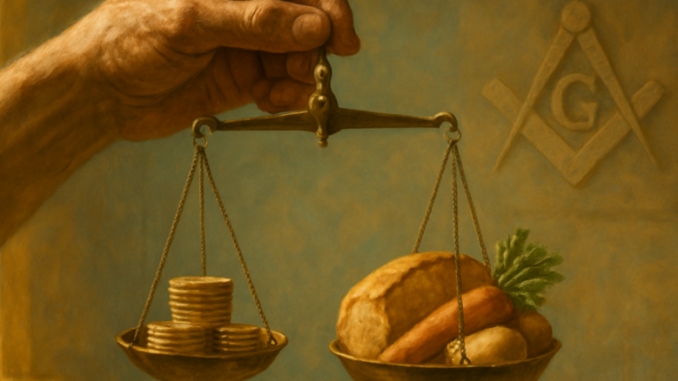
Here is a paradox that demands deeper reflection: economists tell us inflation is falling, that the numbers are moving in the right direction, that the curve is finally bending downward. Yet we look at the receipt at the checkout and feel something quite different. Groceries still cost more than we expect, the energy bill still stings, and fixed costs still gnaw at our peace of mind. How can something simultaneously improve and remain painful? This tension between measurement and experience — between abstract truth and felt reality — touches on fundamental questions about how we, as human beings, assign value to the world around us.
The Gap Between Numbers and Feeling
Let us first examine the paradox more closely. When economists speak of falling inflation, they mean the rate at which prices are rising is slowing down. Prices are not falling — they are simply rising less quickly. It is the difference between a car still moving forward, but decelerating. For anyone already struggling to keep up, this offers little comfort. The distance between where you are and where you need to be is still growing, just not as fast.
This is not a matter of ignorance or misunderstanding on the part of ordinary people. It is a fundamental difference in perspective. The economist measures change; the individual experiences a condition. The economist watches the direction of the arrow; the person feels the weight of the burden. Both are right, yet they speak entirely different languages.
Value as a Human Construction
Freemasonry invites its members to reflect continuously on the nature of value — not just financial value, but value in its broadest sense. What makes something valuable? Is it what something costs, or what it means? Is value objectively measurable, or does it emerge from the interplay between a person and the world? These questions are not merely academic. They go to the heart of how we live together in society.
In the lodge, Brethren learn that outward signs often represent only part of reality. A symbol is never the thing itself — it points to something deeper. The same holds true for money: the number on a price tag is not the value of a product but a symbol referring to a complex web of labor, scarcity, demand, and social agreements. When we complain about expensive groceries, we are really complaining about a shift in that web — a shift that affects us profoundly but that we cannot fully grasp.
The Mason’s Measure
There is an old saying in the building tradition from which Freemasonry draws its symbolism: measure twice, cut once. Accuracy in measurement prevents waste and error. But what if the measure itself is in question? What if the ruler we use to gauge prosperity does not actually capture what we truly want to know?
It is not about what we have, but about what we are in relation to what we need.
Inflation figures track price changes for a standardized basket of goods. But my basket is not your basket. Someone living in a poorly insulated house experiences the energy crisis very differently from someone with solar panels on the roof. A parent raising children feels the price increase of dairy and vegetables differently from someone living alone. The measure is an average — but we are individuals. And it is precisely in that tension between the general and the particular that much of society’s unease resides.
Brotherhood in Times of Scarcity
Freemasonry has witnessed and survived periods of economic turmoil throughout the centuries. Lodges continued to function during wars, recessions, and social upheavals. This was not because Brethren were immune to financial worries — far from it. It was because the lodge offered a space where other values took precedence: mutual support, shared reflection, and the understanding that prosperity is more than what you possess.
In times of scarcity, the question of justice becomes more urgent. How do we distribute what we have? Who bears the burdens, and who reaps the benefits? These are questions that cannot be answered solely by governments and economists. They demand the engagement of every member of society. The Freemason sees himself as a builder of a better world — stone by stone, person by person. That responsibility does not vanish when the statistics offer a glimmer of hope.
Beyond the Numbers
Perhaps the most important lesson we can draw from this paradox of falling inflation and persistent pressure is that we must be careful not to place too much faith in any abstraction. Numbers are useful — indispensable, even — but they do not replace the conversation between people about how things truly are. The question “How are you doing?” is not a question about your inflation-adjusted purchasing power. It is a question about your experience, your worries, your hope.
Numbers describe averages, not individual realities. Value is both objective and subjective. Community is built through attention to the particular. Measuring is knowing, but feeling is understanding.
The lodge does not offer economic solutions. It offers something different: a space where conversations about value, justice, and human dignity can take place without haste, without political agendas, and with respect for every perspective. In that sense, it may be more relevant than ever in an age when the numbers point one way and the heart points another.
The question that lingers is perhaps this: if the measure by which we gauge prosperity does not match our lived experience, should we adjust the measure, recalibrate our expectations, or both? And more importantly — who decides? In a society increasingly fragmenting into individual realities, the conversation about shared values may be the most precious currency we have. That currency never devalues, so long as we continue to invest in it.
Copyright text & image: devrijmetselaar.nl
Texts are based on the ideas and content of the author of devrijmetselaar.nl, reviewed, corrected, and supplemented with the assistance of OpenAI. Images are created based on the ideas of the author of devrijmetselaar.nl using OpenAI/DALL-E.
Frequently Asked Questions
What does Freemasonry teach about understanding value and worth?
Freemasonry encourages members to reflect deeply on value in its broadest sense — beyond mere financial metrics. Through lodge teachings and symbolic study, Brethren learn that outward signs and measurements often represent only part of reality, and that true value emerges from understanding the complex relationships between people, labor, scarcity, and social agreements.
How does Masonic philosophy help us cope with economic uncertainty?
Freemasonry teaches that symbols point to deeper truths and that we must measure carefully before acting, embodied in the principle 'measure twice, cut once.' This wisdom helps Brethren navigate confusing economic signals by encouraging reflection on what truly matters — not just what we have, but our relationship to what we need and what brings meaning to our lives.
Why does Freemasonry emphasize continuous reflection and learning?
The fraternity believes that wisdom comes through thoughtful examination of life's fundamental questions, including how we assign meaning to the world around us. By encouraging Brethren to look beyond surface-level measurements and statistics, Freemasonry helps members develop deeper understanding and resilience in facing life's challenges.
How can Masonic principles bridge the gap between expert analysis and personal experience?
Freemasonry teaches that both objective measurement and personal experience hold truth, though they speak different languages. Through lodge fellowship and shared reflection, Brethren learn to hold both perspectives simultaneously — understanding that economists and individuals are both right — which fosters compassion and wisdom in our communities.

Be the first to comment