In the eighteenth century, when the first Grand Lodges in Europe opened their doors, an unwritten rule applied that remains relevant to this day: whoever enters leaves their social rank at the door. Whether you were a baker or a banker, your standing in the lodge was determined by your inner growth — not by your external achievements. This principle sheds a surprising light on a notion that still circulates in our culture: the belief that everything one touches turns to gold.
The Alchemical Myth Debunked
The expression “everything I touch turns to gold” traces back to King Midas from Greek mythology. His story ends tragically: he nearly starves to death because even his food transforms into gold. From the earliest philosophical traditions, thinkers understood the Midas myth as a warning against hubris — the dangerous overconfidence that arises when success goes to one’s head.
Freemasonry, with its roots in the medieval stonemason guilds, understood this lesson centuries ago. The craftsmen who built the great cathedrals of Europe knew that every masterpiece was the result of countless failed attempts, broken stones, and endless patience. Their wisdom: true craftsmanship reveals itself not in perfection, but in the ability to learn from imperfection.
The Historic Ritual of the Rough Ashlar
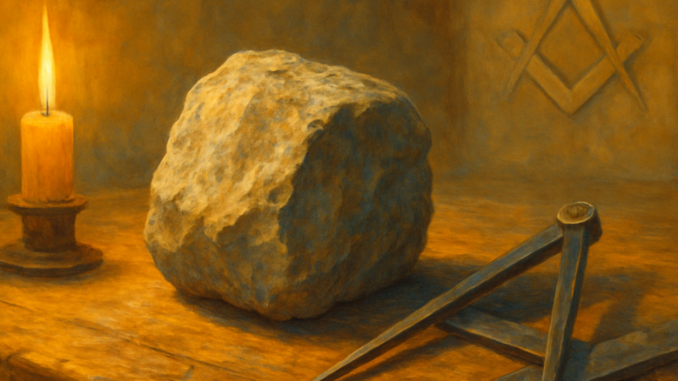
When a man was initiated into a Masonic lodge in the eighteenth century, he received no trophy or certificate. Instead, he was shown a rough, unworked stone — the rough ashlar. This was neither punishment nor humiliation. It was a gift. The rough ashlar symbolized the human being in an unpolished state: full of potential, but not yet perfected. The work of shaping and smoothing that stone was the lifelong task of every Freemason.
What stands out in historical lodge records from this period is how often successful men put their status into perspective the moment they entered the temple. A record from an Amsterdam lodge dating to 1756 describes how a wealthy merchant introduced himself as “an apprentice in life, a master in humility.” This was not false modesty — it was a deeply held conviction that external success says little about inner richness.
What History Teaches Us About Character
The Enlightenment thinkers who shaped eighteenth-century Freemasonry drew a sharp distinction between reputation and character. Reputation was what others thought of you; character was who you truly were when no one was watching. In their eyes, anyone who claimed that everything they attempted succeeded was suspect — not because success itself was wrong, but because the claim revealed a lack of self-knowledge.
“Know thyself,” proclaimed the Oracle at Delphi. The Freemason added: and be honest about what you find.
This ancient wisdom resonates powerfully with contemporary conversations about the limits of personal achievement. Anyone who acknowledges that not everything works out actually demonstrates a refined personality. It reveals a capacity for self-reflection — a quality that Freemasonry has always valued more highly than external accomplishments.
The Lodge as a Training Ground for Honesty
Within the closed space of the lodge, Freemasons have practiced a remarkable skill through the centuries: admitting their own shortcomings without shame. This did not happen through public confession or self-punishment, but through ritual actions that remind each person of their limitations. The square and compasses — Freemasonry’s most recognized symbols — served as measuring instruments not only for stone, but for one’s own conduct.
The compasses remind us of the need for moderation. The square symbolizes fairness toward oneself and others. The rough ashlar represents the unfinished self. The perfect ashlar shows the ideal — never fully achieved. These symbols were never mere decoration. They formed a daily reminder that the perfect human being does not exist, and that recognizing this truth is the beginning of real growth.
From Then to Now: A Lesson for Today
In an age when social media invites us to broadcast our successes above all else, this historic Masonic wisdom sounds like a countervoice. The lessons from eighteenth-century lodges are strikingly relevant: true greatness reveals itself not in claiming infallibility, but in honestly acknowledging one’s own limits.
When someone today publicly admits that not everything they touch turns to gold, they are echoing an age-old wisdom. The stonemasons of centuries past already knew: the most beautiful cathedrals were built by people who did not hide their failures but learned from them. Every crooked stone was a lesson. Every crack was a teacher.
Humility as Maturity
Freemasonry has never claimed to hold the key to success. What it does offer is a framework for putting both success and failure into perspective. In this sense, acknowledging one’s own limitations is not weakness — it is the hallmark of a mature personality that sees beyond the illusions of the moment.
Eighteenth-century Freemasons would probably smile at today’s conversations about the boundaries of personal ability. Not out of cynicism, but out of recognition. They knew what we sometimes forget: that the road to wisdom is paved with acknowledged failures, and that the rough ashlar is more beautiful than the polished mask.
The history of Freemasonry teaches us that humility is not weakness but a sign of inner strength. Those who dare to admit that not everything succeeds stand in a long tradition of thinkers and builders who understood that true greatness lies in self-knowledge. The rough ashlar remains an open invitation — not to be perfect, but to grow honestly.
Copyright text & image: devrijmetselaar.nl
Texts are based on the ideas and content of the author of devrijmetselaar.nl, reviewed, corrected, and supplemented with the assistance of OpenAI. Images are created based on the ideas of the author of devrijmetselaar.nl using OpenAI/DALL-E.
Frequently Asked Questions
What does Freemasonry teach about success and ego?
Freemasonry teaches that true success comes from inner growth and character development rather than external achievements or social status. The fraternity has long understood that humility and self-awareness are marks of genuine strength, drawing on the ancient wisdom that recognizes the dangers of unchecked ego and overconfidence. This principle is symbolized in the rough ashlar—an unpolished stone representing human potential—which reminds Masons that perfection is a lifelong journey of learning from imperfection.
Why do Freemasons use the rough ashlar as a symbol?
The rough ashlar is presented to initiates to symbolize the human being in an unpolished state—full of potential but not yet perfected. This symbol reminds Masons that their lifelong work is to shape and smooth their character through continuous self-improvement, learning, and reflection, much like the medieval stonemasons who built Europe's great cathedrals through countless attempts and patient craftsmanship.
Does Freemasonry reject success and achievement?
No, Freemasonry does not reject success; rather, it emphasizes that true achievement comes from character and inner development rather than from external status or material gains. The fraternity values honest self-knowledge and acknowledges that meaningful accomplishment includes learning from failures and setbacks, which reveals wisdom and self-awareness that external success alone cannot demonstrate.
What is the difference between reputation and character in Masonic philosophy?
In Masonic teaching, reputation is what others think of you, while character is who you truly are when no one is watching. The fraternity prioritizes character development because it reflects genuine inner growth and integrity, while reputation can be superficial or misleading. This distinction encourages Masons to focus on becoming better people rather than simply appearing successful to others.
How did historical Freemasons view their social status in the lodge?
Eighteenth-century Freemasons left their social rank at the lodge door—whether wealthy bankers or humble bakers, their standing was determined by inner growth rather than external achievements. Historical records show that even successful men would introduce themselves with humility, such as one Amsterdam merchant who called himself 'an apprentice in life, a master in humility,' reflecting the Masonic conviction that true richness is found within rather than in worldly status.


Be the first to comment