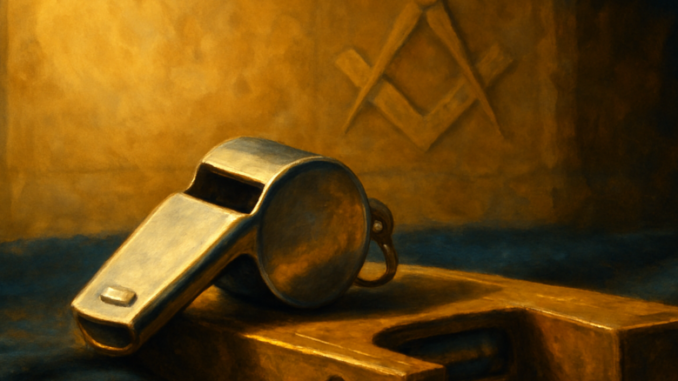
When the head of refereeing for an international football federation declares that even the most powerful figures have no influence over his decisions, it touches on a universal theme: the question of impartiality. How do you preserve your integrity when external pressure mounts? This challenge plays out not only on the football pitch but also in the quiet of the Masonic lodge, where brethren practice the art of judgment without prejudice.
The World of the Referee
In international football, the referee stands as a central symbol of fairness. Every decision is analyzed, criticized, and sometimes regarded with suspicion. When a top official must publicly declare that there has been no outside influence — not even from the highest authority — it reveals something about the world he operates in. It is a world of constant scrutiny, where every whistle can be interpreted as evidence of bias.
The referee moves through an arena where millions of eyes are watching. His neutrality is not merely expected — it is demanded. And yet, he is human, carrying his own experiences, preferences, and blind spots. The art lies not in denying this humanity but in acknowledging it and rising above it. The referee must continually step back from his own perspective in order to lead the game fairly.
The World of the Freemason
Inside the lodge, a different kind of practice takes place. Here, people from diverse backgrounds come together — different professions, beliefs, and life experiences. The Freemason learns not to judge his brethren by their social standing, wealth, or origin. The apron, worn by every brother, symbolizes this equality: regardless of who you are outside the lodge, here you stand as an equal.
This exercise in impartiality is not a one-time achievement but an ongoing process. At every meeting, the Freemason is invited to leave his prejudices at the door. The rituals remind him that true justice begins with self-knowledge. Anyone who does not understand his own biases cannot possibly judge others fairly.
The level teaches us that all people, regardless of their place in the world, stand on the same plane of humanity.
Where Both Worlds Converge
At first glance, the football pitch and the Masonic lodge seem to have little in common. Yet the referee and the Freemason share a fundamental challenge: maintaining impartiality while operating within a larger system. Both function inside structures where power, influence, and expectations play a role. Both must constantly navigate between external pressure and inner integrity.
The referee has regulations and protocols to safeguard his independence. The Freemason has rituals and symbols that remind him of his ethical obligations. In both cases, the goal is not to achieve perfect neutrality — that would be an inhuman standard. The goal is the continual striving, the daily practice of transcending self-interest and prejudice.
The Invisible Test
What truly makes someone impartial? Not the absence of influences — those are everywhere. Rather, it is the willingness to acknowledge those influences and deal with them consciously. A referee who claims that no one has any influence over him makes a bold statement. But the deeper question is: how does he handle the subtle pressures that are never spoken aloud?
In Freemasonry, this question is not avoided — it is placed front and center. The brother is encouraged to examine himself continually. What hidden loyalties are shaping my judgment? What fears or desires are coloring my perspective? This self-questioning is not a sign of weakness but of ethical maturity.
The referee asks himself: Am I being fair in my decisions? The Freemason asks himself: Am I being honest with myself? Both seek a justice that goes beyond rules alone.
What We Can Learn
The debate over bias in football reminds us how fragile trust can be. Once the appearance of influence arises, it is difficult to dispel — even with the most emphatic denials. The same holds true in everyday life. Our integrity is defined not only by our actions but also by how those actions are perceived.
Freemasonry offers no magic formula for impartiality. What it does offer is a framework for continuous self-reflection. By regularly pausing to examine our own prejudices and blind spots, we can grow in our capacity to judge fairly. Not because we stand above human weakness, but precisely because we acknowledge it.
Whether you stand on a pitch with a whistle or sit in silence within a lodge, the challenge remains the same: how do you stay true to your conscience when the world around you pushes and pulls? The answer lies not in denying outside influences but in engaging with them consciously. Both the referee and the Freemason understand that impartiality is not a destination — it is a path that must be walked anew each day.
Copyright text & image: devrijmetselaar.nl
Texts are based on the ideas and content of the author of devrijmetselaar.nl, reviewed, corrected, and supplemented with the assistance of OpenAI. Images are created based on the ideas of the author of devrijmetselaar.nl using OpenAI/DALL-E.
Frequently Asked Questions
What does Freemasonry teach about impartiality and fairness?
Freemasonry teaches that impartiality is an ongoing practice rather than a one-time achievement, emphasizing self-knowledge as the foundation for fair judgment. Through rituals and symbols like the level and apron, Freemasons are reminded to set aside their prejudices and social biases, treating all brethren as equals regardless of their background, wealth, or status. This daily practice of transcending self-interest develops men of integrity who can judge fairly in their lodges and throughout their lives.
How does Freemasonry help members overcome their personal biases?
Freemasonry provides a structured environment where men from diverse backgrounds come together, challenging them to see beyond social standing and personal preferences. The apron symbolizes equality, reminding every brother that inside the lodge, all are on the same plane of humanity. Through regular rituals and the teachings of Masonic symbols, members are continually invited to examine their own blind spots and prejudices, making impartiality a living practice rather than merely an ideal.
What is the significance of the level in Masonic teaching?
The level is a fundamental Masonic symbol that teaches equality and impartiality among all people. It represents the principle that all brethren, regardless of their position in the world, stand on the same plane of humanity within the lodge. This powerful symbol reinforces Freemasonry's core teaching that true justice and fair judgment begin with recognizing the equal worth and dignity of all people.
Is it realistic to expect complete impartiality from anyone?
Freemasonry acknowledges that perfect neutrality is an inhuman standard, as all people carry their own experiences, preferences, and perspectives. Rather than striving for impossible perfection, Freemasonry teaches the continuous practice of transcending self-interest and prejudice through self-awareness and ethical commitment. The goal is not perfection, but the sincere and daily effort to judge fairly and act justly, which is both realistic and noble.
How can Freemasonry principles apply to everyday life outside the lodge?
Freemasonry's teachings on impartiality and self-knowledge equip members to navigate challenges in their professional and personal lives with greater fairness and integrity. By practicing the removal of prejudice within the lodge, Freemasons develop habits of mind that help them make better decisions, treat others with greater respect, and maintain ethical standards even under pressure. These principles transform not only the individual Mason but also positively influence his family, workplace, and community.


Be the first to comment