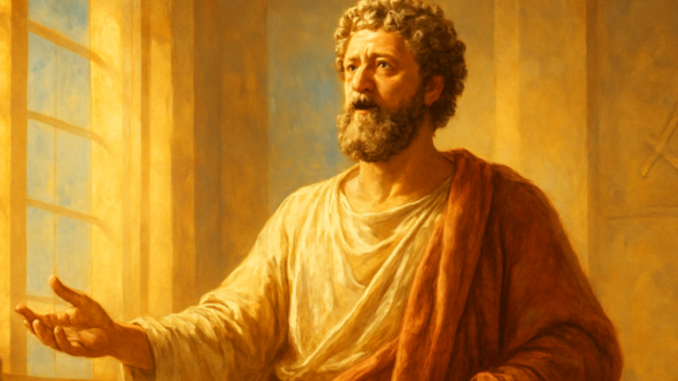
In the eleventh book of his Meditations, Marcus Aurelius turns his attention to one of the most fundamental questions of human existence: how should we deal with the evil that others inflict upon us? The Roman emperor and philosopher never intended these reflections for publication. They were private notes, written during military campaigns and under the weight of imperial responsibility. That is precisely why his words strike so deep. They reveal a man wrestling with the same frustrations and irritations we all know — and searching for a path toward inner peace in a world full of imperfection.
The Heart of Book XI: Understanding Over Judgment
The central theme of Book XI revolves around a paradoxical truth: the evil that people do arises from ignorance, not from deliberate malice. Marcus Aurelius reiterates the Stoic conviction that reaches back to Socrates and Plato. No one willingly does wrong when they truly understand what is good. The person who lies, steals, or insults acts from a clouded understanding of what is truly valuable. This thought invites compassion rather than anger.
This does not mean Marcus Aurelius excuses wrongdoing or naively dismisses it. On the contrary, he fully acknowledges the reality of human failure in all its forms. But he chooses to govern his own reaction. He cannot change the other person — only himself. This focus on one’s own inner world forms the thread running through the entire eleventh book.
The Rough Ashlar and Human Imperfection
For those familiar with Masonic symbolism, this approach resonates deeply. The Rough Ashlar — the traditional symbol for the Entered Apprentice — represents the human being in an unpolished state. Full of irregularities, sharp edges, and hidden cracks. The work on this stone is lifelong, demanding patience both with oneself and with others. Marcus Aurelius describes essentially the same process: the continuous refinement of character through conscious self-reflection.
The evil in others is a mirror for the unfinished work within ourselves. Those who recognize this replace judgment with understanding.
When someone hurts us, the philosopher-emperor argues, we should ask ourselves: what error in thinking led this person to behave this way? And then: am I truly free from comparable faults? This double movement — first outward in understanding, then inward in examination — prevents us from falling into either self-righteousness or bitterness.
Lessons from the Daily Life of an Emperor
Marcus Aurelius peppers his reflections with concrete situations. He speaks of people who lie, who are ungrateful, who gossip behind his back or openly obstruct his efforts. As emperor, he dealt daily with court intrigues, unreliable generals, and corrupt officials. Yet time and again, he chooses composure. Not out of weakness, but out of wisdom. He reminds himself that even these people are part of the same human family, the same cosmic order.
A striking image recurs throughout: the vision of all human beings as limbs of a single body. If a hand were to injure a foot, the entire body would suffer. So it is with humanity. This organic metaphor — which also appears in the letters of Paul and in numerous philosophical traditions — underscores the interconnectedness that renders anger pointless. You cannot truly harm another without harming yourself.
The Square of Inner Judgment
In Freemasonry, the Square serves as a symbol of rectitude and the ability to measure one’s actions against a moral standard. Marcus Aurelius employs a comparable inner square throughout Book XI. Whenever he notices emotions threatening to sweep him away, he holds his reaction against the measuring rod of reason. Is this anger justified? Does it help me or the situation? Most often, the answer is no.
This process of continual self-examination requires practice. It is not a one-time insight but a daily discipline. The emperor wrote these notes for himself — reminders for those moments when the mind weakens and emotions threaten to take over. It is precisely this honesty that makes his work so timeless. He presents not a finished philosophy but a living practice.
Impermanence as Consolation
Another recurring motif in Book XI is the transience of all things. The people who irritate us now will die. We ourselves will die. Our entire generation will be forgotten, just as all generations before us were forgotten. This may sound bleak, but Marcus Aurelius means it as liberation. Why waste precious energy on resentment over matters that will vanish within a few decades?
This contemplation of death — known as memento mori — also forms a core practice within many spiritual traditions, including strands of Masonic thought. Anyone who truly grasps the finite nature of life understands that every day is too valuable to fill with bitterness. The wrongdoing of others loses its grip when set against the backdrop of eternity.
The Universal Lesson of Book XI
What Marcus Aurelius leaves us in this book is not a recipe for moral perfection, but an invitation to self-examination. He does not ask us to become saints, but to become more conscious human beings. Conscious of our own shortcomings, understanding toward those of others, and focused on what truly lies within our power: our own attitude, our own judgment, our own choice to bring light or to deepen the darkness.
The stone we work upon is not only our own character but also our relationship with our fellow human beings. Every encounter with imperfection in another is an opportunity to deepen our own understanding. In this way, evil paradoxically becomes a teacher, and frustration transforms into wisdom.
Book XI of the Meditations offers no easy answers, but it does provide a direction. Marcus Aurelius shows us that inner peace does not depend on the absence of conflict or the perfection of those around us. It depends on our willingness to do the inner work — to take up the gavel and chisel each day and shape ourselves into something closer to what we aspire to be. For the Freemason and the seeker alike, this ancient Stoic wisdom remains a powerful guide: the greatest victory is not over others, but over ourselves.
Copyright text & image: devrijmetselaar.nl
Texts are based on the ideas and content of the author of devrijmetselaar.nl, reviewed, corrected, and supplemented with the assistance of OpenAI. Images are created based on the ideas of the author of devrijmetselaar.nl using OpenAI/DALL-E.


Be the first to comment