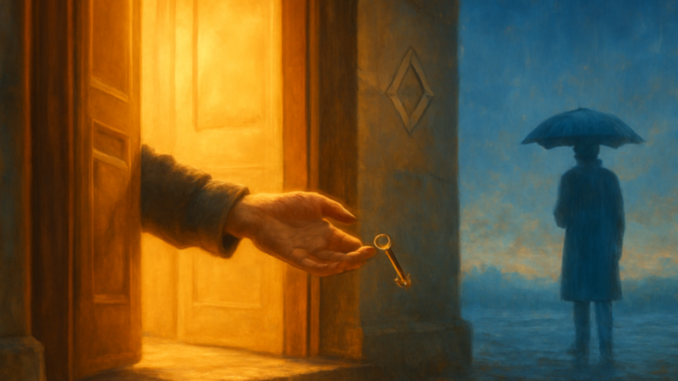
You probably know the feeling: you see a situation that calls for action, but you wait for someone else to step up. Or you quietly convince yourself that your contribution wouldn’t matter in the grand scheme of things. When communities fall short in providing shelter and welcome to those in need, it touches on something far deeper than policy or politics. It raises a fundamental question: how do we relate to the stranger at our door? Freemasonry, perhaps surprisingly, offers deeply practical guidance on this — rooted in centuries-old rituals of hospitality.
The Threshold as a Sacred Boundary
In Freemasonry, the threshold carries powerful symbolic weight. Anyone who enters a lodge building consciously crosses a boundary between the outside world and a space of reflection. But that threshold works in two directions: it protects what lies within, and it determines who is welcome. The question of whom we let in is therefore not a bureaucratic matter — it is an ethical exercise.
Historically, operative lodges maintained strict customs around hospitality. Traveling craftsmen could count on shelter from fellow brothers in distant cities. This wasn’t charity born from pity — it was a practical system of mutual support. You helped the traveler today, knowing that you yourself might be on the road tomorrow. That reciprocity transformed hospitality from a favor into a natural expectation.
Why Do We Wait for Others to Act?
The tendency to hold back while others are in urgent need has a well-documented name in psychology: diffusion of responsibility. The more people who witness a problem, the less likely any single individual is to take action. Everyone assumes someone else will handle it.
Freemasonry breaks this pattern by placing personal responsibility at the center of its teachings. One of its core principles is that self-improvement always begins with yourself — not with pointing out the shortcomings of others. This translates into a direct and powerful question: what can I do, regardless of what my neighbor does? It is a simple but transformative shift in perspective.
Those who wait for the world to change will keep waiting. Those who begin with themselves set change in motion.
Practical Steps Toward Active Hospitality
How do you translate this into your own life? You don’t need to open a shelter to practice hospitality. The lodge teaches us that small, consistent actions carry more weight than grand gestures that happen only once. Here are some concrete ways to begin:
Start by learning what’s happening in your immediate community when it comes to people in need of welcome and support. Know the facts before you form opinions. Volunteer your time with a local organization that supports newcomers — even one afternoon a month makes a genuine difference. Talk about hospitality within your own circles without falling into political debate; keep the focus on the human dimension. And practice in small ways first: invite someone you don’t know well to share a meal. Hospitality begins at your own table.
The Ritual of Welcome
In every lodge meeting, there is a dedicated moment when visitors are formally welcomed. This is no mere formality — it is a deliberate ritual. By ritualizing the act of welcome, it is elevated above the ordinary. It is given weight, meaning, and attention. The visitor feels that their presence is truly acknowledged.
You can adopt this principle in your daily life. How do you greet people who visit your home for the first time? How do you receive a new colleague, a new neighbor, someone who is visibly uncomfortable in a group? By giving conscious attention to the moment of meeting, you transform an ordinary interaction into something meaningful.
The Power of the First Gesture
Freemasons learn that the first gesture sets the tone for everything that follows. A warm reception opens doors that would otherwise remain closed. This applies not only to individuals but to entire communities. The community that is first to stand up and help inspires others to follow. Leadership in hospitality is contagious.
From Symbol to Action
Freemasonry is rich in symbols, but symbols without action remain empty forms. The square and compasses on the wall serve as reminders of values, but it is the daily application of those values that gives them meaning. In the same way, hospitality is not something to philosophize about — it is something to do.
This week, try one concrete experiment: consciously choose a situation where you would normally hold back, and take the initiative instead. It doesn’t have to be anything grand. Strike up a conversation with someone who looks lost. Offer a helping hand without being asked. Then observe what this does — both for you and for the other person.
The ancient master builders knew that a structure rises stone by stone. A hospitable society is built the same way: gesture by gesture, person by person. Not by waiting for the perfect solution, but by working on what lies directly in front of you.
Hospitality is not an abstract ideal — it is a daily practice that can be cultivated and refined. Freemasonry reminds us that waiting for others is a form of standing still. By lowering the threshold yourself, by opening the door and making the first gesture, you set something in motion that reaches far beyond your own life. Start today, start small, start with yourself. The rough stone is only polished by the hand that dares to touch it.
Copyright text & image: devrijmetselaar.nl
Texts are based on the ideas and content of the author of devrijmetselaar.nl, reviewed, corrected, and supplemented with the assistance of OpenAI. Images are created based on the ideas of the author of devrijmetselaar.nl using OpenAI/DALL-E.
Frequently Asked Questions
What does Freemasonry teach about welcoming strangers and newcomers?
Freemasonry teaches that hospitality is a sacred responsibility rooted in centuries of tradition where traveling craftsmen could rely on shelter and support from brother Masons in distant cities. This practice wasn't charity, but mutual reciprocity — helping others today with the understanding that you might need help tomorrow. The lodge emphasizes that welcoming others is an ethical exercise that transforms hospitality from a occasional favor into a natural and expected way of relating to those in need.
How does Freemasonry address the problem of people not taking action to help others?
Freemasonry directly counters the psychological tendency to wait for others to act by placing personal responsibility at the center of its teachings. Rather than pointing out what others should do, Masonry asks each individual: 'What can I do, regardless of what my neighbor does?' This powerful shift in perspective empowers members to initiate change themselves, recognizing that those who wait for the world to change will keep waiting, while those who begin with themselves set meaningful change in motion.
Do I need to do something grand to practice the hospitality that Freemasonry teaches?
No — Freemasonry teaches that small, consistent actions carry more weight than grand gestures that happen only once. You can start by learning about needs in your community, volunteering even one afternoon a month with a local organization, discussing hospitality with others, and practicing in simple ways like inviting someone new to share a meal. These modest but deliberate steps create genuine and lasting impact.
What is the symbolic meaning of the threshold in Freemasonry?
In Freemasonry, the threshold represents a sacred boundary between the outside world and a space of reflection and community. It carries powerful symbolic weight because it works in two directions — it protects what lies within the lodge while also determining who is welcome. This makes the question of whom we let in an ethical exercise rather than merely a bureaucratic one, grounding hospitality in deep principle.



Be the first to comment