In June 2026, it was announced that a former elite athlete would become the first woman to lead the Dutch Olympic delegation. The news was accompanied by a telling remark: it was “about time.” Breakthroughs like these invite deeper reflection. Where do our ideas about leadership actually come from? And what can we learn from the way brotherhoods and societies have wrestled with the question of who gets to lead?
The Eighteenth Century: Enlightenment Ideals and Their Limits
When the first Grand Lodge was established in London in 1717, it was a revolutionary moment. Men from different social classes, religions, and backgrounds came together on a basis of equality — or at least a certain version of it. The Enlightenment philosophy that helped shape Freemasonry spoke of universal human dignity, of reason over birthright, of merit over privilege. Yet these principles initially applied only to men.
This was hardly unique to the Craft. Eighteenth-century society as a whole enforced strict boundaries between what men and women were allowed to do. Even the most progressive thinkers of the age considered women’s leadership unthinkable — not out of malice, but because their imagination simply did not reach that far. The real question is not whether they failed by our standards, but what we can learn from the way their insights were gradually expanded over time.
The Adoption Lodges: A Door Left Ajar
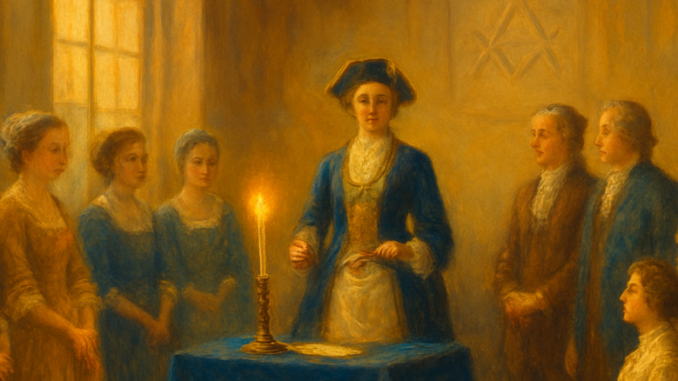
As early as the eighteenth century, so-called adoption lodges emerged in France. These were spaces where women could participate in rituals and meetings, albeit under the supervision of a male lodge. By today’s standards, such an arrangement still seems restrictive. But in its own time, it was remarkable. Women gained access to symbolic work, philosophical conversation, and a space for intellectual and spiritual development beyond the domestic sphere.
The adoption lodges were like a door left ajar — not flung wide open, but no longer completely shut.
Historians note that these lodges were frequently attended by women from the enlightened aristocracy and the educated middle class — women who found no other platform for intellectual growth. The rituals they underwent differed from those in male lodges, but the underlying principles were closely related: the pursuit of self-knowledge, ethical development, and a fraternal bond rooted in shared ideals.
The Nineteenth and Twentieth Centuries: Slow but Steady Shifts
The nineteenth century brought a tightening of gender roles across society, and Freemasonry was no exception. Yet certain currents within the Craft continued to take the original Enlightenment ideals more seriously. In 1882, a woman was initiated in a regular lodge in France — an event that caused significant controversy but also planted the seeds for later developments.
By the end of the nineteenth century, mixed orders had emerged in which men and women worked together as equals. In countries like the Netherlands, several Masonic streams have coexisted ever since — some exclusively for men, some exclusively for women, and others mixed. This diversity reflects the ongoing struggle with a fundamental question: how do universal principles relate to historically established forms?
Leadership as Proof of Merit
One of the central ideals of Freemasonry is that a person’s worth is determined by character and action — not by birth, gender, or outward appearance. This principle, though not always consistently applied, lies at the heart of Masonic ethics. When we see a woman stepping into a leadership role that was once considered unthinkable, we can understand it as the continuation of a long historical movement toward the realization of this ideal.
The remark that something is “about time” acknowledges both the breakthrough and the delay. It is an honest assessment: we could have been here sooner. At the same time, it is an invitation to look forward — toward the boundaries we may not yet see today but that future generations will surely recognize.
What History Teaches Us
Progress rarely follows a straight line. There are periods of openness and periods of contraction. Principles proclaimed as universal are only gradually applied universally. Every generation bears the responsibility of correcting the blind spots of those who came before. And breaking through established boundaries requires both individual courage and the maturity of the wider community.
From the Past to the Present
The appointment of a woman to lead a national sports delegation is not an isolated event. It belongs to a broad historical movement in which talent and character are given increasing room to flourish, regardless of the limitations that earlier generations took for granted. For Freemasons, this is a familiar process: it is the ongoing work of building a better world — a world in which the rough stone is continually refined.
The lesson we can draw is one of both humility and hope. Humility, because we too undoubtedly accept boundaries that future generations will view as outdated. Hope, because history shows that change is possible — provided people are willing to question existing forms and embrace new possibilities.
When we look back across three centuries of Freemasonry and the broader societal developments that have accompanied them, a pattern of gradual expansion emerges. Today’s breakthroughs in women’s leadership stand in a long tradition of taking Enlightenment ideals seriously. It is indeed “about time” — and at the same time, it is an invitation to keep searching for the boundaries we cannot yet see. Because true equality is never a destination. It is a horizon that calls us to keep traveling.
Copyright text & image: devrijmetselaar.nl
Texts are based on the ideas and content of the author of devrijmetselaar.nl, reviewed, corrected, and supplemented with the assistance of OpenAI. Images are created based on the ideas of the author of devrijmetselaar.nl using OpenAI/DALL-E.
Frequently Asked Questions
Did Freemasonry ever allow women to participate?
Yes, as early as the eighteenth century, adoption lodges in France allowed women to participate in rituals and meetings, providing them with access to philosophical discussion and intellectual development. While these arrangements seem restrictive by modern standards, they were remarkable for their time and represented a significant opening for women seeking intellectual and spiritual growth beyond the domestic sphere.
When did women first become full members of Freemasonry?
The first woman was initiated in a regular lodge in France in 1882, an event that sparked significant controversy but ultimately helped pave the way for future progress. By the end of the nineteenth century, mixed orders had begun to emerge in which men and women worked together as equals, with several Masonic streams adopting these practices.
How did Freemasonry's founding principles relate to women's participation?
When the Grand Lodge was established in 1717, it was built on Enlightenment ideals of equality, reason, and merit over privilege. While these progressive principles initially applied only to men due to the limitations of eighteenth-century society, they contained the seeds for eventual expansion, and successive generations of Freemasons gradually worked to apply these foundational ideals more universally.
What can modern society learn from Freemasonry's evolution on gender and leadership?
Freemasonry's gradual expansion of leadership opportunities demonstrates that even institutions rooted in progressive ideals must continuously reflect on and improve their practices. The organization's multi-century journey toward greater inclusivity shows how fundamental principles—like merit and dignity—can be meaningfully expanded over time to create broader opportunities for leadership and personal development.

Be the first to comment