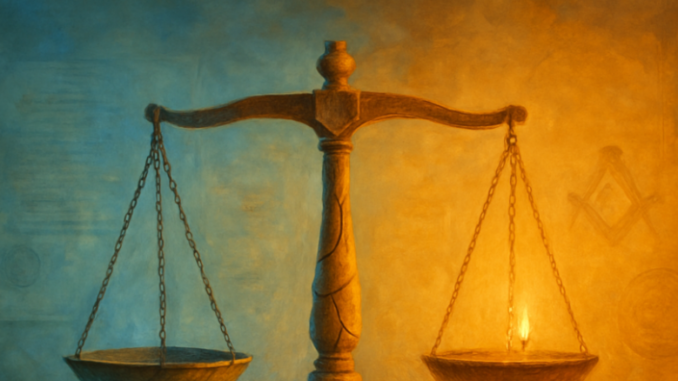
When news breaks that suspects linked to a political assassination in a neighboring country have been arrested, it touches on fundamental questions about law, borders, and human dignity. A recent case involving the arrest of two individuals connected to the death of a critical voice in Poland invites deeper reflection — not about guilt or innocence, which belongs to the courts, but about the deeper layers of justice itself. How do the codified laws of nations relate to the unwritten laws of conscience? And what can we learn when we place two perspectives side by side: that of the secular legal order and that of the initiatory tradition?
The Perspective of the Secular Order
For the modern legal system, justice is a matter of procedures, burden of proof, and jurisdiction. When a crime is committed on the territory of one nation by individuals from another, a complex web of treaties, extradition agreements, and diplomatic negotiations comes into play. The rule of law operates according to written rules that are meant to apply equally to everyone. The suspect has rights, the victim has rights, and society has the right to protection.
This system, imperfect as it may be, represents centuries of human development. From Roman legal codes to the Enlightenment, from the Magna Carta to modern human rights treaties, people have repeatedly tried to replace arbitrariness with reason, and vengeance with due process. The arrest of suspects in a case like this is an expression of that enduring aspiration. It is an attempt to provide a counterweight — through transparent procedures — even when those in power seek to silence their critics.
The Perspective of the Initiatory Tradition
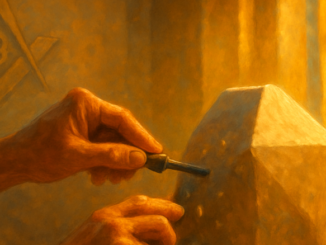
The Freemason approaches the concept of justice from an entirely different starting point. In the lodge, the discussion does not center on the laws of nations, but on the inner law that every human being carries within. The concept of the “rough ashlar” — the unworked stone that must be refined through diligent labor into a perfect cube — speaks of a justice that begins in one’s own heart. Before one can judge others, one must first measure one’s own actions against universal principles of truth, righteousness, and brotherly love.
This does not mean the Freemason turns away from the secular order. On the contrary: one of the oldest obligations within the Craft is obedience to the laws of the country in which one resides. But there is a dimension that transcends the purely juridical. The question is not only whether someone is guilty according to the law, but what the act means for the soul of the one who committed it, for those left behind, and for the human community as a whole.
Where Both Perspectives Converge
Despite their different starting points, the secular legal order and the initiatory tradition share a fundamental conviction: that human life is valuable and deserves protection. Both recognize that power exercised without accountability corrupts. Both seek an ordering of society that replaces the law of the strongest with principles that also protect the most vulnerable.
Justice without mercy is cruelty; mercy without justice is weakness.
This ancient maxim, passed down through the centuries in various forms, points to the tension that both traditions know intimately. The court must judge, but it must not become inhumane. The initiate must forgive, but must not ignore injustice. Within that tension lies perhaps the very essence of what justice truly means: a constant search for balance.
The Border as a Mirror
The fact that this case crosses national borders adds a distinctive layer to our reflection. In the symbolism of Freemasonry, the concept of the threshold plays an important role. The entrance to the temple marks the transition from the outer world to the sacred space. Yet at the same time, the tradition teaches that the true boundaries are not geographical, but moral and spiritual.
When an act of violence is planned in one country, carried out in another, and suspects are arrested in yet a third, we see just how artificial our borders really are. The pain of loss knows no nationality. The need for truth knows no passport. And the cry for justice sounds the same in every language.
What We Can Learn
Comparing the secular and the initiatory perspectives on justice teaches us that both are necessary. The rule of law provides the framework within which those responsible can be held accountable. Without that framework, chaos would reign. But the inner law reminds us that no verdict can ever fully capture the complexity of human action. There will always remain a dimension that escapes our judgment.
For those who immerse themselves in the Masonic tradition, this is not a reason for resignation, but for redoubled effort. One works to improve society by striving for just institutions. At the same time, one works on one’s own inner temple, knowing that ultimately no one can compel another to do good. Change begins with the self.
The Quiet Question
Behind every headline about arrests and court proceedings lies a quieter question — the question that every tradition, whether religious or philosophical, ultimately asks: How do we want to live? What kind of world do we want to leave behind? Freemasonry offers no ready-made answers, but it does offer a method for honestly confronting these questions. In the privacy of the lodge, surrounded by symbolism stretching back centuries, a person can hold a mirror up to themselves.
Perhaps that is the deepest form of justice: not the verdict pronounced by others, but the honest judgment one passes upon oneself — and the willingness, armed with that insight, to begin again.
The secular legal order and the initiatory tradition approach justice from different angles, yet they arrive at a remarkably similar destination. One builds courtrooms and codifies rights; the other builds inner temples and cultivates conscience. Together, they remind us that true justice is never a finished product — it is a living practice, renewed in every act of honest self-examination, and in every society that dares to hold power accountable. For the Freemason, this dual commitment — to the outer world and the inner life — is not a contradiction but a calling.
Copyright text & image: devrijmetselaar.nl
Texts are based on the ideas and content of the author of devrijmetselaar.nl, reviewed, corrected, and supplemented with the assistance of OpenAI. Images are created based on the ideas of the author of devrijmetselaar.nl using OpenAI/DALL-E.
Frequently Asked Questions
What does Freemasonry teach about justice?
Freemasonry approaches justice from the perspective of inner development and universal principles rather than solely through legal procedures. Freemasons are taught to examine their own actions against principles of truth, righteousness, and brotherly love before judging others, using the symbolism of the rough ashlar being refined into a perfect cube. This complements rather than replaces respect for secular law and the rule of law in society.
Do Freemasons support the legal system and obedience to laws?
Yes, absolutely. One of the oldest obligations in Freemasonry is obedience to the laws of the country in which one resides. Freemasons recognize the importance of the rule of law, transparent procedures, and due process as vital protections against arbitrary power and injustice throughout history.
How can Freemasonry's perspective on justice complement modern legal systems?
While secular law focuses on procedures, burden of proof, and jurisdiction, Freemasonry adds a dimension of personal moral accountability and reflection on how actions affect the human community as a whole. Both perspectives share the conviction that human life is valuable, power must be accountable, and society requires ordered principles—together they create a more complete understanding of justice.
What is the 'rough ashlar' and what does it represent?
The rough ashlar is an unworked stone that symbolizes the human being in their natural state, requiring refinement through diligent labor into a perfect cube. In Freemasonry, this symbol represents the journey of self-improvement and inner development, where justice and virtue begin with perfecting oneself before attempting to judge or improve others.


Be the first to comment