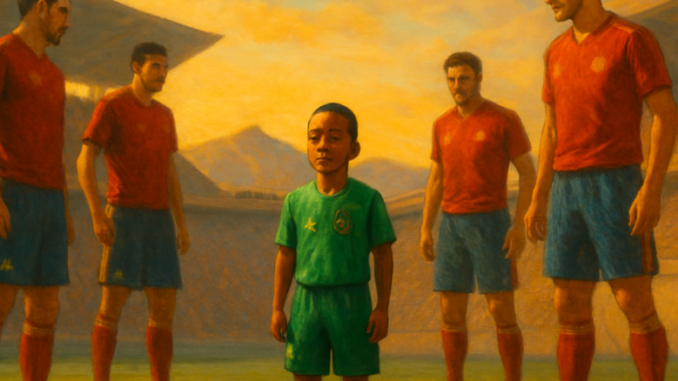
In a crowded living room, a Freemason watches the screen intently. Cape Verde — an island nation of barely half a million people — is holding its own against the mighty Spain. Somewhere in that tension, in that improbable resistance, he recognizes something he has also felt in the lodge: the power that emerges when humility and determination meet the seemingly impossible head-on.
When the Small Challenges the Great
There are moments in sport that transcend goals and statistics. Today’s World Cup clash, in which Cape Verde nearly pulled off a stunning upset against Spain, is one of those moments. A team whose players trace their roots to both the Cape Verdean islands and the Netherlands showed that conviction can sometimes outweigh reputation. For anyone willing to look beyond the scoreboard, a profound spiritual lesson unfolds.
In Freemasonry, we hold the principle that true growth does not come from displays of strength, but from acknowledging our own limitations. The candidate who enters the lodge for the first time does not arrive as a conqueror — he arrives as a seeker. He comes not to impress, but to learn. Much like Cape Verde stepped onto the pitch without any expectation of winning, yet with a willingness to give everything they had.
The Courage of the Beginner
There is a particular form of courage we often overlook: the courage to try something when the world expects you to fail. In spiritual traditions, this is sometimes called “beginner’s mind.” Those who have nothing to lose approach every challenge with an openness that the seasoned expert has long since forgotten. The Cape Verdean players embodied that openness — uninhibited, wholehearted, and free from the burden of expectation.
Freemasons are encouraged to cultivate this very attitude, even after years of experience. Our rituals remind us that we are always apprentices, regardless of our degree or age. The rough ashlar we symbolically work upon is never made perfectly smooth. There is always more work to be done, always room for growth. This acknowledgment is not a weakness — it is a wellspring of strength.
Roots That Connect
What makes this match especially compelling is the mixed heritage of the Cape Verdean squad. Players with Dutch roots represented a nation that lies geographically and culturally far from the Netherlands, yet remains connected through deeply human bonds. This interweaving of identities raises powerful questions about what it truly means to belong.
In Freemasonry, we speak of a universal brotherhood that transcends borders. Whether a brother was born in Rotterdam or Praia matters nothing to the bond forged within the lodge. What counts is the shared pursuit of truth, the shared commitment to improving oneself and the world. The Cape Verdean national team demonstrates beautifully that identity need not be confined to a single passport or a single birthplace.
The true strength of any community lies not in its size, but in the conviction with which its members stand together.
Defeat as a Teacher
In the end, Spain won. Cape Verde came close, but the upset was not to be. Yet it is worth asking whether this should truly be called a defeat. In spiritual terms, failure is often more fertile than success. Those who never lose seldom learn anything new. Those who never struggle develop no resilience.
The Freemason learns that the path toward light is not a straight line. There are moments of doubt, setbacks, and apparent standstills. But it is precisely in those moments that character is forged. Today’s match was not an endpoint for Cape Verde — it was a station on a longer journey. The same is true for every one of us striving to become a better person.
The Spiritual Echo of the Stadium
What lingers after a match like this is not the final score, but the emotion. The hope that flared when Cape Verde seemed on the verge of equalizing. The disappointment that followed, but also the pride in what had been achieved. This ebb and flow of emotions is what elevates sport beyond mere entertainment. It becomes a mirror for our own inner life.
In the temple, Freemasons experience something strikingly similar. Ritual evokes feelings of awe, connection, and sometimes even sorrow. These emotions are not a byproduct — they are the heart of the experience. They remind us that we are living, feeling beings, connected to something greater than ourselves.
Lessons for the Seeker
What can we carry away from this sporting tale? Perhaps this: that the scale of the challenge should never be a reason not to begin. That connection is stronger than origin. That loss is not a disgrace, but an opportunity to grow. And that the most beautiful moments often arise when we least expect them.
Approach every challenge with the openness of a beginner. Seek connection beyond the boundaries of background or birthplace. View setbacks as teachers, not as final verdicts. And cherish the emotions that arise in moments of shared endeavor.
The Freemason who watched tonight’s match saw more than eleven players in blue shirts. He saw a reflection of his own journey: uncertain, hopeful, and ultimately enriched by the attempt itself.
Cape Verde may not have won the match, but what the team showed transcends any scoreline. In their play was a spiritual message that Freemasons will recognize immediately: it is not the victory that defines us, but the courage with which we enter the struggle. That courage — born from humility and sustained by brotherhood — is the true light we seek. On the pitch and in the lodge.
Copyright text & image: devrijmetselaar.nl
Texts are based on the ideas and content of the author of devrijmetselaar.nl, reviewed, corrected, and supplemented with the assistance of OpenAI. Images are created based on the ideas of the author of devrijmetselaar.nl using OpenAI/DALL-E.
Frequently Asked Questions
What does Freemasonry teach about facing challenges that seem impossible?
Freemasonry teaches that true growth comes not from displays of strength, but from acknowledging our limitations and approaching challenges with humility and determination. Like Cape Verde facing Spain, Masons are encouraged to embrace the 'beginner's mind' — approaching every challenge with openness and wholehearted commitment, regardless of the odds. This principle reminds us that courage is not the absence of doubt, but the willingness to try despite expectations of failure.
How does Freemasonry view the concept of universal brotherhood across different cultures?
Freemasonry emphasizes a universal brotherhood that transcends borders, nationalities, and birthplace. Whether a brother was born in one country or another, what truly matters is the shared pursuit of truth and the shared commitment to self-improvement and service to the world. This principle reflects the beautiful reality that identity and belonging are defined by our values and bonds with others, not by geography or passport alone.
What is the Masonic concept of the 'rough ashlar' and why is it important?
The rough ashlar is a central symbol in Freemasonry representing the continuous work of self-improvement that never reaches perfection. Masons are taught that there is always more work to be done and room for growth, regardless of their degree or experience level. This acknowledgment that we are always apprentices, always learning, is presented not as a weakness but as a wellspring of strength and spiritual development.
Why does Freemasonry encourage members to maintain a 'beginner's mind' even after years of experience?
A beginner's mind cultivates openness, humility, and the willingness to learn without the burden of established expectations or expertise. Masonic rituals remind members that continuous growth requires maintaining this fresh perspective throughout one's life, approaching challenges with the same wholehearted commitment as a first-time candidate. This attitude prevents complacency and keeps the spirit of discovery alive within the fraternity.
What spiritual lesson does Freemasonry draw from underdogs who compete with conviction?
Freemasonry recognizes that true power emerges when humility and determination meet seemingly impossible challenges. Underdogs who approach their trials without the weight of expected success often display a purity of purpose and commitment that resonates with Masonic values. This teaches that meaningful achievement is measured not by victory alone, but by the growth, character, and conviction demonstrated in the pursuit itself.

Be the first to comment