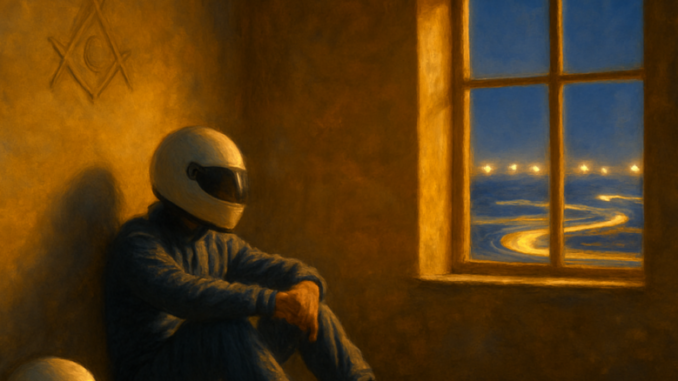
A race car sits idle in the pit lane. The driver climbs out, leaves the circuit, and seeks silence. Hours later, he returns and delivers the qualifying lap of his lifetime. The story made headlines around the world yesterday: sometimes you have to leave in order to truly arrive. For those familiar with the symbolism of Freemasonry, an ancient truth resonates here — one that reaches far deeper than any racetrack.
The Circuit as a Mirror of Society
A racing circuit is more than asphalt and crash barriers. It is a closed system where pressure, expectation, and performance converge in a relentless rhythm. Lap after lap, second after second — everything is measured, compared, and judged. In many ways, this mirrors the society in which we all operate: a world of deadlines, targets, and the unceasing demand for more, faster, better.
The driver who chose to temporarily step away from this system did something that defies every rule of our performance-driven culture. He stopped when pushing forward was expected. He sought distance when proximity was demanded. And yet, it was precisely this departure that became the key to his finest performance.
The Chamber of Reflection: The Symbolism of Withdrawal
In Freemasonry, there is the concept of the Chamber of Reflection — the darkened room in which a candidate sits before receiving the light. This chamber is not a punishment; it is a gift. It is the place where the outside world temporarily falls away, where the noise of everyday life grows silent, and where a person can return to themselves. The darkness here is not the absence of something — it is the presence of possibility.
What the driver did by leaving the circuit touches the same ancient wisdom. He created his own Chamber of Reflection — a moment of solitude in which the constant stream of data, instructions, and expectations could finally fall silent. In that stillness, he found what he was searching for: a reset, as he called it himself. A return to the starting point from which everything can begin anew.
“The person who knows himself knows the world. The person who wishes to know the world must first begin with himself.”
Leaving in Order to Arrive
There is a paradox in the idea that walking away can lead to better performance. Our society values perseverance, grit, the refusal to ever give up. And rightly so — without these qualities, little of lasting value would ever be accomplished. But there also exists a form of persistence that becomes counterproductive: a blindness that develops when we are so fixated on the goal that we lose sight of the path that leads us there.
The ancient master builders, whose tools still live on symbolically within Freemasonry, understood this principle well. A cathedral was not built in a single season. There were moments of pausing, of stepping back, of letting the work rest so the stone could settle and the mortar could harden. The interruption was never a weakness — it was an essential part of the building process itself.
The Compasses and the Square
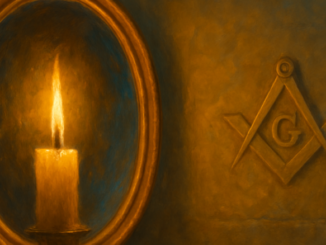
Two symbols that stand at the heart of the Masonic tradition are the compasses and the square. The compasses draw circles, create boundaries, and define the space within which work is done. The square ensures right angles, structure, and precision. Together, they represent the balance between limitation and order.
The driver who left the circuit was, in a sense, using his own compasses. He drew a boundary around himself — a circle of calm that shielded him from the overwhelming pressure of the moment. Within that circle, he was able to rediscover his inner square: the clarity of mind needed to return with renewed focus and purpose.
What Society Can Learn
In a world that spins ever faster, where we are permanently reachable and the line between work and rest has all but dissolved, the art of stepping away grows more valuable — and more difficult — by the day. We are encouraged to be always “on,” to seize every moment, to view rest as wasted time.
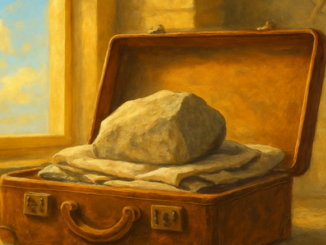
Yet ancient wisdom whispers something different. Freemasonry, with its emphasis on inner work and self-knowledge, reminds us that a human being is not a machine capable of unlimited output. The rough ashlar that must be shaped into a perfect cube requires time, attention, and sometimes a pause — a moment for the dust to settle so the true contours can become visible.
Consider these truths that Masonic philosophy illuminates:
- Withdrawal is not weakness, but a conscious choice.
- Silence creates space for clarity.
- The best performance sometimes demands distance.
- Setting boundaries is a form of self-knowledge.
The Return to the Light
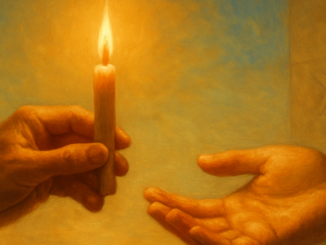
After darkness comes the light. This is not an empty promise but a rhythm that repeats itself in nature, in the seasons, and in human life itself. The driver who returned to the circuit was not the same person who had left. He came back carrying something he had found along the way: clarity, focus, and the inner calm required to give the very best of himself.
This may be the deepest lesson hidden behind what appears to be a simple sports story. Not that we all need to leave the circuit, but that we must have the courage to recognize when a reset is needed — in our work, in our relationships, in our lives. The wisdom to know when to press on and when to stand still is a life skill found in no manual. It reveals itself only to those willing to listen to the quiet voice within.
A driver left the circuit and found himself. In that simple act lies a timeless truth that Freemasonry has cherished for centuries: the way outward often leads first inward. In a society that asks us to keep going at all costs, the ability to pause consciously may be the most underestimated power we possess. The Chamber of Reflection awaits anyone who dares to enter.
Copyright text & image: devrijmetselaar.nl
Texts are based on the ideas and content of the author of devrijmetselaar.nl, reviewed, corrected, and supplemented with the assistance of OpenAI. Images are created based on the ideas of the author of devrijmetselaar.nl using OpenAI/DALL-E.
Frequently Asked Questions
What is the Chamber of Reflection in Freemasonry?
The Chamber of Reflection is a darkened room where Masonic candidates sit in solitude before receiving initiation light. Rather than being a punishment, it is a sacred space where the noise of the outside world falls away, allowing a person to reconnect with themselves and prepare for spiritual transformation. This moment of intentional withdrawal has been part of Masonic ritual for centuries as a powerful tool for inner renewal.
How does Freemasonry view the concept of taking a break or stepping away?
Freemasonry teaches that strategic withdrawal and reflection are not signs of weakness, but essential parts of genuine progress and self-knowledge. Like the ancient master builders who understood that cathedrals required periods of rest for materials to properly settle, Masonic wisdom recognizes that sometimes stepping back allows us to move forward with greater clarity, purpose, and spiritual alignment.
What is the Masonic principle of self-knowledge?
A foundational Masonic teaching states: 'The person who knows himself knows the world.' Freemasonry emphasizes that true understanding begins with honest self-reflection and inner work. By taking time to understand our own nature, values, and motivations through quiet contemplation, we gain the wisdom needed to better engage with the world around us and contribute meaningfully to society.
How do Masonic principles apply to modern life and personal development?
Freemasonry offers timeless wisdom that remains profoundly relevant today, teaching that amid modern pressures and constant demands, moments of deliberate pause and reflection are vital to personal growth. By incorporating Masonic principles of self-examination, intentional withdrawal, and steady progress, individuals can achieve greater balance, clarity, and authentic success in their lives.

Be the first to comment