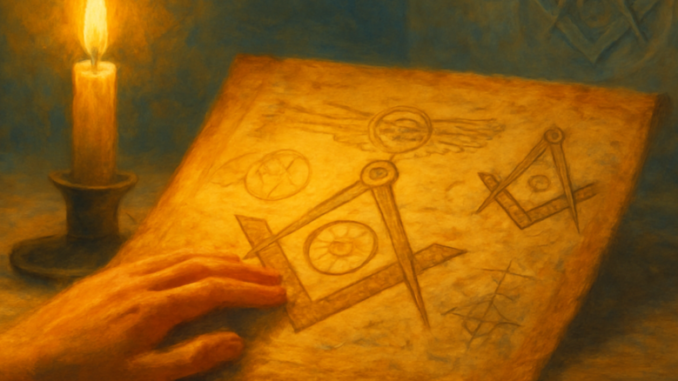
When we explore the connection between Freemasonry and Gnostic traditions, we step into territory where ancient questions come alive once more. What does it truly mean to know? And how does knowing differ from believing? These are questions that searching minds have been asking since the early centuries of the Common Era — and they still echo through the lodges of today. The relationship between these two traditions runs deeper than most people realize, and it has something genuinely valuable to offer us in the present moment.
Why Do People Compare Freemasonry with Gnostic Thought?
It’s a fair question to start with, and the comparison doesn’t arise by accident. Both traditions emphasize that outward forms are merely carriers of deeper meaning. A Gnostic from antiquity would say that the material world is a veil behind which a higher reality is hidden. A Freemason speaks of symbols that only reveal their secrets when the gaze turns inward. In both cases, the personal inner journey stands at the center — not the blind acceptance of dogma.
Yet the resemblance is subtler than it first appears. Gnosis, the Greek word for “knowledge,” refers to a direct, experiential form of knowing. It isn’t about intellectual information but about transformative insight that touches the whole person. Freemasonry shares this aspiration for depth, though it expresses it differently. The real question becomes: are these streams drawing from the same source, or are they parallel rivers that happen to flow in the same direction?
Is There a Historical Link Between Gnosis and Freemasonry?
This is where things get interesting — and where we need to tread carefully. Organized Freemasonry as we know it emerged in the early eighteenth century. The Gnostic movements flourished primarily in the second and third centuries. That leaves a gap of more than fifteen hundred years, and direct transmission is historically difficult to demonstrate.
What we do know is that Freemasonry drew from a rich tapestry of sources from its very inception: medieval guild traditions, Hermetic philosophy, Kabbalistic symbolism, and the Renaissance revival of Neoplatonism. Some of these streams had their own ties to older Gnostic ideas. Consider the emphasis on emanation, on light as a metaphor for consciousness, on the ladder or stairway as an image of spiritual ascent. These motifs circulated through the centuries and found their way into the symbolic language of the lodge.
What Does the Symbolism Itself Reveal?
Let’s look at a concrete symbol: light. In virtually all Gnostic texts, light plays a central role. The divine spark within the human being is described as a particle of light trapped in matter, longing to return to its source. In Freemasonry, we find a strikingly similar motif. The candidate begins his journey in darkness and is gradually led toward the light. This light is no physical lamp — it is a metaphor for insight, for the awakening of the inner eye.
The light we seek does not burn outside of us. It waits patiently in the deepest chambers of our own being.
Another shared theme is that of the builder. The Gnostics often viewed the creator of the material world as an imperfect craftsman — a Demiurge working with flawed material. The Freemason, by contrast, elevates the builder to a revered figure: the Grand Architect of the Universe. Yet both visions share the idea that the human being is itself a work of architecture — a temple in the making, one that can be perfected through conscious effort.
How Do Knowledge and Belief Relate in This Connection?
Here we touch on a crucial distinction. Many religious traditions emphasize faith as the path to the divine: trust in revelations, scriptures, or authority. The Gnostic approach offers a different posture. Not believing in order to know, but knowing through direct experience. This isn’t arrogance — it’s an invitation to inner inquiry.
Freemasonry occupies a unique position in this regard. It prescribes no specific belief to its members but does ask for acknowledgment of a higher ordering principle, however one chooses to name it. Within that space, every Brother or Sister may walk their own path. For some, that path leads through Gnostic insights; for others, it follows entirely different routes. The lodge provides the framework, not the content of conviction.
What Can We Learn Today from This Ancient Connection?
Perhaps the most important lesson is this: the search for meaning and significance is not a modern invention. People have always tried to look beyond the surface, to find something enduring beneath the shell of the everyday. The Gnostics did this in their time, with their language and their symbols. Freemasons continue to do so in theirs.
Both traditions invite self-reflection and inner work. Both warn against the dangers of superficiality and spiritual laziness. Both recognize that true knowledge cannot be bought — it must be earned.
The question is not whether Freemasons are Gnostics, because that would be an oversimplification. The more fruitful question is: what can we, in our own time, learn from the Gnostic emphasis on inner knowledge? And how can the structure of the lodge — with its rituals and symbols — help us unlock that knowledge within ourselves?
Is This Just Old Wine in New Bottles?
A critical reader might raise this objection. And honestly, there may be some truth to it. But is that a problem? Wine that has been preserved for centuries must be of exceptional quality. The core conviction shared by both Gnostic and Masonic traditions is that the human being is more than what appears on the surface — that there are deeper layers of consciousness and meaning waiting to be discovered. That message has not grown old. On the contrary, in an age of constant distraction and shallow stimulation, it is more relevant than ever.
The conversation between Freemasonry and Gnostic tradition is not a relic of the past — it is an ongoing dialogue. Both paths remind us that the most important journey is the one that leads inward, and that the tools for that journey — symbols, ritual, reflection — have been available to seekers for millennia. Whether you approach these ideas as a Freemason, a student of Gnosticism, or simply as someone searching for deeper understanding, the invitation remains the same: look beyond the surface, do the inner work, and trust that the light you seek has been within you all along.
Copyright text & image: devrijmetselaar.nl
Texts are based on the ideas and content of the author of devrijmetselaar.nl, reviewed, corrected, and supplemented with the assistance of OpenAI. Images are created based on the ideas of the author of devrijmetselaar.nl using OpenAI/DALL-E.
Frequently Asked Questions
What is the main connection between Freemasonry and Gnostic traditions?
Both traditions emphasize inner knowledge and direct, experiential understanding rather than blind acceptance of dogma. They share a focus on symbols and deeper meanings that require personal spiritual exploration and transformation. While they express this differently, both value the inward journey and recognize that outward forms carry hidden wisdom for those who seek it.
Is there a direct historical link between Freemasonry and ancient Gnosticism?
While organized Freemasonry emerged in the eighteenth century and Gnostic movements flourished in the second and third centuries, there is no direct documented transmission between them. However, Freemasonry drew from rich sources including Hermetic philosophy, Kabbalistic symbolism, and Neoplatonism—many of which carried forward older Gnostic ideas and motifs across the centuries.
How does Freemasonry use symbolism to teach inner knowledge?
Freemasonry employs powerful symbols like light to represent spiritual insight and awakening. The candidate's journey from darkness to light mirrors the Gnostic quest for illumination and inner understanding. These symbols are designed to speak to the whole person, facilitating transformative insight rather than mere intellectual knowledge.
What does 'Gnosis' mean, and how does it relate to Freemasonry?
Gnosis is a Greek term meaning direct, experiential knowledge—not intellectual information, but transformative insight that touches the whole being. Freemasonry shares this same aspiration for depth and personal spiritual transformation through its emphasis on symbols, rituals, and the candidate's inner journey of discovery.

Be the first to comment