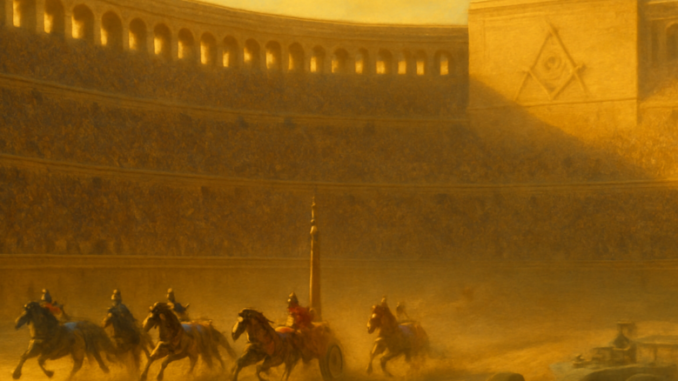
On a sweltering afternoon in Barcelona, drivers battled for the best starting position while thousands of spectators held their breath. The scene was strikingly reminiscent of one that played out two thousand years ago in Rome’s Circus Maximus: charioteers risking their lives under a blazing sun in pursuit of glory and honor. The parallels between ancient chariot racing and modern motorsport are remarkable — but what can these contests truly tell us about our views on status, community, and the society we live in?
The Circus Maximus: Arena of Heroes and Symbols
In ancient Rome, the Circus Maximus was the beating heart of public life. Up to 250,000 people would gather here to witness chariot races. The four racing stables, known as factiones, were identified by color: blue, green, red, and white. These colors represented far more than sporting rivalry — they symbolized the seasons, the elements, and the cosmic order. The race itself was a ritual, a symbolic battle between the forces of nature fought again and again in the dust of the arena.
The charioteers, called aurigae, were often slaves or freedmen who could rise to the status of folk heroes through sheer courage and skill. Their position was deeply paradoxical: socially low, yet worshipped like gods in the arena. This tension between outward rank and inner worth is a theme that has remained relevant across the centuries.
Bread and Circuses: The Function of Competition
The Roman poet Juvenal coined the famous phrase panem et circenses — bread and circuses. He used it to criticize how the populace allowed itself to be distracted by entertainment while political freedoms were being eroded. But behind this cynical observation lies a deeper truth: human beings have always craved shared experience — moments when an entire community comes together around a collective spectacle.
That need has not disappeared. When millions of people around the world tune in to watch a qualifying session today, they are repeating an ancient pattern. The tension, the heat, the battle for the best position — these are modern versions of rituals our ancestors already knew. The question is not whether we need these rituals, but what we can learn from them.
The Lodge as an Alternative Arena
Within Freemasonry, there exists a fundamentally different view of competition and status. Where the arena revolves around winning and losing, around first place and last, the Lodge strives for equality. When Brethren come together, they leave their worldly titles and functions at the door. The CEO and the carpenter meet as equals, united by their shared pursuit of truth and self-improvement.
“In the Temple, we are all rough stone — equal in our imperfection and equal in our desire to be shaped.”
This principle has its origins in the medieval stonemasons’ lodges, where craftsmen were judged on their skill and character regardless of birth. The mason who could hew a perfect stone was respected irrespective of the social class into which he was born. Here we find an echo of the Roman charioteer who, through pure skill, transcended his chains.
Heat as Trial: The Forge of Character
The scorching conditions under which modern racing drivers must perform evoke another ancient symbol: the forge. In the alchemical tradition — closely interwoven with early Masonic symbolism — heat represents transformation. Metal only becomes pure when it passes through fire. In the same way, a person is shaped by the trials they endure.
Freemasonry knows this principle as the “work on the rough stone.” It is not the easy path but the confrontation with adversity that forges character. A driver who must perform under extreme pressure undergoes, in accelerated form, what the Freemason pursues through years of inner work: victory over the lower self, the discipline to remain clear-headed when everything around you is burning.
Beyond the Rankings
One of the most striking aspects of a qualifying session is how fleeting positions can be. Whoever tops the first session may fall back in the second. Whoever sits in sixth place today may stand in first tomorrow. This volatility reminds us of the impermanence of worldly status. The Romans had a phrase for this awareness: memento mori — remember that you are mortal. Even the greatest champion is subject to fate.
In the Lodge, this wisdom is translated into a practical principle: do not place too much value on titles and positions. What endures is not the trophy on the mantelpiece but the manner in which one has conducted oneself. How did you handle setback? How did you treat those who were less successful?
From the Stadium to Society
The pressing question is what we, as a society, choose to learn from our collective rituals. Do we remain caught up in the superficial thrill of winning and losing, or do we look through the spectacle to discover its deeper layers? Freemasonry offers a perspective that reconciles both: an acknowledgment of the human drive toward competition alongside the awareness that true value lies elsewhere.
Competition as a mirror: What our heroes reveal about our values.
Community as purpose: The connection that arises through shared experience.
Equality as an ideal: Looking beyond the leaderboard to see the human being.
Transformation as a path: Embracing trials as opportunities for growth.
From the Roman arena to the modern circuit, humanity remains fascinated by the struggle, the speed, the hero who rises from the dust. But behind that fascination lies a deeper hunger — a hunger for meaning, for connection, for a community that is more than the sum of individuals who happen to be watching the same screen.
Tomorrow, the sweltering qualifying session in Catalonia will be yesterday’s news. But the patterns it reflects are timeless. Freemasonry invites us to look beyond the surface of the spectacle and ask ourselves what truly matters: not where we finish in the ranking, but who we become along the way. In the end, the race is not against others — it is the ancient, ongoing work of shaping ourselves into something worthy of the light.
Copyright text & image: devrijmetselaar.nl
Texts are based on the ideas and content of the author of devrijmetselaar.nl, reviewed, corrected, and supplemented with the assistance of OpenAI. Images are created based on the ideas of the author of devrijmetselaar.nl using OpenAI/DALL-E.
Frequently Asked Questions
How does Freemasonry differ from the competitive status systems described in the article?
While ancient chariot races and modern motorsports celebrate winners and rank competitors by performance, Freemasonry operates on the principle of equality among all members. When Brethren enter the Lodge, they leave their worldly titles and social status behind, allowing a CEO and a carpenter to meet as true equals united in their shared pursuit of truth and self-improvement.
What is the significance of leaving titles at the door in Freemasonry?
This practice reflects Freemasonry's core principle that all men, regardless of their external circumstances or social rank, are equal in their imperfection and in their desire for personal growth. By removing worldly distinctions, the Lodge creates a genuine brotherhood where respect is earned through character and commitment rather than wealth, power, or status.
How does the Lodge connect to the medieval stonemasons mentioned in the article?
Freemasonry's principle of equality has deep roots in medieval stonemasons' guilds, where craftsmen were valued solely on their skill and character, regardless of their birth or social class. This tradition of merit-based respect continues today in the Lodge, where a member's worth is determined by their dedication to the Craft and their contribution to the brotherhood, not their external position in society.
Can you explain the phrase 'In the Temple, we are all rough stone'?
This beautifully expresses Freemasonry's belief that all members begin as imperfect and equal, with unlimited potential for self-improvement and personal refinement. Just as stonemasons shape rough stones into perfect ashlar, Freemasonry provides the tools and fellowship for each Brother to develop morally, intellectually, and spiritually throughout his life's journey.

Be the first to comment