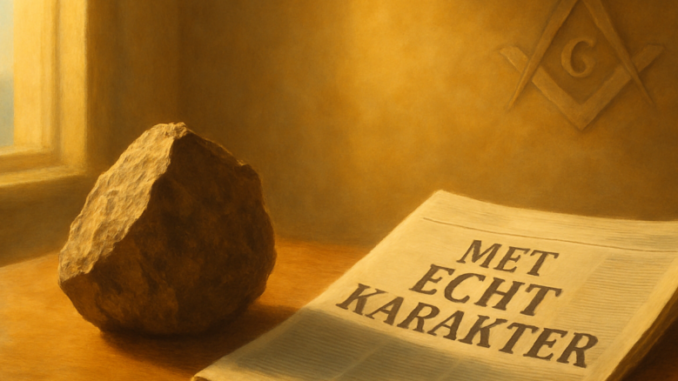
A brother sits at his kitchen table the morning before his advancement to a higher degree. His eye catches an advertisement bearing the words “with true character.” He pauses. Those two simple words cut straight to the question he has been wrestling with for months: who am I, really, beneath all the layers I present to the world?
In professional sports, public disputes sometimes play out through unexpected channels. A footballer takes out a full-page newspaper ad — not about statistics or trophies, but about character. Who are you when the pressure is at its peak? That question resonates deeply within Freemasonry, where the development of personality and character has been the guiding thread for centuries.
The Rough Stone as Mirror
At the heart of Masonic symbolism stands the rough, unworked ashlar. It represents the human being as they arrive: full of potential, but also full of imperfections, blind spots, and ingrained patterns. The work on this stone is the work on yourself — not to become a perfect human being, because that does not exist, but to become a more authentic one. Someone whose exterior more closely reflects what lives within.
Character, in this context, is not a fixed trait. It is not something you are born with that remains unchangeable throughout your life. Character is something you forge, day by day, choice by choice. The lodge offers a remarkable space for this kind of practice. Among like-minded individuals, in an atmosphere of trust, you can experiment with who you truly want to be.
When the Mask Falls
Most people wear masks. Not out of dishonesty, but out of necessity. The world demands adaptation, diplomacy, the smoothing of sharp edges. There is nothing inherently wrong with that. But somewhere, in a quiet corner of our consciousness, the question lingers: do I still know myself beneath all those layers?
Freemasonry invites us to temporarily set those masks aside. Not through confrontation or coercion, but through ritual and reflection. In the stillness of the temple work, surrounded by symbols that speak to the subconscious, space opens up. Space to look inward without immediate judgment. Space to discover what “true character” means to you personally.
Character is not what you do when everyone is watching — it is who you are when no one sees.
The Test of the Public Arena
A footballer who publicly shares his vision on character takes a risk. He makes himself vulnerable, knowing that critics are ready to pounce. That same dynamic plays out in the daily life of anyone who chooses authenticity. Showing true character is never a safe choice. It takes courage to go against the current, to speak your mind, to act on your convictions even when doing so is unpopular.
Freemasonry prepares its members for exactly those moments. Not by telling them what to think or do, but by teaching them to reflect on the foundations of their actions. What are your values? Where do your boundaries lie? And perhaps most importantly: are you willing to defend those values, even when it costs you something?
Personality Versus Character
It is tempting to treat personality and character as synonyms, but there is a fundamental difference. Personality is how you behave, how you come across, the impression you make. Character runs deeper. It touches your moral compass, your ability to choose between right and wrong, your willingness to take responsibility for your actions.
Personality is visible from the start; character becomes visible in crisis. Personality can be learned; character must be forged. Personality attracts; character inspires.
In the lodge, brothers and sisters do not primarily work on their personality — their social skills or charisma. They work on their character, the invisible foundation upon which everything else rests. Because an impressive personality without character is like a beautiful façade on an empty building.
The Daily Practice
Character is not developed solely within the lodge. The real practice takes place outside the temple walls, in ordinary life. In the way you handle adversity, criticism, and success. In the choices you make when no one is watching. In the words you speak and the words you hold back.
A full-page advertisement about character is a public statement. But the real test of character plays out in the small moments. In the hand you extend to someone who has fallen. In the truth you speak even when a lie would be easier. In the quiet endurance of injustice when resistance would accomplish nothing.
The Stone That Remains
At the end of a life, little of true value remains. Possessions deteriorate, fame fades, even memories blur with time. What endures is the impression you have left in the hearts of others. The moments when you showed true character. The times you chose integrity over convenience.
Freemasonry invites you to begin that work today. Not tomorrow, not when circumstances are more favourable, but now. Because every day offers new opportunities to smooth the stone a little more, to refine your character a little further, to become a little more the person you already are in potential.
When someone speaks publicly about “true character,” it touches something universal — the need to be known as you truly are, beyond roles and masks. Freemasonry does not offer ready-made answers to the question of who you are, but it does offer a path for taking that question seriously. In the stillness of ritual, in the mirror of symbols, and ultimately in the choices of daily life. Because character is not a destination — it is a lifelong journey toward becoming.
Copyright text & image: devrijmetselaar.nl
Texts are based on the ideas and content of the author of devrijmetselaar.nl, reviewed, corrected, and supplemented with the assistance of OpenAI. Images are created based on the ideas of the author of devrijmetselaar.nl using OpenAI/DALL-E.
Frequently Asked Questions
What does Freemasonry mean by 'true character'?
In Freemasonry, true character refers to authenticity—when your outer actions align with your inner values and convictions. It's not about being perfect, but about removing the unnecessary masks we wear and becoming genuinely consistent in who we are. The craft teaches that character is something you develop day by day through conscious choice and reflection, rather than something fixed at birth.
How does the lodge help members develop their character?
The lodge provides a unique space of trust and mutual respect where members can reflect deeply on their values and beliefs through ritual, symbolism, and fraternal discussion. In this supportive environment, surrounded by like-minded individuals, members can explore who they truly want to be and practice living more authentically. The lodge doesn't dictate what to think, but teaches members to examine the foundations of their own actions and values.
What is the 'rough ashlar' and why is it important in Freemasonry?
The rough ashlar is a Masonic symbol representing each person as they are—full of potential but also imperfections and blind spots. The Masonic work is the personal work to refine yourself, metaphorically working that rough stone into something more refined. It reminds members that character development is an ongoing process of self-improvement and alignment between inner truth and outer expression.
Does Freemasonry require members to be perfect?
No—Freemasonry recognizes that perfection does not exist. Instead, the craft encourages members to work toward becoming more authentic and aligned with their true values. The goal is continuous personal growth and the courage to show your genuine character, even when it's unpopular or challenging.
Why does showing true character take courage?
Authenticity requires vulnerability and the willingness to stand by your convictions even when others disagree or criticize. Freemasonry prepares its members for these challenging moments by teaching them to reflect deeply on their values and boundaries. The craft empowers members to act with integrity, knowing that true character is defined not by what you do when everyone is watching, but by who you are when no one sees.

Be the first to comment