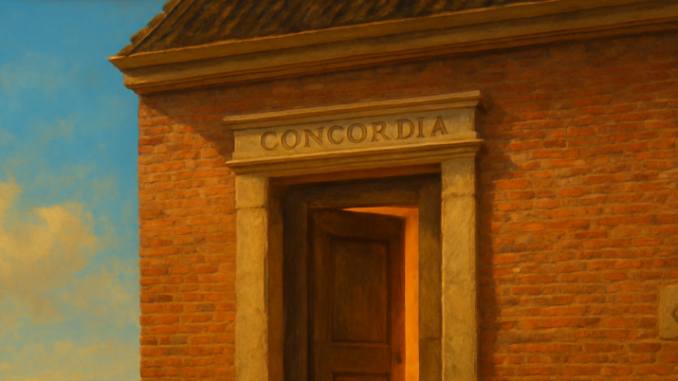
In the Frisian canal city of Sneek, there stands a building that most passersby would scarcely notice. Yet behind its unassuming exterior, the lodge building of Concordia Sneek holds a world of symbolic depth. Today, we turn our attention not to the rituals performed within its walls, but to something seemingly ordinary: the door. What can a door tell us about the transition from outside to inside, from the everyday to the essential? And what does the architecture of a Masonic lodge reveal about the construction of the inner self?
The Name Concordia: Architecture of Harmony
To hear the name Concordia is to think of an abstract ideal. Yet there is a deeply architectural principle embedded in this Latin word for harmony or unity of spirit. Just as stones only form an arch when they hold each other in perfect balance, so concordia only emerges when diverse elements align themselves to a shared pattern. The lodge in Sneek carries this name for good reason. Every Masonic lodge is a symbolic workshop — a space where brethren practice the art of building something greater than themselves.
The architecture of a lodge building is never accidental. Every wall, every window, every proportion between spaces carries meaning. At Concordia Sneek, we see how a seemingly modest building harbors an interior order rooted in age-old building principles. The layout follows the four cardinal directions. The placement of chairs reflects hierarchy and equality in equal measure. The building is not simply a meeting room — it is a three-dimensional symbol.
The Door at Concordia Sneek: Far More Than an Entrance
Consider, for a moment, the door of a lodge building. In daily life, we open and close dozens of doors without giving them a second thought. But philosophically, a door is a remarkable object. It marks the boundary between two worlds — between here and there, between now and what comes next. At Concordia Sneek, the door to the temple room is anything but merely functional. It represents the transition from the profane to the sacred, from the noise of the world to the silence of contemplation.
In Freemasonry, the candidate who enters the temple for the first time is symbolically blindfolded. Not because there is something he must not see, but because he must first feel what it means to cross a threshold without knowing what awaits him on the other side. That threshold is not an obstacle — it is an invitation to surrender. Every time a brother passes through that door thereafter, the moment recalls that first step into the unknown.
Building the Inner Self: The Lodge as Blueprint
The architecture of a Masonic lodge like the one in Sneek is not designed to impress the outside world. Quite the opposite: the exterior is often understated, while the interior is rich with symbolism. This principle reflects a core idea of Freemasonry — that true wealth resides within. Where a cathedral points upward toward the heavens, the lodge points inward toward the self.
“Man is a temple in the making. Every action, every thought, every encounter is a stone being laid.”
This quotation, drawn from an eighteenth-century manuscript, captures the essence of the Masonic endeavor. The lodge building serves as a reminder of the greater work: the formation of character. At Concordia Sneek, brethren do not gather to stack literal stones but to work upon themselves. The physical architecture is merely an aid — a mirror that confronts the builder with his own incompleteness.
Frisian Lodge Life: Water and Connection
Sneek sits in a landscape shaped by water. The canals and lakes that surround the city are more than geographical features — they symbolize connection and movement, the flow between communities, the bridging of distances. It is no coincidence that Freemasonry has a distinctive tradition in Friesland. The famous Frisian plainspokenness and strong sense of community align naturally with the values practiced in the lodge: equality, mutual respect, and the willingness to work together toward something that transcends self-interest.
The lodge building in Sneek stands firmly in this tradition. It is a place where people from diverse backgrounds come together — not to debate worldly affairs, but to reflect on the great questions of existence. The architecture of the space supports this process. The proportions are balanced, light enters at carefully chosen points, and the acoustics invite focused listening.
Symbols in Stone and Wood
Anyone who looks closely at the architectural details of a lodge building will discover references to the tools of the builder’s craft. The compasses and the square, the plumb line and the level — they appear in ornamental details, in the design of floors, in the proportions between windows. At Concordia Sneek, these symbols are woven into the design, subtly present for those who know how to recognize them. They remind every visitor that building is an act requiring both precision and vision.
The Compasses: the ability to set boundaries and to respect them.
The Square: the pursuit of right proportion and fair dealing.
The Plumb Line: the vertical connection between earthly reality and the ideal.
The Level: the horizontal bond that unites all people as equals.
These tools are not meant for constructing houses. They are metaphors for inner work. The Freemason learns to regard himself as a rough stone, gradually shaped into a fitting part of a greater whole.
Concordia Sneek: A Mirror for the Seeking Mind
The lodge building in Sneek does not stand still. Though its walls may endure for centuries, the community that gathers within them is constantly changing. New brethren bring new questions, new insights, new perspectives. The architecture remains, but the meaning ascribed to it evolves. This is what makes a lodge a living organism — a place where tradition and renewal meet in a continuous dialogue.
For anyone who has never seen the inside of a lodge building, it can remain a source of curiosity and perhaps even mystery. But the most important insight that a building like Concordia Sneek offers is deceptively simple: every door you encounter in life is also a threshold. The question is not whether the door will open, but whether you are willing to step through it — and to be changed by what you find on the other side.
Concordia Sneek reminds us that architecture is never merely about bricks and mortar. It is about intention, meaning, and the invisible structures we build within ourselves. The next time you stand before a door — any door — pause for a moment. Consider what you are leaving behind and what you might be stepping into. In that brief moment of awareness, you are already doing the work of the builder. And that, in its essence, is what Freemasonry is all about.
Copyright text & image: devrijmetselaar.nl
Texts are based on the ideas and content of the author of devrijmetselaar.nl, reviewed, corrected, and supplemented with the assistance of OpenAI. Images are created based on the ideas of the author of devrijmetselaar.nl using OpenAI/DALL-E.
Frequently Asked Questions
What is the significance of the door in a Masonic lodge like Concordia Sneek?
The door represents a sacred threshold between the everyday world and the contemplative space within the lodge. It symbolizes the transition from the profane to the sacred, and reminds members of their first initiation when they crossed that threshold blindfolded, surrendering to the unknown. Each passage through the door recalls this meaningful moment of personal transformation.
Why is the building's architecture important in Freemasonry?
In Freemasonry, every architectural element—from walls and windows to proportions and layout—carries symbolic meaning. The lodge building itself serves as a three-dimensional symbol and blueprint for inner development, with the layout following cardinal directions and spatial arrangements that reflect both hierarchy and equality. This intentional design transforms the lodge into a symbolic workshop where members practice building something greater than themselves.
What does the name 'Concordia' mean for the lodge?
Concordia, a Latin word meaning harmony or unity of spirit, represents an architectural principle where diverse elements align to create a unified whole—much like stones in an arch. The lodge carries this name to reflect the Masonic ideal of brethren working together in perfect balance to achieve shared purpose and spiritual growth.
Is Freemasonry focused on external appearances or inner development?
Freemasonry prioritizes inner development over external impressions. The lodge's understated exterior contrasts with its symbolically rich interior, reflecting the core Masonic principle that true wealth and growth reside within. Rather than pointing outward toward worldly status, Freemasonry directs members inward toward self-discovery and personal enlightenment.


Be the first to comment